


Fleece Blanket Sizes Guide: Throw, Twin, Queen and King
Buying a blanket with the same size label as your mattress isn't enough. That familiar advice overlooks how far the fabric hangs, whether it covers someone curled up on the sofa, and whether you can wash and dry it at home.
The best way to compare fleece blanket sizes is to start with finished dimensions, then match them to the user's routine. For a photo gift, there's another consideration: the size and proportions determine how much of the picture stays visible.
Fleece Blanket Sizes at a Glance
Fleece blankets come in a handful of familiar finished dimensions, but these are reference sizes, not universal specifications. The chart pairs common blanket measurements with the mattress or seating use they're intended to cover.
The bed and throw reference points below align with the blanket sizing guide from Mattress Stores Los Angeles and Mattress Nut's blanket size guide. The small baby or pet format is also a size we offer.
| Size label | Finished size (in) | Finished size (cm) | Mattress it covers |
|---|---|---|---|
| Baby or pet | 30 x 40 | 76 x 102 | Not bed-sized |
| Throw | 50 x 60 | 127 x 152 | Not bed-sized (sofa, chair, lap) |
| Oversized throw | 50 x 70 | 127 x 178 | Not bed-sized (extra shoulder wrap) |
| Twin | 66 x 90 | 168 x 229 | Twin, 38 x 75 in (97 x 191 cm) |
| Queen | 90 x 90 | 229 x 229 | Queen, 60 x 80 in (152 x 203 cm) |
| King | 108 x 90 | 274 x 229 | King, 76 x 80 in (193 x 203 cm) |
Read the chart by intended use
The baby or pet format is a compact blanket, not a substitute for a bed covering. It can be useful for supervised comfort or carrying along in the car, but a size label doesn't establish safe use: keep loose blankets out of an infant's sleep space and away from the face.
A throw belongs primarily on a sofa, chair, or lap. An oversized throw adds wrapping length without turning it into a bed blanket, which makes it useful when a regular throw leaves someone choosing between covered shoulders and covered feet.
Twin, queen, and king formats are intended for mattresses. The extra width and length provide drape over the sides and foot, rather than matching the sleeping surface edge to edge.
Understand what the extra fabric does
A blanket laid flat across a bare mattress won't hang the same way once pillows, sleepers, and other bedding sit underneath it. A deep mattress also uses more of the available fabric down its sides, leaving less to tuck beneath the edge.
If you're unsure which mattress you own, use Gorins Furniture & Mattress's reference to find the right bed size before measuring your preferred overhang. Confirming the mattress category prevents you from comparing a blanket against the wrong starting point.
For personalized designs, distinguish the full printed surface from the part visible on top of the bed. A photograph can extend across the whole blanket while important details disappear down the sides.
Start with the use: Find the row that matches where the blanket will live, then check the actual product measurements before buying.
Throw and Twin Sizes for Laps and Single Beds
A throw works best for sitting; a twin works best for one sleeper. That distinction is more useful than treating a twin as a larger couch accessory.
A typical throw measures 50 x 60 inches (127 x 152 cm), while a commonly cited twin range is 64–68 inches wide by 80–96 inches long, according to ProductBible's blanket size guide. The range matters because a short twin and a generously cut twin won't give the same foot coverage.
Sitting coverage versus sleeping coverage
On an armchair, a throw can cover the lap without leaving a pile of fabric beside the chair legs. On a bed, the same piece is better treated as decorative layering at the foot, not the main sleeping blanket.
An oversized throw suits someone who wants to wrap their shoulders while seated. A twin offers more generous all-around coverage, but it can feel cumbersome in a narrow nursery rocker, especially when you're standing up while holding a child.
For a child's bed, teen's room, or single guest bed, a twin is the more practical starting point. If you're uncertain about the mattress underneath it, consult the mattress sizing help from Willis Furniture before choosing the blanket.
- Choose a throw for seated use. Check that it reaches from your preferred shoulder or waist position to your feet.
- Choose twin for sleeping. Lay an existing blanket across the actual mattress and check the sides and foot.
- Choose decorative coverage deliberately. Our guide to what a throw blanket is used for explains how a smaller piece works across seating and bed-end styling.
A twin isn't a reliable full- or queen-bed covering. Its problem isn't necessarily length, but insufficient width for generous side drape or shared use. Test that coverage before ordering a matching second piece.
Queen and King Sizes for Shared Beds
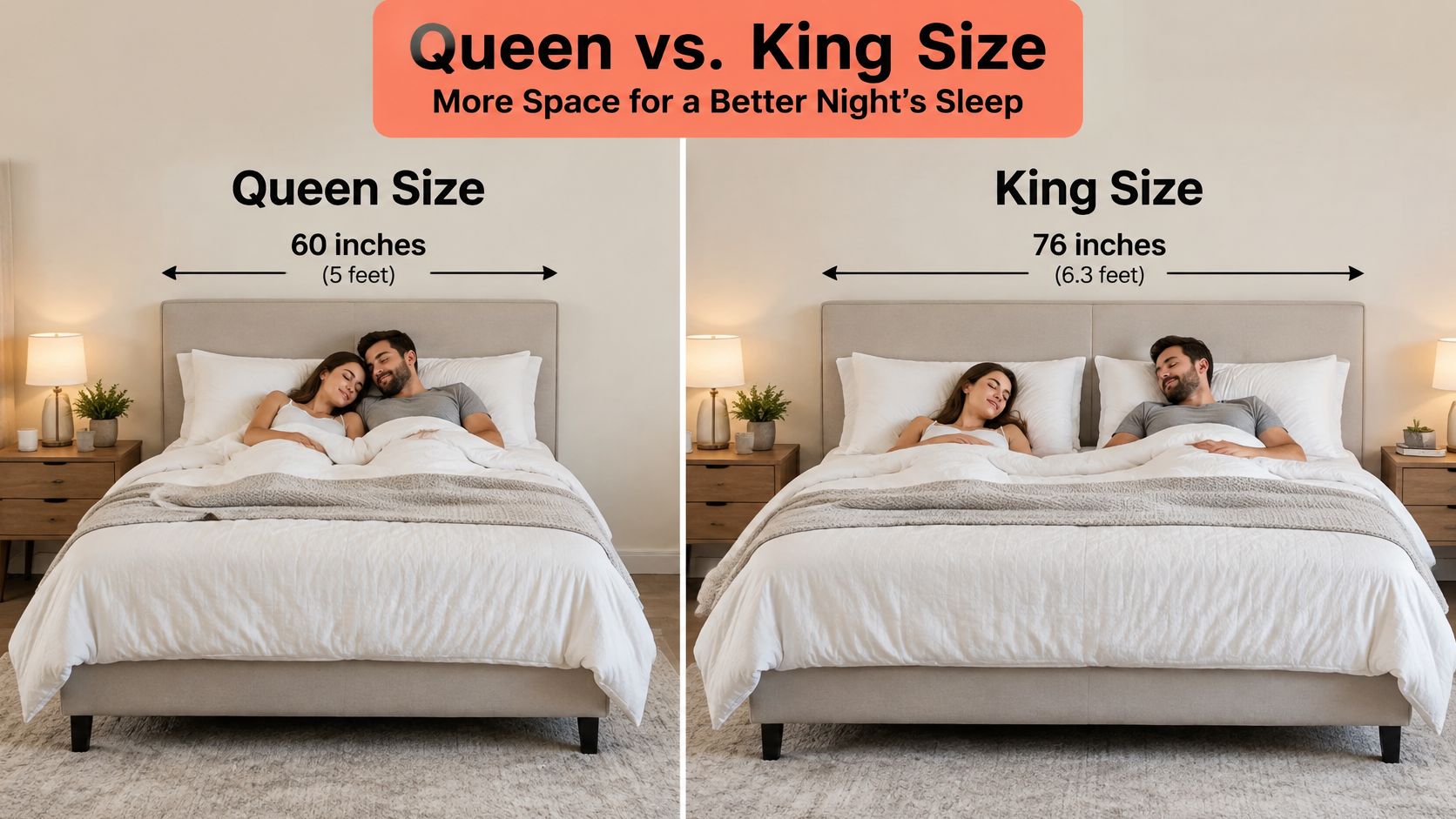
Check a queen blanket's length before trusting its label. Queen blankets are commonly listed around 90 x 90 inches through 90 x 100 inches, according to Size Parade's blanket size chart. That difference changes foot coverage even when the width stays the same.
For a couple, usable coverage depends on more than fabric lying flat. When sleepers turn onto their sides or pull the blanket around themselves, they use material that would otherwise hang over the mattress edge.
Compare the sleeping surface and the room
A square queen blanket can provide useful side drape on a queen mattress. A longer version adds fabric toward the foot, which may help with tucking but can bunch against a footboard.
A king blanket offers broader coverage for a king mattress or a wide sofa-sharing arrangement. For family movie night, place its long edge across the seating area rather than assuming the product's listed length must run from shoulders to feet.
The mattress size guide from Miller Waldrop helps distinguish the underlying sleeping surfaces. Use the mattress measurement as your base, then judge the blanket's extra fabric against the people who'll share it.
Account for the handling trade-offs
- For a couple on a queen bed, prioritize enough width to stay covered when either person turns.
- For a family on a sofa, check the span across occupied cushions and the reach toward everyone's feet.
- For a room with pets or small children, avoid edges that trail into walking routes or collect beneath moving furniture.
Larger blankets also mean more fleece to lift, fold, and load into a washer. A king may solve a coverage problem while creating a storage or laundering problem.
More fabric helps only when you can use it comfortably and care for it conveniently.
Before choosing the largest option, identify where it will dry. A rack or line needs enough usable space to support the blanket without leaving it tightly folded over itself.
Size Labels and Full Bed Sizes Across Markets
The label is not a measurement. Bedding names describe categories within a market, and manufacturers still choose how much extra fabric to add around the mattress.
The Sensoire bedding size guide gives the following U.S. mattress reference points and explains why international labels shouldn't be treated as interchangeable.
| U.S. mattress label | Mattress dimensions |
|---|---|
| Twin | 38 x 75 inches |
| Twin XL | 38 x 80 inches |
| Full | 53 x 75 inches |
| Queen | 60 x 80 inches |
| King | 76 x 80 inches |
| California king | 72 x 84 inches |
The same guide compares a U.S. queen of approximately 152 x 203 cm with a European 160 x 200 cm format. The European bed is about 8 cm wider and 3 cm shorter, so translating the name alone doesn't establish a match.
Full and twin XL need a closer look
A full mattress has more width than a twin without becoming a queen. That leaves shoppers deciding between a blanket that offers minimal drape and a larger category that may hang farther than they want.
Twin XL creates a different issue: extra mattress length. Someone shopping only by width can overlook the need for foot coverage.
The United States commonly uses inches, while most countries use centimeters. International buyers should compare both measurements before ordering, especially when a listing uses a familiar English size name for a differently proportioned product.
- Width: Compare the finished blanket width with the mattress and desired side coverage.
- Length: Allow for the foot drape or tuck you want.
- Intended bed size: Confirm which mattress format the seller used as its reference.
If a listing gives only a label, it hasn't given you enough information to judge fit confidently. Look for finished dimensions rather than trying to infer them from the product photograph.
Choosing a Size and Measuring Before You Order
Answer these questions before browsing designs: Where will the blanket live? Who will share it? How much drape feels comfortable? Is it decorative or used for sleep? How often will it be washed?
Those answers help you choose a useful size rather than automatically buying the largest one. Expert Market Research's U.S. home-textiles coverage identifies interest in sustainable materials; practically, that means considering material information alongside whether the blanket will serve your household well, not assuming a bigger purchase is better.
Match the recipient's routine
| Use or recipient | Size to choose | Why it fits |
|---|---|---|
| Sofa, armchair or nursery rocker, one person | Throw 50 x 60 in | Covers one seated person without excess fabric |
| Taller person who wants shoulder coverage | Oversized throw 50 x 70 in | Extra length for wrapping the shoulders |
| Baby, pet or car seat | 30 x 40 in | Small footprint, easy to handle and wash |
| Child's bed or single guest bed | Twin 66 x 90 in | Covers one sleeper with drape at the sides and foot |
| Couple sharing a queen bed | Queen 90 x 90 in | Width covers the mattress with drape on each side |
| Wide king bed or large sofa sharing | King 108 x 90 in | Covers the full width of a king bed |
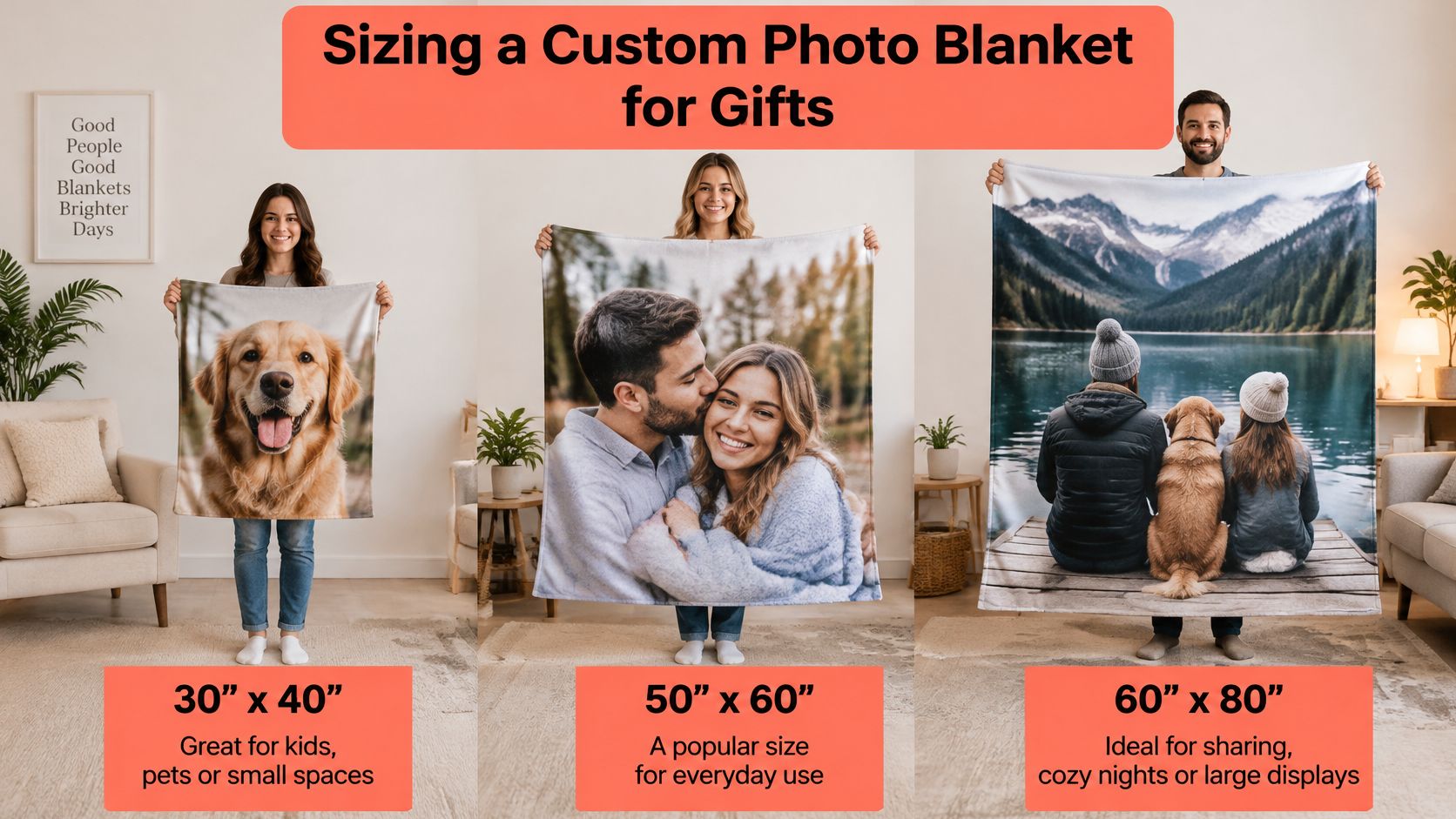
These are shopping reference points, not a universal product menu. For our Custom Photo Blankets, the 30 x 40-inch size suits babies and pets, 50 x 60 inches suits a loveseat or couch throw, and 60 x 80 inches suits sharing with loved ones.
For car travel, keep a small blanket clear of harness routing and the child's face. Don't treat a blanket's dimensions as permission to use loose bedding for infant sleep.
Measure before approving the design
Use the checklist as a reminder to compare dimensions rather than names.
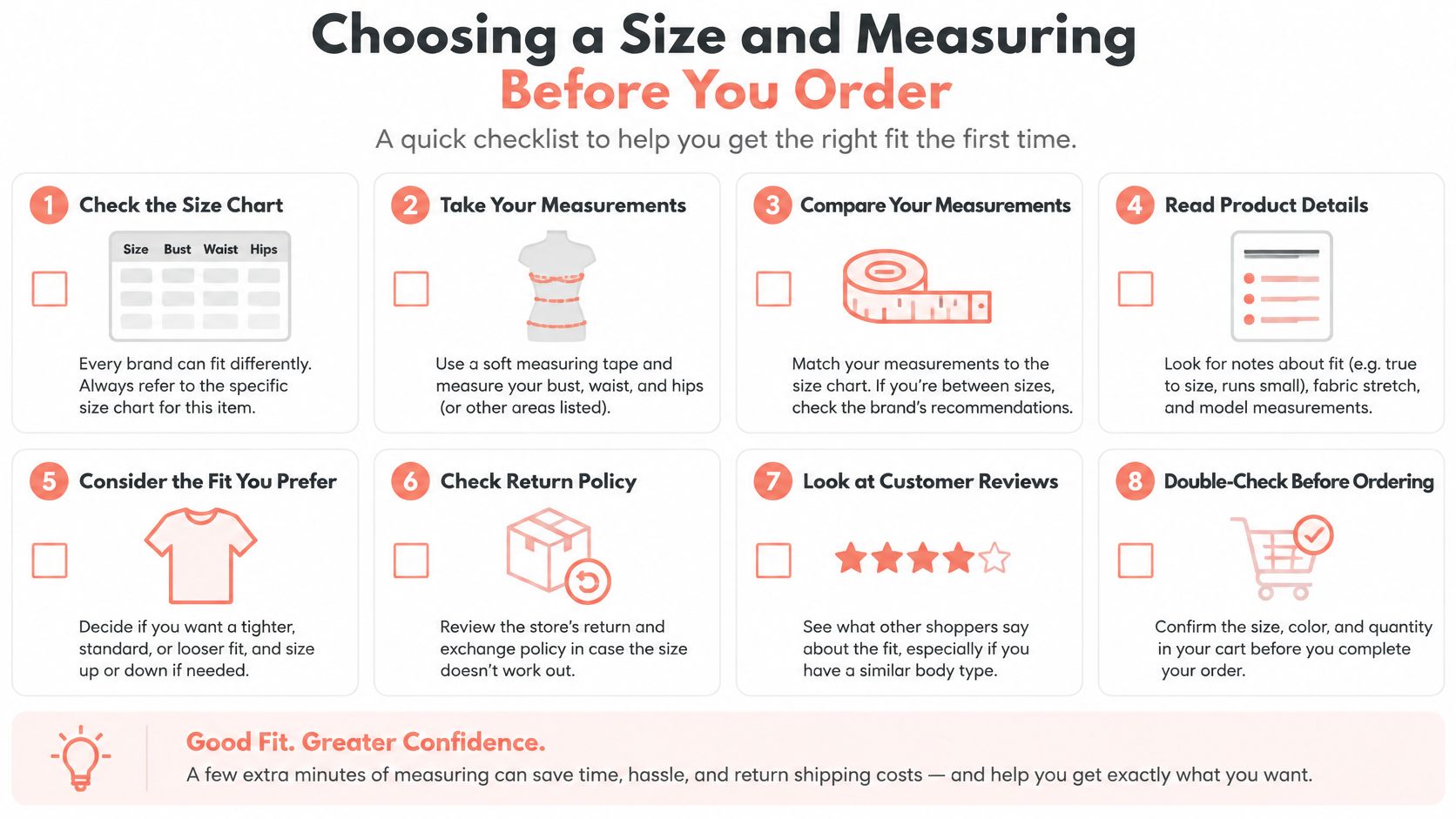
- Measure the space. Use a flexible tape for mattress width, length, and depth. On a sofa, measure the occupied seating span and the distance toward the user's feet.
- Pick the row that matches both the space and the activity. A blanket for reading upright has a different job from one used stretched out overnight.
- Confirm finished dimensions in both units. Compare the product measurements with your tape measurements, including the drape you want.
- Check the washer drum, dryer capacity, and available air-drying space. Don't plan around a blanket compressed into its packaging.
- Review the gift layout and timing. Check the photo's orientation, the position of faces, and the delivery information before checkout.
For a gift, upload the photo and select the available dimensions that match the recipient's routine. Confirm the finished size again before approving the order, even if the category name sounds right.
Washing and Drying Fleece by Size
A blanket that fits the bed but overwhelms the washer isn't a practical everyday choice. Machine capacity, fabric thickness, and construction matter alongside width and length, so don't assume every throw fits every compact washer or every king requires a laundromat.
Small blankets and throws are generally easier to load with room for movement. Larger bed blankets may need a large-capacity machine, particularly when they have a substantial backing.
Leave room for washing and spinning
Load the blanket loosely rather than pushing it into a packed drum. Wet fabric that gathers into a heavy lump can throw the load off balance; stop and redistribute it if the machine struggles during spinning.
- Wash gently. Use a gentle cycle with cool or warm water when the care label permits it, and choose a mild detergent.
- Skip fabric softener. It can leave a coating that changes fleece's feel.
- Avoid excess heat. Use low tumble heat only when the product's drying instructions allow it.
Plan where the whole blanket will dry
A throw is easier to spread across a drying rack. A twin may need a line or additional rack space, while a king needs a broad, well-supported drying area with airflow between folds.
Don't leave a large blanket piled on a rack or spread directly over a floor that traps moisture underneath it. Reposition thick folds so damp sections can dry fully before storage.
Laundry rule: Choose the size you can wash and dry within your normal household routine, not just the size you can squeeze into the machine.
If you're deciding on cleaning frequency, use our guide to how often to wash blankets. For a frequently washed gift, include simple care instructions so the recipient doesn't have to guess.
Sizing Mistakes and How to Avoid Them
An expensive mistake is approving a personalized design before checking either its physical size or its crop. A beautiful image won't fix a blanket that trails across a child's floor, and generous dimensions won't restore a face cut off at the edge.
Diagnose the problem before moving up a size. Cold feet, exposed sides, and fabric pooling on the floor point to different fixes.
| Mistake | What happens | Fix |
|---|---|---|
| King for a child's bed | Blanket pools on the floor and bunches | Choose twin or throw |
| Throw on a full or queen bed | Sides and foot stay uncovered | Move up to twin or queen, checking bed coverage |
| Trusting the queen label | Finished length may be shorter or longer than expected | Check finished inches before ordering |
| Oversized blanket for a small washer | Fabric does not fit the machine or dries slowly | Choose a size your machine and drying space handle |
| Ordering a photo without checking the layout | Faces or key details get cropped | Test horizontal and vertical versions for the size |
Fix the right dimension
If someone's feet remain uncovered while excess fabric hangs beside them, more width won't solve the problem. Try a longer format or change the blanket's orientation before buying a larger category.
If both sleepers lose side coverage when turning, prioritize width instead. For a full bed, don't assume the next label up automatically supplies your preferred drape; measure the actual gap you need to cover.
Check the less visible constraints
Drying space is easy to overlook because product photographs show blankets in use, not hanging across a small apartment. Before ordering a large size, identify an unobstructed place where it can dry without blocking doors or walking routes.
For photo designs, inspect the outer edges as carefully as the center. Names, dates, and pet ears need breathing room, especially if the preview places them close to the trim.
If several rows seem plausible, return to the use-based decision framework: location, users, drape, sleep or decoration, and laundry frequency. Those answers narrow the choice more reliably than buying extra fabric just in case.
Sizing a Custom Photo Blanket for Gifts
Changing a photo blanket's size can change its crop. More printable area doesn't automatically mean more of the original photograph survives, because a square layout and a long rectangle require different compositions.
A throw can suit a single portrait or a compact collage. A twin offers room for a grid, while a larger bed design can accommodate a family photograph, provided the original image has enough detail and the important subjects remain in the visible area.
Protect the photograph before checkout
Test both horizontal and vertical arrangements where the customization tool allows them. Keep faces near the central viewing area and avoid stretching a small image to fill the canvas.
- For a portrait, leave space around the head and shoulders.
- For a family group, check the people at both outer edges.
- For a collage, inspect each photo individually rather than judging only the overall pattern.
Our guide to how to order a photo blanket walks through the customization process. Review the selected size and image preview together, not as separate decisions.
Match the gift to the season
November and December are holiday-gifting months. The National Retail Federation's holiday reporting forecast U.S. holiday retail sales exceeding $1 trillion across those months. For a December gift, leave time for choosing photos, reviewing the design, production, and delivery rather than relying on a last-minute order.
April and May are the planning window for Mother's Day gifting. A family-photo throw suits personal reading time, a bed-sized design can brighten a guest room, and a sharing blanket can become part of evenings together.
Choose the picture for its meaning and the size for the recipient's daily life. That combination gives the memory a useful place in the home instead of leaving it folded away.
That Blanket Co offers Custom Photo Blankets that turn family, pet, and milestone photographs into practical keepsakes. Visit That Blanket Co to upload your favorite image, choose the dimensions that fit your recipient's routine, and review the crop before checkout.