


How to Wash Woven Blanket Without Shrinking or Fading
Your favorite blanket has picked up a coffee mark, the fringe looks tangled, and you're standing beside the washer wondering whether the delicate setting is enough. Perhaps the last throw came out smaller after a hot wash, and you don't want to repeat that mistake with a sentimental keepsake.
Learning how to wash a woven blanket starts with identifying what it's made from, not choosing a cycle. Fiber, construction, and the care label determine whether the blanket needs a machine wash, a supported hand wash, or professional cleaning.
Check the Label and Fiber Before You Wash
Start with the tag, then the fiber, then the construction. A dry-clean-only label, unstable dye, weakened yarns, or water-sensitive trim rules out an experimental soak, and a cold setting will not make an unsuitable textile washable.
Woven names the construction; fiber names the material. Cotton, wool, acrylic, polyester, and blends can share a similar surface yet behave differently once wet: cotton tolerates more agitation, wool felts under heat and friction, acrylic can stretch, and printed fleece needs its face protected. Use the custom blanket materials guide to match the product description to the blanket in front of you before choosing a method.
Washing method by fiber and label
Use these as conservative starting points, always subject to the care label. For washable wool, Woolmark's washing guidance puts machine washing at 30–40°C (86–104°F) with wool detergent and a drum no more than one-third full; a lower label limit wins.
| Fabric or case | Water and cycle | Detergent | Drying |
|---|---|---|---|
| Cotton woven, machine-wash label | Cool to warm water, gentle cycle | Mild liquid detergent | Tumble low if permitted, or air dry |
| Wool woven | 30–40°C (86–104°F) on a wool cycle, or hand wash, only when the label permits; keep the drum no more than one-third full | Wool-specific detergent | Flat dry, never tumble |
| Acrylic or polyester woven | Cool water, gentle cycle | Mild detergent | If tumble drying is permitted, remove while slightly damp and finish flat |
| Linen woven | Cool water, gentle cycle; warmer water only within the label limit | Mild detergent | Air dry flat |
| Printed or personalized blanket | Machine wash cold, gentle cycle | Mild detergent, no bleach | Tumble low and remove promptly, or air dry; do not iron the printed side directly |
| Unknown blend | Cold hand test on a hidden corner first | Mild detergent | Flat dry if wet cleaning proves suitable |
Inspect before committing
Press a damp white cloth against an inconspicuous colored area. Dye transfer means stop; a successful spot test still does not prove that an unknown blanket can tolerate full immersion.
Check fringe knots, pulled threads, and loose weaving. Support those areas when wet instead of lifting the blanket by an edge, since saturated weight concentrates at weak points.
Practical rule: A missing label is a reason to investigate, not permission to choose delicate.
For fragile or unidentified textiles, Tumble Laundry's garment cleaning services provide a professional assessment route rather than a trial wash. Read the tag, confirm the fiber, inspect the structure, and decide whether full washing is appropriate before water touches the whole piece.
Treating Stains Before the Wash
Speed matters, but technique matters more. Blot the spill with a clean white cloth rather than rubbing, because rubbing drives the stain deeper into the weave and can fuzz the surface. Work from the outer edge toward the center so the mark doesn't spread, and test any treatment on a hidden corner before applying it to the visible area.
Keep the stained area away from heat until the mark is fully gone. Hot water and dryer heat set many stains permanently, so check the damp patch under good light before the blanket goes anywhere near a dryer.
Stain treatment by stain type
| Stain | First treatment | Avoid |
|---|---|---|
| Red wine | Blot, rinse with cool water, dab mild detergent | Hot water and rubbing |
| Coffee or tea | Cool water rinse, then dab mild detergent | Heat before the stain is removed |
| Grease or oil from food or lotion | On washable, colorfast fabric, dab a drop of plain dish soap, let it work briefly, then rinse thoroughly | Dryer heat |
| Blood | Cold water only, then mild detergent | Hot water |
| Pet urine or dirt | Use a fiber-compatible enzyme cleaner or mild detergent; rinse fully | Bleach and heat |
| Ink | Test a hidden corner first; use a specialist for wool or valuable textiles | Rubbing and alcohol on the print |
| Candle wax | Chill until firm, gently scrape away loose wax, then blot residue with paper | Direct ironing |
For grease, use plain dish soap sparingly, never dishwasher detergent, and rinse it out fully before machine washing so leftover suds don't interfere with the cycle. On wool, reach for wool detergent rather than improvising with a degreaser.
Enzyme cleaners need matching to the fiber. Some formulas are unsuitable for protein fibers, so don't apply a pet-stain product to wool unless its label explicitly permits that use. Brush away dry dirt before adding water, since grit turns to a smear once wet.
Know when to stop
If ink spreads, dye transfers to your cloth, or the surface starts to fuzz, stop treating it. Continued rubbing enlarges the damaged area even when it lightens the original mark. Our blanket stain-removal guide covers treatment choices by stain and material in more detail.
A spill heavy enough to soak through a blanket can also reach the carpet beneath it, which calls for a different kind of treatment than the textile itself. Maid's carpet cleaning prices offer a reference point if that separate job needs a professional.
Don't use bleach anywhere in this routine. On printed photo blankets, press and lift the cloth carefully rather than scrubbing the image surface.
How to Wash a Woven Blanket in the Machine
Wash a new washable blanket before first use to remove excess lint left from manufacturing. Machine washing is appropriate when the label permits it and the blanket fits comfortably in the drum.
Temperature and movement work together. The American Association of Textile Chemists and Colorists' accelerated laundering method uses a 45-minute test to simulate approximately five hand or home launderings, illustrating why repeated washing conditions matter, not just whether a blanket survives its first cycle.
Set up a low-stress wash
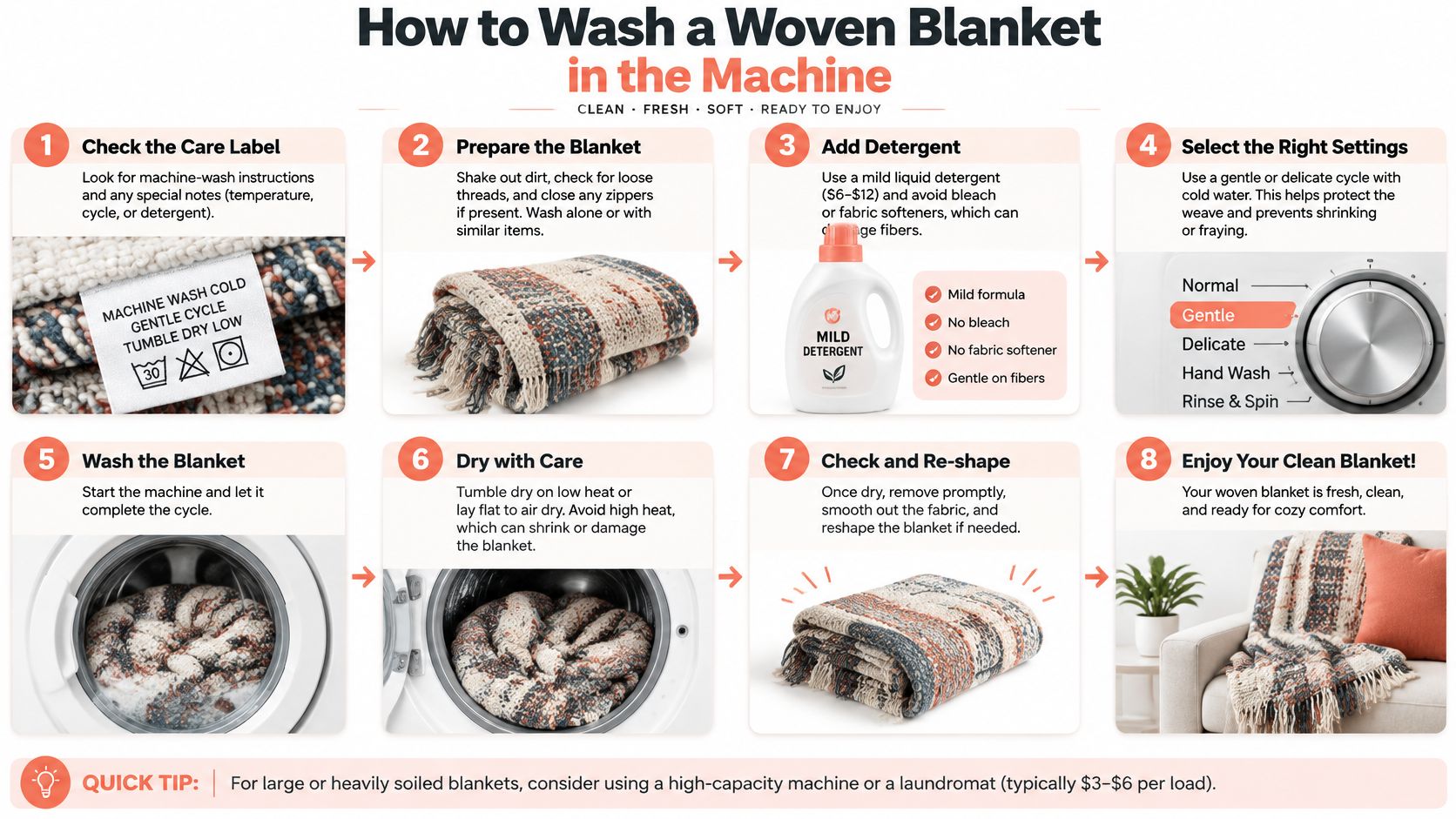
- Shake it out outdoors. Remove crumbs, loose hair, and surface debris before loading. Gently separate tangled fringe with your fingers rather than pulling it through a brush.
- Inspect and treat visible stains. Don't rely on a longer or hotter wash to compensate for an untreated oily mark.
- Protect the surface appropriately. Turn a removable blanket cover inside out, but don't try to turn a flat throw inside out, because it has no interior. For a flat blanket, avoid abrasive wash companions and use a roomy laundry bag only if the blanket can still move freely.
- Load it alone when practical, especially for its first wash. If washing with other items, choose similar colors and smooth fabrics, not jeans, zippers, hooks, or towels that can catch the fringe.
- Select cold water and a gentle cycle. Use a dedicated wool program only for wool explicitly labeled machine washable. Hotter water isn't automatically a better cleaning choice, particularly when color retention and surface protection matter.
- Add mild detergent at the product's light-load dose. Choose wool-specific detergent for wool, skip bleach, and avoid adding fabric softener as a shortcut to softness.
- Keep the drum loosely loaded. If the blanket is compressed against the drum or can't move, use a larger suitable machine rather than forcing it into a smaller one.
- Remove it promptly when the cycle ends. Support the blanket as you lift it out, then move it directly to its label-approved drying setup. Don't leave it bundled and damp in the machine.
Use this visual checklist beside the washer:
Check the result before drying
An overloaded machine creates more contact between surfaces while making thorough rinsing harder. A stronger cycle doesn't correct that mismatch. Give the blanket room instead.
Inspect the fringe, stained areas, and surface while the blanket is damp. Successful washing leaves the original colors intact, the weave undistorted, and no new pilling. If detergent remains, use a suitable rinse rather than adding more cleaning product.
Hand Washing a Woven Blanket for Wool and Delicate Fibers
Hand washing suits washable wool, linen labeled for hand washing, and delicate blankets whose labels prohibit machine agitation. It isn't an alternative for a blanket that must not be wet-cleaned.
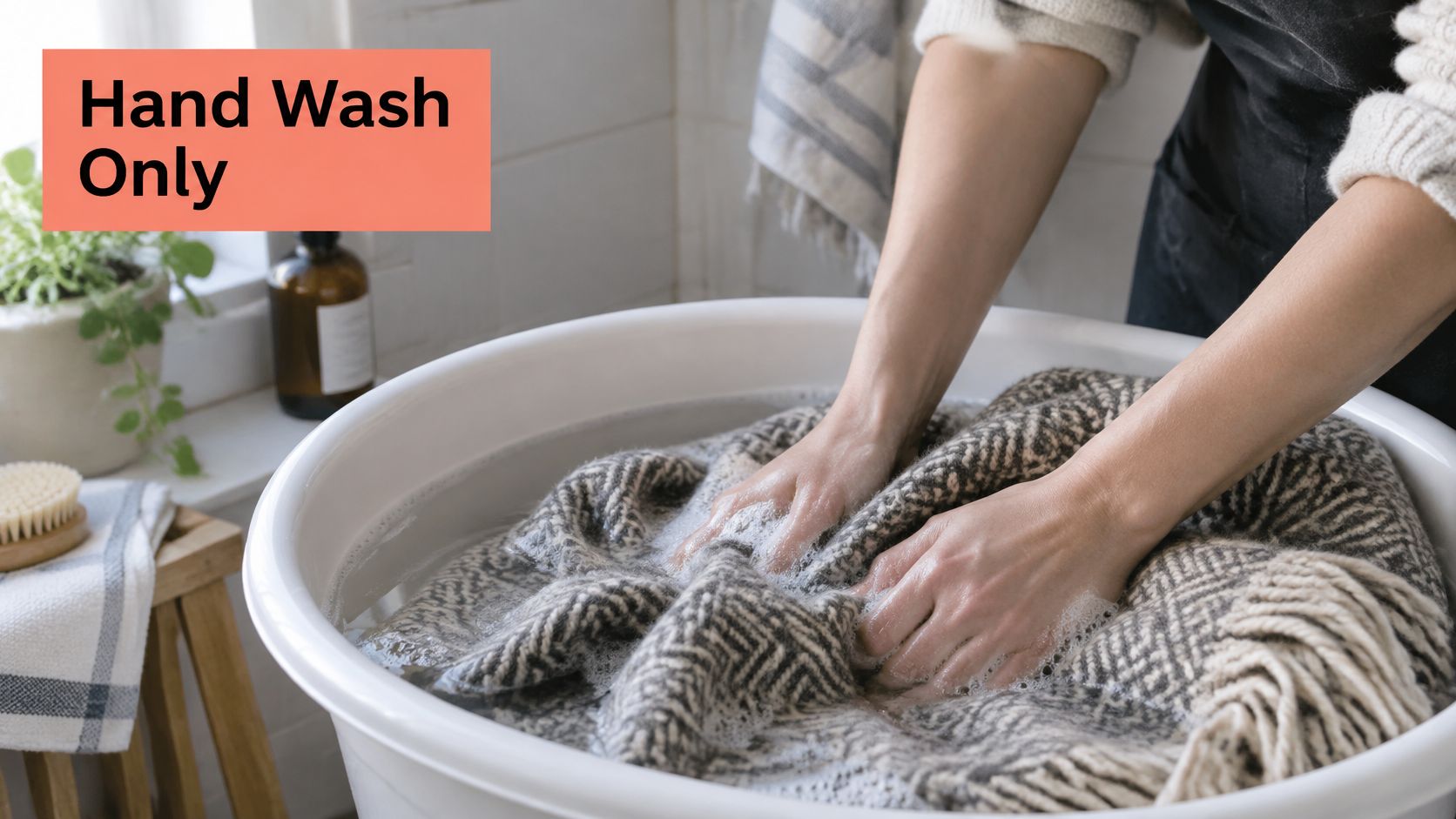
Prepare a clean tub, cotton towels, a thermometer, and a flat drying surface before filling the basin. This is the kind of fully supported handling to aim for:
Soak and rinse without scrubbing
For a conservative conservation-style wash, University of Georgia Extension's heirloom-care guidance describes a 30-minute presoak, approximately 1 tablespoon of mild liquid detergent per 4 gallons of water, a further 30-minute detergent soak, and four to five rinse soaks lasting 15–30 minutes, or until detergent is gone; it also keeps wool below about 90°F (32°C) and notes that cotton or linen may tolerate up to about 110°F (43°C).
- Presoak gently. Immerse the washable blanket in lukewarm water within its label limit. Keep wool comfortably cool, and don't add hot water while the blanket is in the tub.
- Prepare fresh detergent water. Dissolve the detergent completely before introducing the blanket. Use a wool-specific product for wool and follow its dosing directions if they differ.
- Let soaking do the work. Press gently with open palms to move water through the fabric. Don't scrub folds together or pull at stained areas.
- Drain with support. Leave the blanket resting in the tub while the water drains. Don't lift it by the fringe or corners.
- Rinse patiently. Refill with water at a similar temperature and press gently. Continue until there's no slippery detergent feel or lingering foam.
- Blot and reshape. Transfer the supported blanket onto cotton towels, press out moisture, and arrange it flat in its original shape.
Move a heavy blanket safely
Use a clean sheet as a sling if the blanket is too heavy to move without sagging. Have helpers support both ends and the middle, keeping the bundle level throughout the transfer.
Never wring a blanket to make it easier to carry. Remove water while its weight is supported.
For a separate wool-floor-covering task, Top Cleaners' guide to clean wool carpets safely at home provides material-specific context. Carpet extraction techniques aren't interchangeable with full-immersion blanket washing.
Use the video as a handling aid, while keeping your blanket's label in charge:
Drying Without Stretching or Stiffening
A hot dryer isn't the safe default after a careful wash. The blanket still needs a drying method suited to its fiber, weight, and decoration.
For tumble-safe woven throws, a woven-blanket care guide suggests low heat until roughly 80% dry, followed by air drying. Treat that as an optional approach, not a requirement or permission to tumble wool.
Match the method to the blanket
Lay delicate or loosely woven blankets flat, supported across their entire surface. Smooth the edges while damp, without stretching them to force a larger size. Replace saturated towels and allow air to circulate underneath when possible.
For tumble-safe blankets, clean the lint filter, use low heat, and check frequently. Remove promptly rather than running another cycle just to eliminate the last trace of dampness. Never iron the printed side directly.
Drying problems, causes and fixes
| Symptom | Likely cause | Fix |
|---|---|---|
| Stretched or distorted shape | Hung while wet | Dry flat and reshape gently while damp |
| Stiff or crunchy texture | Excessive heat or detergent residue | Check rinsing; use label-approved low heat or flat drying |
| Shrunken blanket | Hot water, hot dryer, or felting from agitation | Reshape while damp; full recovery isn't guaranteed |
| Dull or cracked print | Ironing or excessive heat on the printed side | Use cool washing and no direct ironing; existing damage may be permanent |
| Pilling on the surface | Rough wash companions or overloaded drum | Wash with smooth, similar items and leave room in the drum |
If a blanket shrank after a cold wash, check the dryer settings first. For wool, agitation can also cause felting, so cold water alone doesn't rule out wash-related damage.
Drying checkpoint: The blanket should feel dry through its thickest folds before you store it, not merely dry on the surface.
Air drying also avoids unnecessary dryer use. A 2025 microfiber review reports that tumble-drying emissions can be comparable to washing emissions, while noting inconsistent measurement methods. Low heat shouldn't be presented as a proven microfiber solution for every fabric.
Cool washing has a clearer energy benefit: the EPA's laundry-equipment guidance notes that water heating accounts for approximately 90% of the energy used to operate a clothes washer. Wash when needed, not automatically after every use.
Store It Right and Plan Your Gift Timing
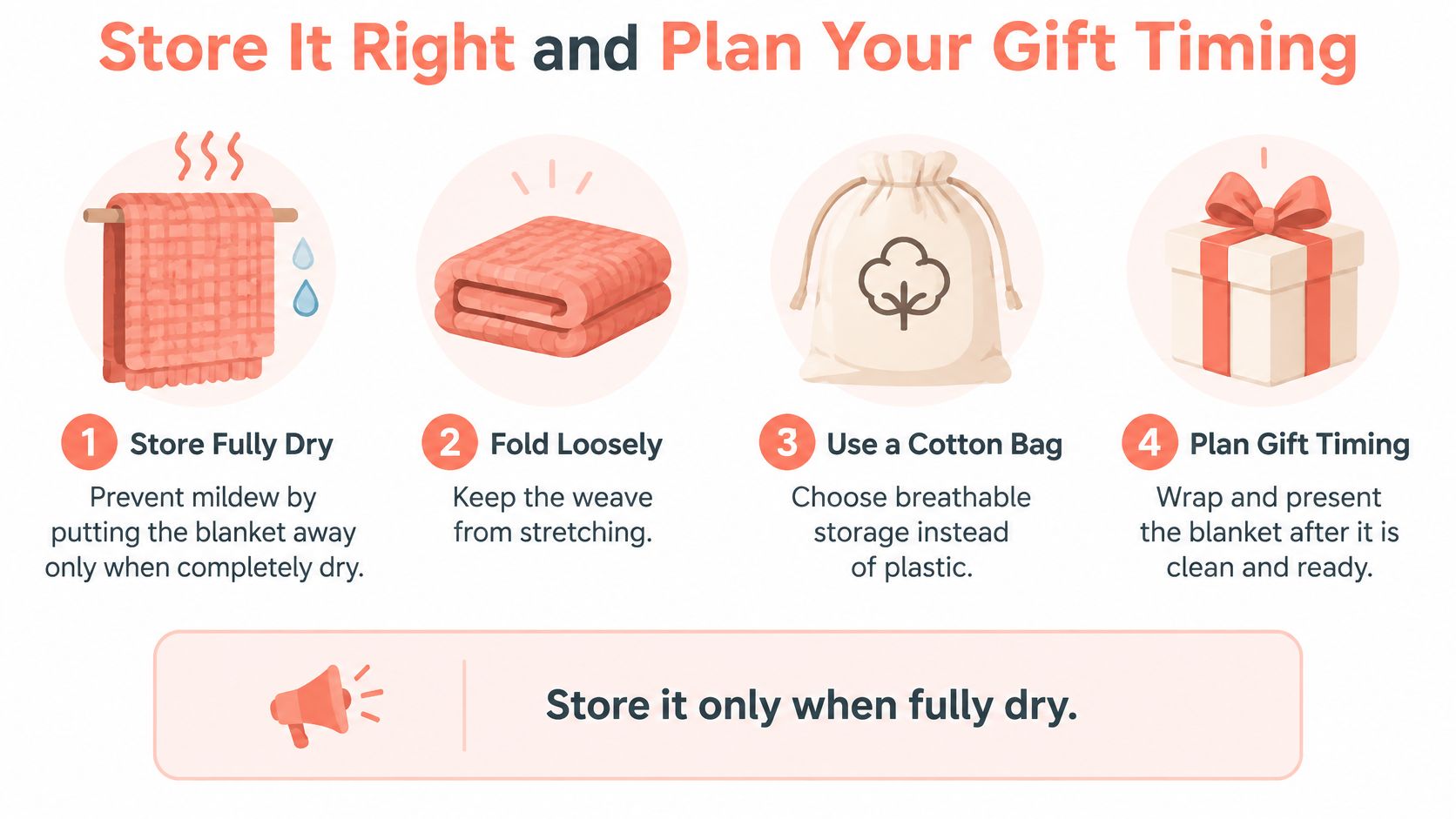
Put a blanket away only when it's completely dry. Check fringe, folded edges, and thick sections with your hand before packing, because trapped dampness can lead to mildew and an unpleasant surprise when the gift is opened.
Fold loosely rather than hanging a heavy blanket for storage. Use a breathable cotton bag, keep it away from direct sunlight, and avoid compressing it beneath heavy boxes. Our blanket storage ideas can help you choose a practical home for a keepsake between uses.
Keep it gift-ready
- Retain the original tag. The recipient needs the actual fiber and care instructions, not a generic washing rule.
- Add a brief care card. Copy the permitted wash and drying settings from the label, including any print or fringe precautions.
- Inspect before wrapping. Check for residual stains, detergent scent, loose threads, and damp patches.
- Allow time for correction. Leave enough room before the gift date to finish drying or arrange specialist care if needed.
This checklist keeps storage and presentation simple:
Plan around the occasion
For November and December gifting, the National Retail Federation defines the winter holiday shopping season as November 1 through December 31, encompassing Thanksgiving, Christmas, Hanukkah, and Kwanzaa. Choose the recipient's celebration date first, then allow time for personalization, delivery, inspection, and wrapping.
For April and May, make Mother's Day the planning priority. The National Retail Federation's 2026 Mother's Day survey found 84% of U.S. adults planned to celebrate, with record planned average spending of $284.25 per person and projected total spending of $38 billion. The useful takeaway isn't a spending target, it's to plan a personal gift before the delivery deadline becomes urgent.
Choose a personalized keepsake from Custom Photo Blankets by That Blanket Co early in April for a May celebration, checking delivery information before ordering. Our woven option is medium-weight fleece with decorative fringed edges, available only in 50" × 60", so its appearance shouldn't be mistaken for wool construction. With proper care, we guarantee the blanket's colors won't fade, crack, or peel.
Set the gift date, confirm the care label, and reserve time to prepare the blanket without rushing its drying.
That Blanket Co offers personalized photo blankets that turn favorite family, pet, and milestone pictures into washable keepsakes. Visit That Blanket Co to choose a design, confirm the material and care instructions, and create a gift suited to the recipient's everyday life.