


Photo Blanket Soft Fabrics, Care and Picks
You pull a photo blanket from its mailer, unfold a favorite family picture, and run your palm across it. The colors look rich, but the fabric feels thinner, slicker, or less fluffy than you expected. Choosing Custom Photo Blankets gets easier when you separate what looks good on a screen from what feels good across your knees.
A sharp photograph and a plush surface don't always come together. The useful question isn't just what makes a photo blanket soft, but which kind of softness suits the person, the picture, and the washing routine.
Why a Photo Blanket Feels Soft or Flat
Say you're buying a blanket for a grandparent who spends evenings reading. You choose a lovely portrait, but overlook the fabric description. When the gift arrives, the image is clear enough to recognize every smile, yet the blanket feels more like a smooth printed cloth than the fluffy throw you pictured.
That difference comes from the fabric's hand, the textile term for how it feels when touched, squeezed, and draped. Softness includes how readily the surface fibers bend against skin, whether the backing feels supple, and whether the edges scratch.
Think of the surface as a lawn
A raised fabric surface resembles a lawn. Taller, densely packed fibers can feel fuller under your palm, while a closely trimmed surface feels smoother and less cushiony. A flat weave has little of that raised pile, so you notice the threads rather than a soft covering of fibers.
Polyester fleece, minky, sherpa, and fine microfiber are common options for a soft-feeling photo blanket. A woven blanket offers a different experience: more texture and structure, less fluffy nap.
Practical rule: Decide whether you want softness that feels silky, velvety, or deeply fluffy. Those aren't interchangeable sensations.
A blanket can also change after use. Surface fibers that lie neatly when new may tangle with friction, even while the underlying cloth remains comfortable.
The buying decision comes down to a few practical questions:
- Which fabric feels right? Match the surface to the recipient's preference, not just the product photograph.
- What happens to the image? Consider how texture breaks up fine details.
- How will it be used? A daily lap blanket needs a different balance from an occasional keepsake.
Use the fabric chart to choose the kind of hand you want.
Fabric Hands From Sherpa to Woven
How soft photo blanket fabrics feel and print
| Fabric | Hand feel | Warmth | Photo look | Best when |
|---|---|---|---|---|
| Sherpa | Dense fluffy pile, cloudiest hand | Highest lap-warming feel among these typical constructions | Softer edges if printed on a raised face | Maximum cuddle and cold-weather gifts |
| Minky fleece | Short, even plush pile; lightweight | Medium, cozy without bulk | Smooth face with strong photo clarity | Everyday soft throws and supervised baby laps |
| Smooth fleece | Silky, low pile; lightweight constructions include 275 GSM | Lighter warmth | Cleanest single-sided print surface | Sharp portraits and large photos |
| Microfiber | Fine, drapey fibers; soft when new | Light | Smooth initially; surface fuzz can obscure detail | A lighter throw when surface wear is monitored |
| Woven | Textured threads, least plush | Breathable, less lofty | Less smooth detail; color can last longer | Frequent washing over maximum softness |
Separate the printed face from the backing
A sherpa blanket doesn't necessarily have a photograph printed directly onto its fluffy surface. Many constructions pair a smooth printed front with a sherpa back. In that arrangement, the back supplies the cushioning while the front carries the picture.
That distinction matters more than the fabric name alone. A thick backing doesn't automatically blur a photograph; texture on the actual print face is what interrupts small features, lettering, and clean outlines.
Minky offers a useful middle ground. Its relatively short, even pile feels plush without the deep texture associated with sherpa. Smooth fleece feels less padded, but it gives portraits a quieter surface on which to reproduce eyelashes, hair, and subtle facial shading.
The trade-off between a cleaner fleece image and a more textured, potentially longer-lasting woven image is discussed in this photo blanket fabric comparison. Treat that as a construction comparison, not a promise that every woven blanket will outlast every fleece.
Look beyond the material name
Polyester is commonly the fiber behind fleece, minky, and sherpa. Those names describe fabric styles or surfaces, not separate guarantees of composition, thickness, or quality. Microfiber describes very fine fibers, so the word alone doesn't establish whether a blanket will resist fuzzing.
When comparing descriptions, examine:
- Drape: A supple blanket settles around knees rather than standing away from them.
- Edges: A bulky binding can feel firmer than the main cloth.
- Surface uniformity: Sparse patches and uneven brushing can make a blanket feel inconsistent.
- Construction: A separate backing adds a different tactile experience from a single-layer fabric.
For a broader explanation of fleece structures, The Fabric Company's guide to find the right fleece for apparel helps clarify why the same general fabric family can produce different hands. Its apparel context is useful for understanding construction, not for assuming blanket performance.
For blanket-specific distinctions, compare fleece, sherpa, and woven materials. Choose sherpa or minky for cuddling, smooth fleece for a clear photograph, and woven when a textured hand is an acceptable exchange for wash-life priorities.
How Nap and Printing Change the Hand
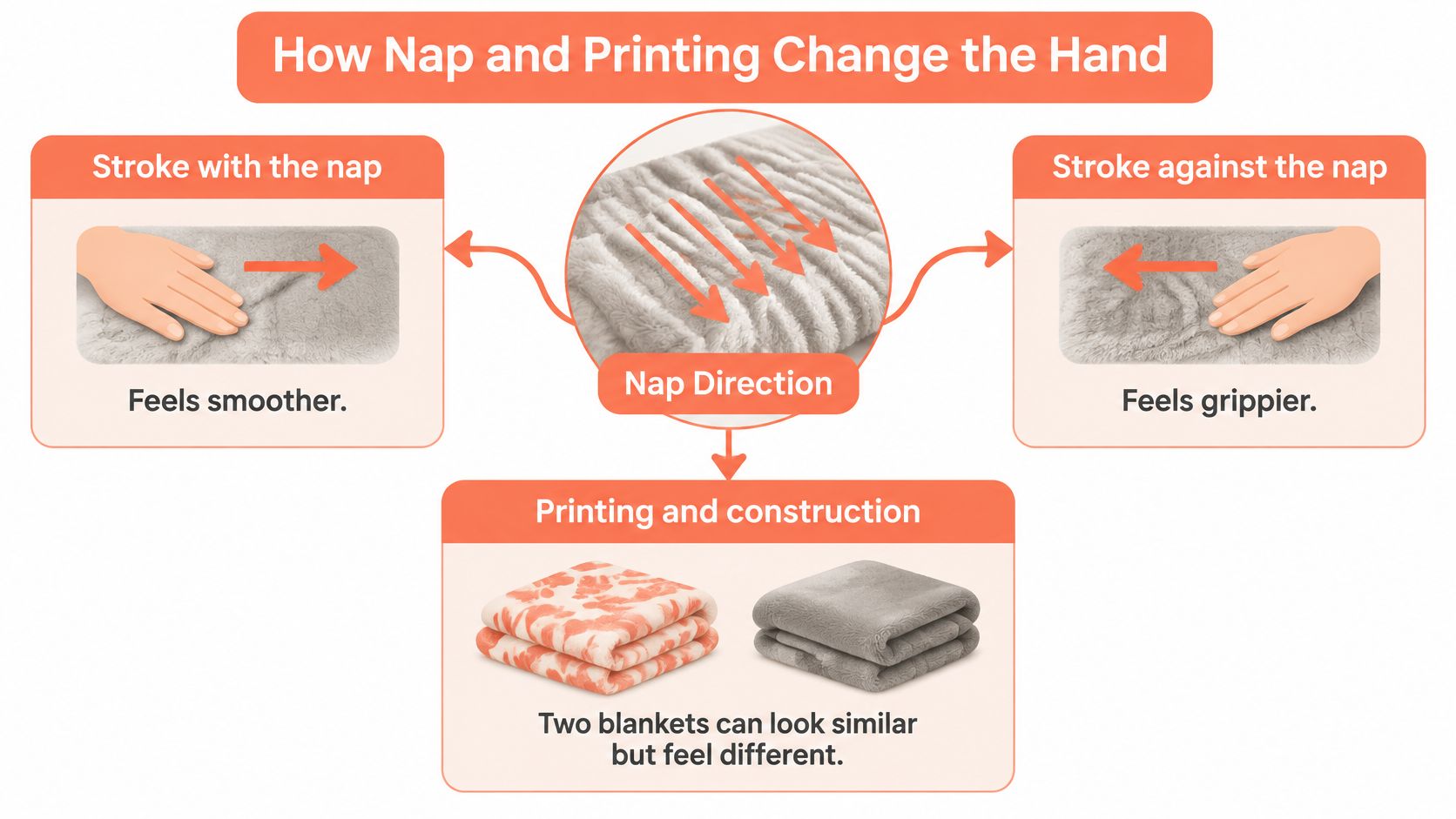
Stroke a brushed blanket toward its edge, then reverse your hand. One direction may feel smooth while the other feels slightly grippy. That is nap direction, the way raised fibers lean across the surface.
Two polyester blankets can share the same fiber label yet feel different against your palm. Fiber height, density, brushing, and finishing determine whether the surface feels velvety, springy, smooth, or slightly coarse.
Why the same picture looks different on plush cloth
A longer raised surface works like a soft-focus lens over small photographic details. Individual fibers interrupt the flat, continuous surface that paper provides, so fine lines and facial details can appear gentler even when the image is well printed.
Nap also changes reflected light. Brush a dark area in opposite directions and it may appear lighter or darker without any dye having disappeared. The visual difference comes from the angle of the fibers and the light they catch.
Dye-sublimation printing introduces dye into polyester rather than leaving a stiff film across the surface. The cloth remains flexible and the pile can bend naturally. With one-sided printing, the reverse remains an unprinted contact surface, which is useful when the recipient primarily holds that side against their skin.
A darker-looking print does not automatically promise better durability. Color density and color retention are separate qualities.
What laundering evidence can tell you
A peer-reviewed study of digitally printed polyester found that additional ink layers increased both saturation and wash-out. Richer initial coverage can therefore create a stronger-looking image while also increasing the amount of dye that may release during laundering.
Different hues can also shift at different rates after repeated washing. For that reason, a fade-resistance claim is most meaningful when it names the wash method used and the actual measurements recorded rather than treating every color as though it will age identically.
For a good starting image:
- Use the original file: A saved screenshot or heavily compressed social-media copy can lose useful detail.
- Keep shadow detail visible: A dark pet's eyes should remain distinct from its fur before printing.
- Check saturated areas: Deep reds, purples, and other dense colors deserve attention in a production sample.
- Evaluate the actual cloth: A paper proof cannot show how a raised fleece surface changes a face.
Resist darkening a photograph to make it dramatic on a bright screen. Preserve separation between neighboring tones so the printed picture stays readable once the fibers interrupt its surface.
Washing Steps That Keep the Pile Soft
A blanket doesn't need aggressive washing to feel fresh. The goal is to remove everyday soil without repeatedly grinding the raised surface against rough fabrics, trapping detergent in the pile, or exposing it to unnecessary heat.
Use the sewn-in care instructions to resolve any difference between a general routine and the needs of the finished blanket.
A gentle wash routine
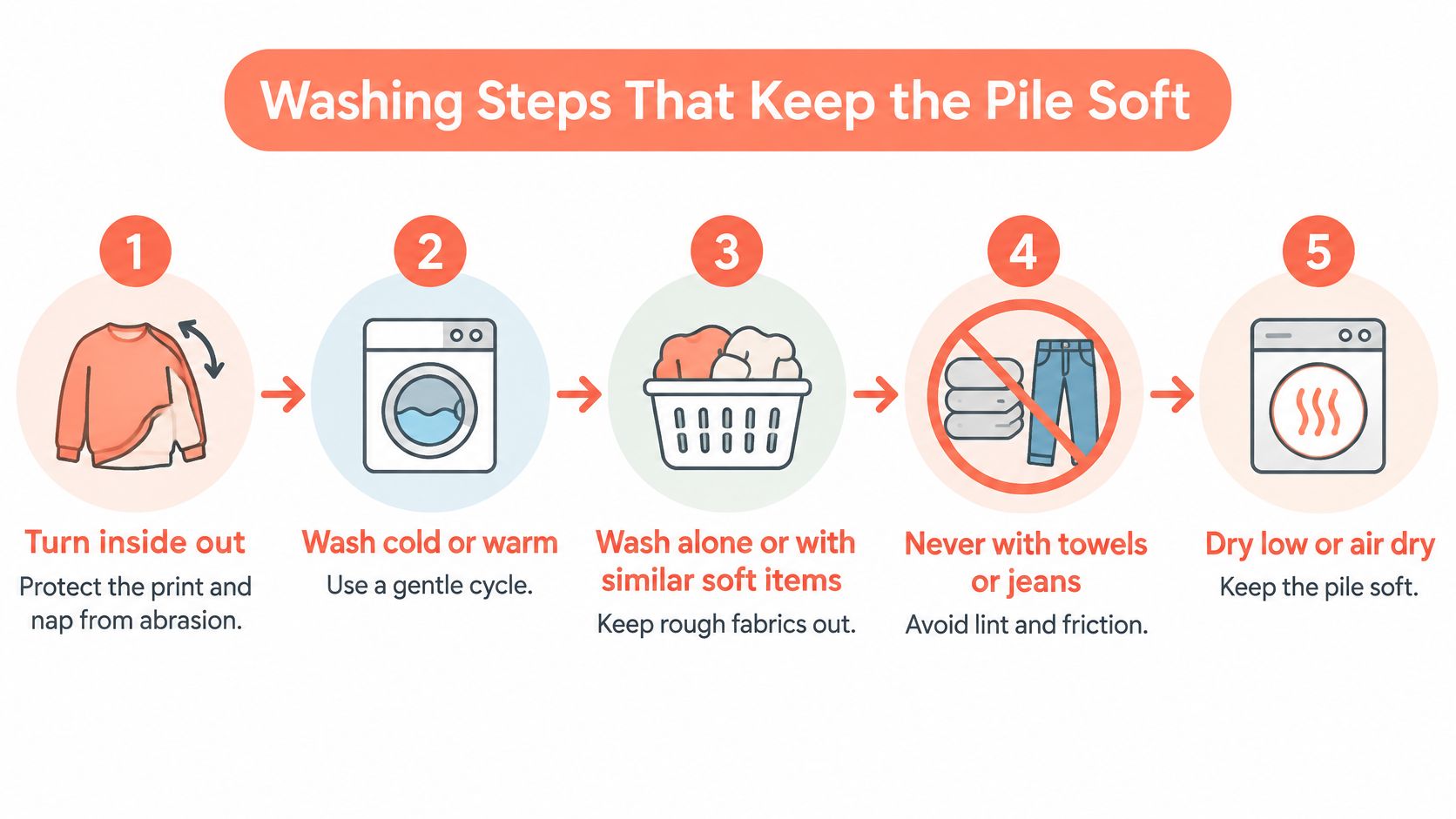
- Protect the printed surface. Turn a reversible or enclosed item inside out where its construction permits. A flat blanket has no true inside, so loosely fold the printed face inward without packing it tightly; don't expect that fold to stay fixed throughout the wash.
- Choose cold or warm water and a gentle cycle. Wash alone or with similarly soft items that can move freely in the drum. Keep towels, jeans, and exposed hook-and-loop fasteners out because their rough surfaces increase friction and snagging.
- Measure a small amount of mild detergent. Use the detergent's guidance for your machine and load rather than adding extra for reassurance. Skip chlorine bleach and fabric softener; residue can coat the fibers and leave the surface feeling less clean and supple.
- Air dry or use low heat if permitted. Spread the blanket so air can circulate, or remove it promptly from a low-heat dryer. Don't iron the printed face or try to flatten the pile with direct heat.
- Store away from prolonged direct sun. Choose a shaded drying position and avoid leaving the blanket permanently across a sunlit window seat. This reduces unnecessary light exposure between washes.
What pilling actually means
Pills are small tangles of loose fibers that collect on the surface. A blanket can remain soft underneath while those little balls make it look worn and feel uneven.
ASTM D4970/D4970M uses a Martindale procedure to evaluate pilling on a 5-to-1 scale, where 5 means no pilling and 1 means very severe pilling. A useful test result identifies the fabric, test conditions, and finished construction; a grade earned by one fleece doesn't establish the performance of every sherpa.
There isn't an honest universal promise for exactly how a photograph will look after a particular wash count. Fabric weight, brushing, finishing, ink, and laundering all change the outcome.
| Care decision | Quick setting |
|---|---|
| Water | Cold or warm, as permitted |
| Cycle | Gentle |
| Wash companions | Similar soft fabrics |
| Detergent | Mild, correctly measured |
| Additives | No chlorine bleach or fabric softener |
| Drying | Air dry or permitted low heat |
For another household-textile perspective on friction and fiber tangling, the guide to softer sheets with SouthShore Fine Linens offers useful pilling context. Our machine-washable blanket guide can also help you plan everyday care.
For a frequently washed family or pet blanket, favor a manageable smooth fleece or suitable woven construction when maintaining appearance matters more than the fluffiest first touch.
Soft Picks for Laps, Pets and Gifts
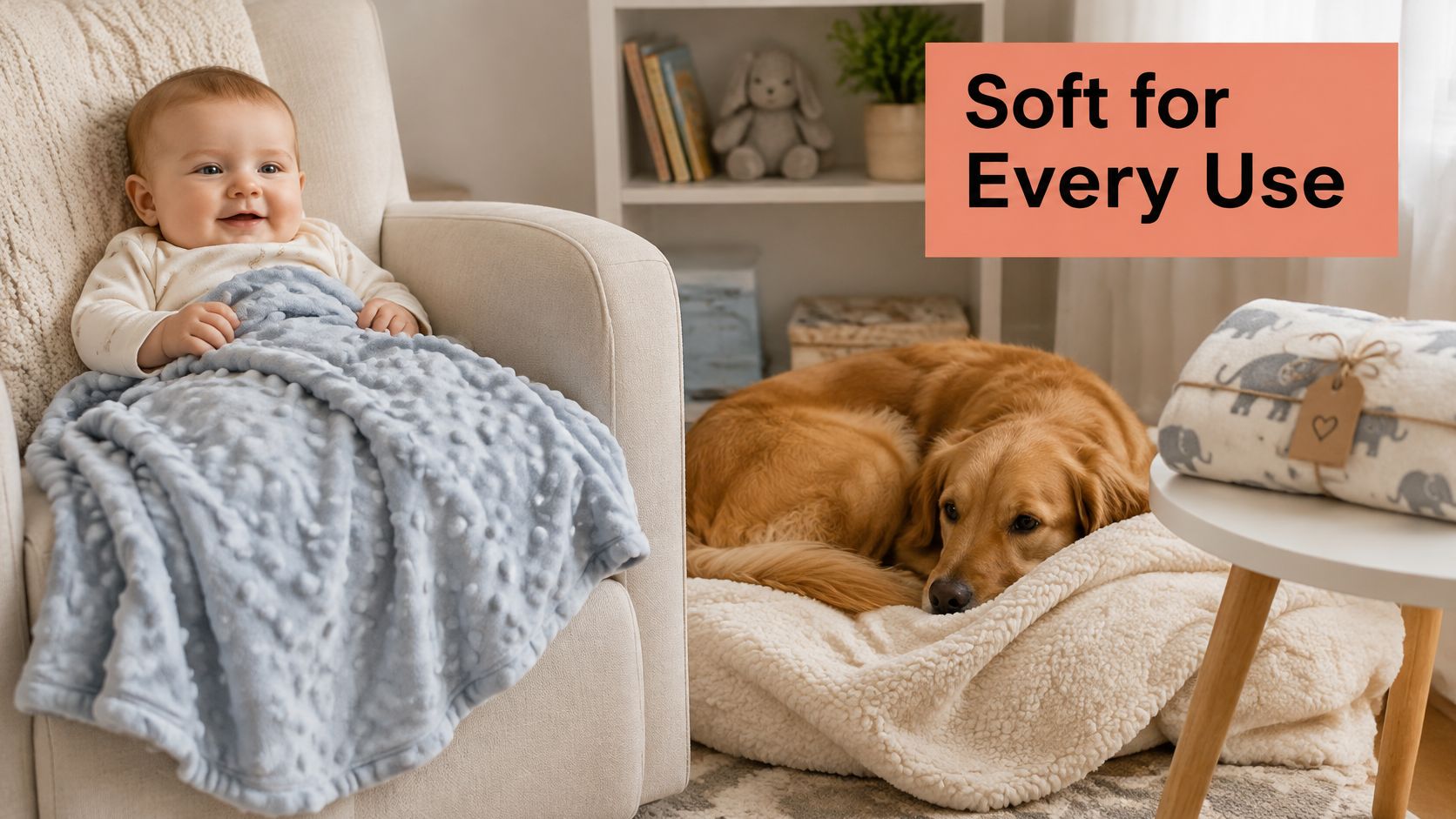
A parent settles into a chair with a baby for a supervised cuddle. A lightweight minky or smooth fleece blanket can cover the adult's lap without a bulky bundle around the child. Choose a clear family face rather than a crowded layout, and keep loose blankets out of an infant's sleep space.
Across the room, a dog claims the sofa corner. That blanket needs to fit the washer comfortably and tolerate frequent cleaning, so an easy-care surface matters more than a dramatic fluffy finish. Silky, lightweight fleece packs into a manageable wash load, which is why it suits a pet's throw better than deep sherpa pile. For a pet-themed gift bundle, SunnyBay's guide to compare stuffed dog sizes can help you judge the scale of a companion plush without guessing from product photographs.
Match the gift to the person's routine
Start with the recipient's habits, then let the fabric follow. Softness and photo sharpness pull in opposite directions: a deep pile feels plusher in the hand but rounds off fine detail, while a smooth print face shows a portrait crisply and feels sleeker rather than fluffy. Decide which of the two the recipient will notice.
- The always-cold television watcher benefits from sherpa's loft, which traps warm air the way a coat lining does. Pick one bold portrait that stays readable when the throw is folded over a chair arm, since a folded blanket works like a book cover: only the top panel gets seen.
- The sentimental parent or grandparent is better served by a single photo filling the whole blanket, paired with a short personalized line such as a date, a thank you, or an "I love you." A smooth fleece face keeps that one face sharp.
- A couple's gift suits the Heart Blanket, which sets a favorite photo inside a heart alongside two names and a message, and comes in sherpa or minky in 50" x 60" and 60" x 80" sizes.
- The family archivist can fit two to nine photos on a collage blanket. Each added photo shrinks every face, so fewer and larger usually reads better from across the room.
One readable portrait and a thoughtful line can feel more personal than a collage filled with every available memory.
Mother's Day and winter holiday choices
April and May are Mother's Day gifting months. The 2026 National Retail Federation and Prosper Insights & Analytics survey, reported in this Mother's Day spending release, projected $38 billion in U.S. spending and $284.25 per person, with 84% of U.S. adults planning to celebrate and 54% shopping for a mother or stepmother. A family or grandchild portrait with a short thank-you makes a blanket a lasting complement to flowers or an outing.
November and December call for winter holiday gifting. U.S. consumers planned to spend an average of $890.49 on 2025 holiday gifts and seasonal items, including $627.93 on gifts for family and friends, according to the National Retail Federation survey reported by Fibre2Fashion.
Around half of U.S. Gen Z and millennial consumers said they were more likely to buy or give a personalized gift during the 2024 holiday season than the previous year, according to Statista's consumer analysis. For parents, grandparents, and partners, choose the picture and fabric around how they'll enjoy the gift. A blanket that gets used every night delivers more comfort than a plusher one that stays folded in a closet.
How to Choose the Softest Custom Blanket
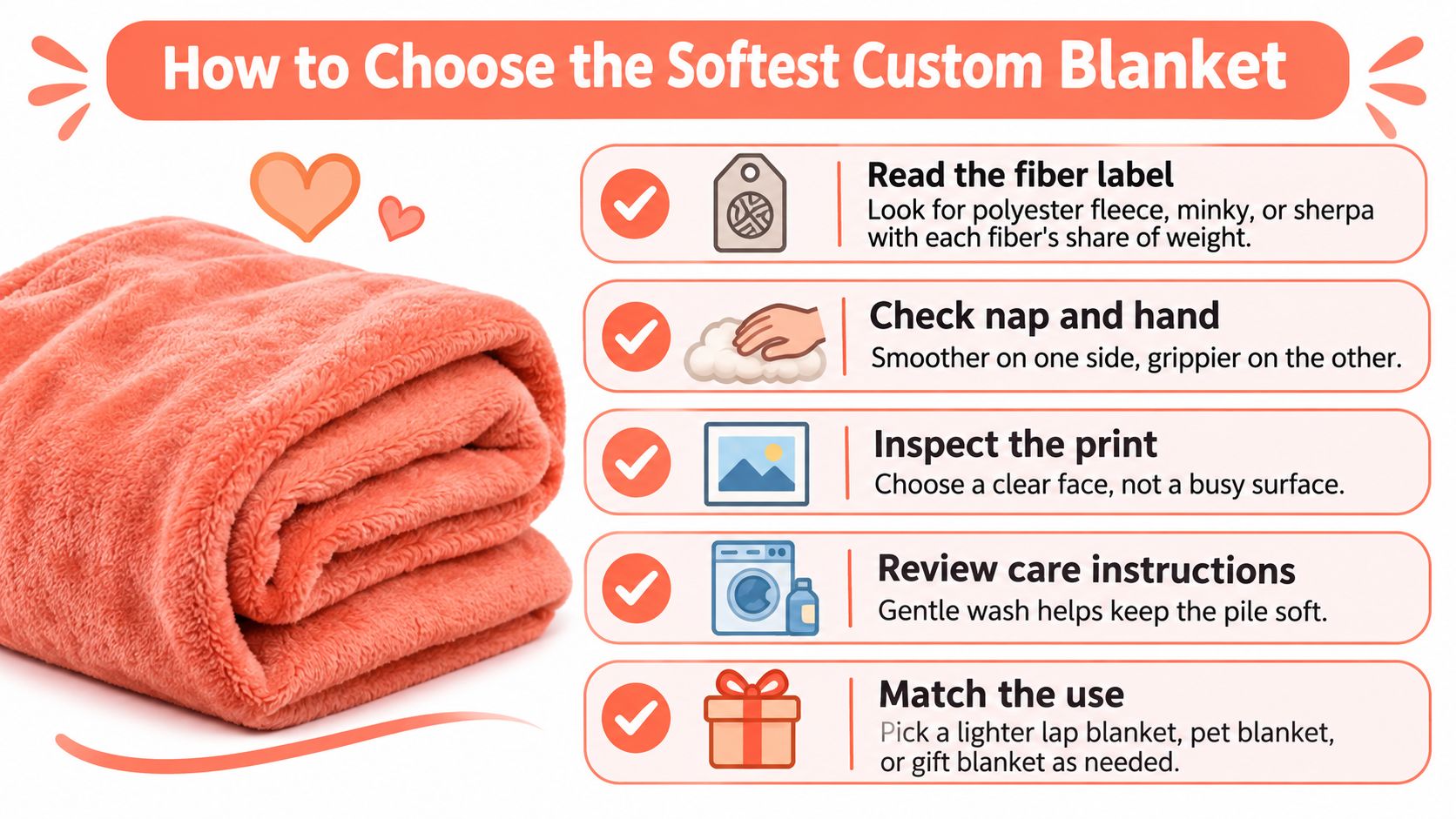
Start with the recipient's habits, then read the fabric the way you would read a sweater label: fiber, surface, weight, and care. Softness is a trade-off. A taller pile can feel plush against bare skin yet soften fine edges in a portrait; a flatter print face can keep the photo cleaner while feeling less deep. The best choice balances feel, warmth, and image life.
Check the material and construction
- Read the fiber information. The label or product listing should state fiber content and country of origin, and the care directions should be clear enough to follow at home. If composition or washing guidance is vague, treat broad cozy language as guesswork.
- Match the pile to the job. Pile behaves like carpet: longer fibers feel deeper, but they can hide detail and hold lint; shorter fibers feel smoother and keep edges cleaner. For help separating a low, silky hand from a deeper plush hand, use this fleece versus plush blanket comparison.
- Confirm the print construction. A one-sided dye-sublimation print on polyester keeps the photo face flexible and leaves a plain reverse. Check whether that reverse is fleece or sherpa, because the backing is often the surface that touches skin most.
Check the design and practical fit
- Give important faces enough room. A single-photo layout works well when the portrait is the whole point. For a collage, use simple crops with uncluttered backgrounds, keep text away from eyes and mouths, and avoid placing names across the part of the image people will look at first.
- Choose size by use. A throw suits a lap gift or sofa corner. Twin or queen makes sense when the blanket will also serve as a bedding layer, but a larger piece should still fit the recipient's washer, dryer, and storage space.
At That Blanket Co, soft minky fleece is lightweight, smooth, and cozy without the bulk, while premium fleece or sherpa options shift the balance toward warmth. Compare that fabric note with the photo layout before upload, especially when a face needs a smoother surface.
The softest sensible order is the one whose labeled fabric, contact surface, and care plan fit everyday habits. A blanket that gets used weekly beats a plusher one that stays folded because it feels too bulky or awkward to clean.
Order a Soft Custom Photo Blanket
Choose sherpa or minky when the first touch should feel plush. Choose smooth fleece when a clean photographic surface is the priority.
At That Blanket Co, we make Custom Photo Blankets in soft minky fleece, lightweight smooth fleece, and premium fleece or sherpa options using ultra-soft polyester materials. Our minky fleece is lightweight, smooth, and cozy without the bulk; our 275 GSM smooth fleece has a single-sided print and fleece backing, with dye-sublimation keeping the image flexible rather than creating a stiff printed film.
Prepare a gift that will be used
Start with the person, then prepare the image and message:
- Select a favorite photograph. Upload an original image with a clear subject and enough surrounding space for a comfortable crop. A warm, candid expression can matter more than a formal pose.
- Pick throw, twin, or queen. Think about where the blanket will live, whether across a reading chair, on a sofa, or at the end of a bed.
- Add a short message. For Mother's Day in April or May, a simple thank-you can carry the meaning. For November or December holiday gifting, choose a family greeting, shared date, or affectionate note.
- Plan the first wash. Follow the blanket's care instructions, protect the printed face where practical, and use a gentle routine rather than treating the new blanket like a load of towels.
Leave enough quiet space around the photograph for the image to remain the focus. A short message is easier to read when it isn't laid across a busy background, and a deliberate crop keeps the most important details away from the edges.
Order the fabric that matches how the blanket will be held, not the plushest word on the page.
That Blanket Co offers custom photo blankets that pair meaningful pictures with a choice of soft fabric surfaces. Visit That Blanket Co to choose your layout and size, upload a favorite photo, and create a blanket with the feel your recipient will enjoy every day.