


Printed Throw Blankets: Materials, Sizes and Gift Ideas
You're scrolling through family photos on a cold evening, trying to choose a gift that won't end up in a cupboard. A favorite portrait could become a blanket for Grandma's reading chair, but the choices quickly multiply: fleece or sherpa, collage or full-size photo, small throw or something large enough for the sofa. Start with how the recipient will use it, then choose the fabric, artwork and ordering date.
Printed Throw Blanket Materials Compared
A printed throw blanket is a soft fleece, sherpa, minky or woven throw with a photo, pattern or text printed across one side, edge to edge. It's a physical keepsake that also keeps someone warm, so neither the picture nor the fabric should be an afterthought.
Printed throw blanket materials at a glance
| Material | Feel | Warmth | Best For |
|---|---|---|---|
| Fleece | Soft, lightweight, smooth photo surface | Light to medium | Everyday couch and gifts |
| Sherpa | Plush with fleecy pile backing | Medium to high | Cold rooms and winter gifts |
| Minky | Ultra-soft, lightweight and smooth | Light | Babies, kids and lounging |
| Woven | Textured classic surface, durable | Medium | Heritage decor and bold designs |
Fleece is the sensible everyday choice. Its relatively smooth face suits photographs, and it's easy to drape over a chair. Choose sherpa when the recipient gets cold while reading or watching television. Minky suits someone who wants a smooth, cozy feel without much bulk.
Woven fabric gives bold lettering and heritage designs a textured finish. Check whether the artwork is printed onto woven cloth or created with colored yarns, because those are different constructions.
Softness doesn't tell you the warmth
Thickness, structure and air permeability affect thermal comfort, as explained in this textile thermal-insulation evaluation. Lofted layers trap air, while open structures allow more ventilation, so a silky surface alone doesn't establish how warm a blanket will feel.
The category is substantial: Dataintelo valued the global throw blankets market at $4.8 billion in 2025. That scale doesn't make every construction interchangeable.
Use the fleece, sherpa and woven materials guide to compare finishes. Choose the material by its intended use, then check the dimensions.
How Printing Methods Shape Photo Quality
Digital textile printing starts with an image file, rather than an engraved screen for every design. That makes individual photographs and short production runs practical, a central advantage described in the Textile Association's history of digital printing.
The process graphic shows why custom artwork doesn't need traditional screen setup.
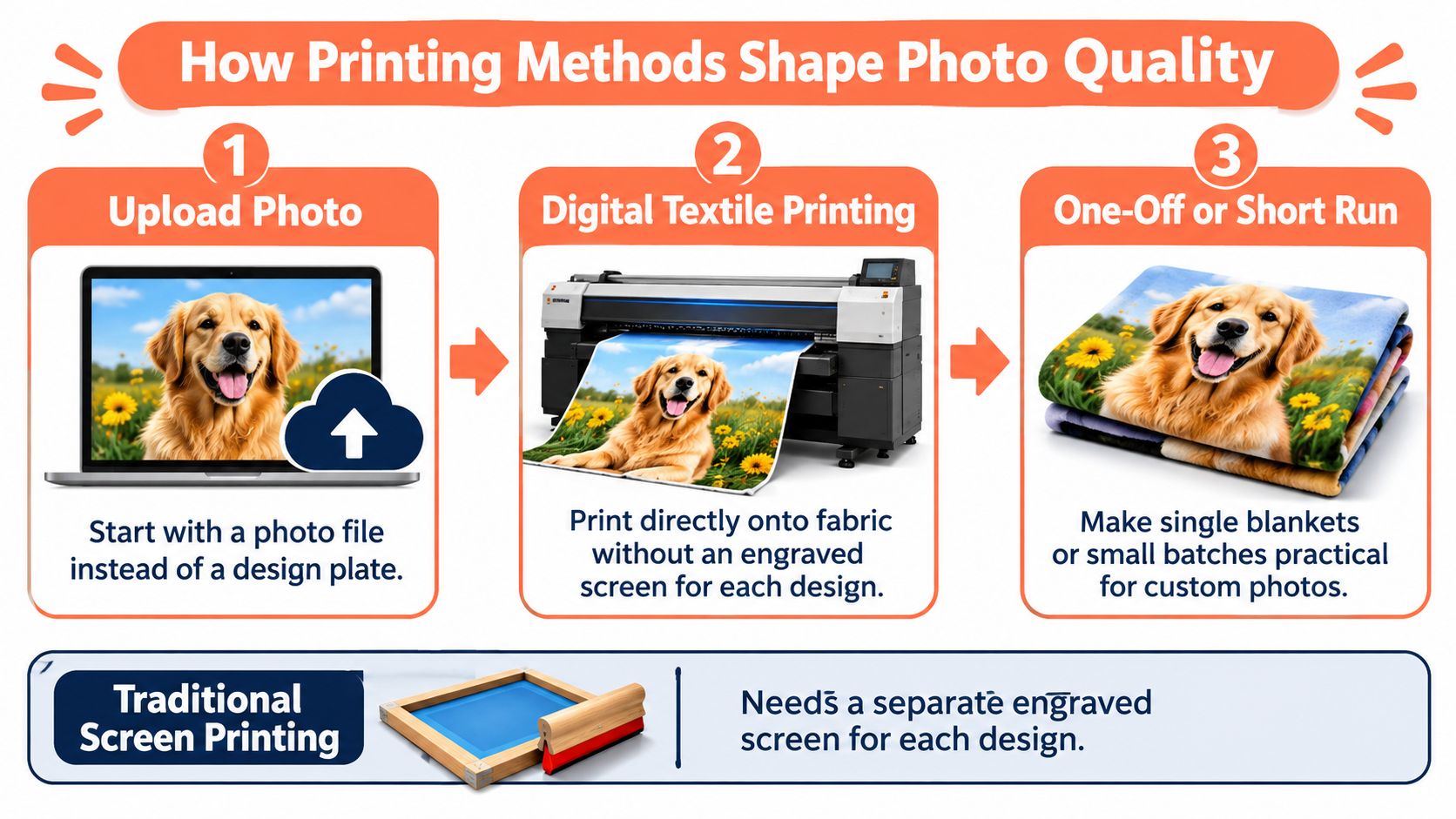
On polyester fleece, dye-sublimation uses heat to transfer dye into the fibers rather than leaving a thick printed layer on top. At our production facility, we print premium fleece edge to edge with this technology. Our blankets have a one-sided print and are shrink and fade resistant.
From image file to finished fabric
- Prepare the fabric. A suitable, consistent receiving surface helps prevent uneven color across faces and backgrounds.
- Print the full-color artwork. The image is prepared for edge-to-edge transfer. Sharp faces and legible lettering still require a sharp original file, printing can't recover missing detail.
- Fix the dye with heat. Controlled transfer helps produce crisp edges and vivid color within the polyester fibers.
- Cut and finish the blanket. The finishing stage establishes the final edges, so important features need room around the perimeter.
A smooth fabric face generally presents photographic detail more cleanly than a textured pile. Small text also needs enough contrast and space to remain readable when the blanket bends or folds.
This video offers another look at the photo-blanket process.
Expect vivid, edge-to-edge artwork on the front, with the reverse left as plain fabric. Don't expect the appearance of glossy photo paper, the textile's surface remains part of the finished image.
Throw Sizes and Styles to Match Your Room
Throw sizes and where they fit
| Size | Dimensions | Best Use |
|---|---|---|
| Small (Letter Blanket) | 30 x 40 inches | Lap, child or small chair |
| Throw | 50 x 60 inches | Loveseat or couch, the most-ordered size |
| Large throw | 60 x 80 inches | Larger sofa or bed cover |
The 50 x 60 inch throw is our most popular and most-ordered size, and it suits a loveseat or couch. It's the practical starting point when you want useful coverage without a large expanse of fabric trailing onto the floor.
The Letter Blanket is available in all the dimensions listed above. Twin and queen options also exist, but those labels aren't substitutes for measurements. Compare the selected product's dimensions with the furniture using the blanket size guide.
Match the layout to the display space
A collage groups photographs into a grid and works well for family memories or a milestone year. Count the pictures you want before choosing the template. Packing in extra images makes each person smaller.
An all-over photo gives a strong portrait the entire surface. Choose it when the subject is clear and the background won't become distracting at blanket scale. A name, date or short message works better in a text or monogram layout than squeezed across someone's face.
Sherpa changes the blanket's fullness and winter feel. Woven fringe creates a more traditional drape, especially over a reading chair or wooden bench. Consider whether the recipient prefers that decorative edge or a simpler finish.
Fit check: Mark the intended width and length on the sofa with painter's tape before ordering.
Measure the space where the blanket will live, not an empty stretch of floor. Leave room for the design to remain visible when draped.
Choosing the Right Blanket for Gifts, Decor and Pets
A birthday blanket shouldn't look like a wedding keepsake. Choose the emotional subject first: family togetherness for grandparents, a shared portrait for an anniversary, a team-inspired design for sports pride, or a composed photograph for a memorial.
Other meaningful occasions include graduations, new baby keepsakes, pet memorials and Mother's Day. A family collage suits several relationships; an all-over photograph suits a single person, couple or favorite pet.
Best printed throw blanket by recipient
| Recipient | Best Pick | Photo Choice | Watch For |
|---|---|---|---|
| Holiday gift | 50 x 60 sherpa or fleece | Family collage or single portrait | Confirm the preview before ordering |
| Home decor | 50 x 60 woven or fleece | All-over photo or simple collage | Match colors to the room |
| Pet owner | 50 x 60 fleece or minky | Close-up with a clear background | Pet fur and shedding |
| Baby or kids room | Minky with nursery or kids design | Name, milestone or favorite character | Decorative only, not sleepwear |
Choose for the room as well as the recipient
For living-room decor, take colors from cushions, curtains or artwork rather than trying to match every shade. A restrained collage can add interest to a neutral room; a bold all-over image should have enough surrounding space to look deliberate.
For pet owners, choose a close-up with a clear background and measure the animal's favorite resting place. A sentimental blanket isn't automatically a protective furniture cover. The Sofa Cover Crafter's guide to choosing protective sofa throws for dogs is useful when coverage and furniture protection matter as much as the photograph.
Keep nursery decoration separate from sleep equipment
Minky with a name, milestone or favorite character can suit a child's room. A decorative printed throw is not sleepwear or a crib product, however, and personalization doesn't establish suitability for infant sleep.
The U.S. Consumer Product Safety Commission's children's sleepwear guidance explains category-specific flammability and labeling requirements. Those requirements shouldn't be casually applied to decorative blankets as a safety endorsement.
Don't place a decorative throw in a baby's crib or assume it's suitable for overnight infant sleep. Follow pediatric safe-sleep guidance and the product's intended-use labeling. Choose by recipient first, then material, then size.
Picking and Uploading Photos That Print Well
The original photograph sets the ceiling for print quality. A flattering expression matters, but it won't compensate for motion blur, a tiny downloaded image or a face lost in shadow.
Use this visual checklist before opening the design tool.
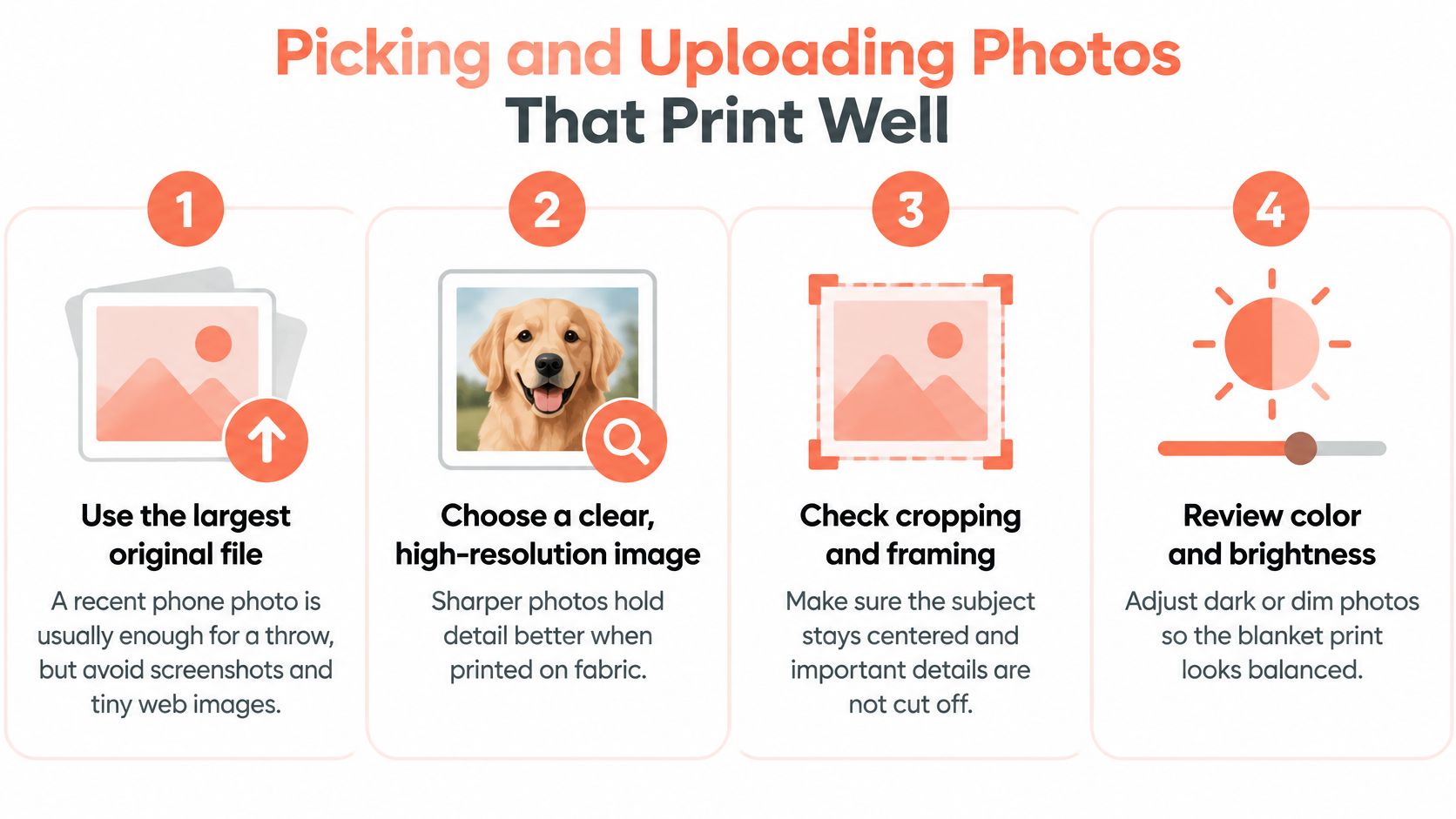
Prepare the file before uploading
- Use the largest original file you have. A recent phone photograph is usually a workable starting point. Avoid screenshots, messaging-app thumbnails and tiny web images, which can look soft when enlarged.
- Choose sharp, well-lit photographs. Zoom in on the eyes, hair and clothing edges. Blur becomes more obvious at blanket scale, so pick the clearer image even if another has a slightly better pose.
- Keep faces and text inside the edges. Trimming and sewing use some perimeter space. Don't position a forehead, pet's ear or meaningful date against the boundary.
- Crop to the blanket's proportions. A portrait photograph may need substantial trimming in a horizontal layout. Make that decision deliberately rather than accepting an automatic crop.
- Inspect dark areas. If you can barely distinguish a dark-haired pet from the sofa on screen, that separation may be weaker on fabric. Adjust exposure gently without bleaching skin tones.
- Review the complete preview. Check spelling, orientation, image order and the selected layout. We print exactly as shown in the design preview before ordering.
For a collage, inspect every image individually. A sharp main portrait won't disguise a blurry smaller picture, especially if that picture contains someone important to the recipient.
Approve the composition you can see, not the composition you hope production will improve.
Our print runs across the selected front surface, so use the preview boundaries carefully. The upload routine should be simple: pick, crop, preview, confirm. Save the approved image files together so you don't accidentally replace a corrected version with an earlier one.
Caring for a Printed Throw Blanket So It Lasts
Machine washable doesn't mean wash frequently. Launder a blanket because it needs cleaning, not because it has spent a few evenings on the couch.
Durability depends on the fiber, ink chemistry, preparation and fixation, not just how saturated the image looks. A textile-printing study found that additional ink layers improved color saturation but also increased wash-out, supporting the need to assess the finished fabric rather than ink alone.
Clean with less friction
- Wash only when needed. Air the blanket between uses and spot-clean small marks with a damp cloth and suitable mild detergent.
- Protect the printed face. A flat throw can't be turned inside out like a garment. Fold the printed side inward before loading, then use a cold, gentle cycle if the care label permits.
- Use mild detergent and avoid bleach. Don't add aggressive stain treatments without checking their suitability for the fabric.
- Skip unnecessarily long, high-spin programs. Choose the gentlest effective cycle rather than treating a lightly used throw like heavily soiled laundry.
- Dry according to the label. Use low heat where permitted, or air-dry with the blanket supported rather than stretched from a corner.
- Store clean and folded. Keep it dry and away from direct sunlight, without compressing plush pile unnecessarily.
Balance cleanliness with shedding
A household laundering study detected microfiber and nanofiber release in wash effluent and found an association between emissions and wash cycles. Washing only when necessary avoids needless laundering, although the exact shedding reduction for a particular blanket isn't established by that finding.
Care priority: Keep the blanket hygienic, but don't use a full wash to solve a problem that airing or spot-cleaning can handle.
For durability comparisons, request finished-fabric wash-fastness results under ISO 105-C06 or ISO 6330, rather than relying on an unexplained fade-resistant label. Each year, inspect seams, remove stored lint and wash before seasonal storage only if needed.
Mother's Day Keepsakes for April and May
April and May are for Mother's Day keepsake planning, not generic spring decor. A Northwestern University Medill Spiegel Research Center report, based on an April 2026 survey of 7,877 respondents, found average Mother's Day spending of $284.25 per person.
Custom Photo Blankets make sense here because the photograph carries the message. Choose children and grandchildren for a family collage, or a portrait of a grandmother sharing a favorite moment for an all-over design.
Work backward from the celebration
- March: Gather original photographs and decide who the gift is for.
- Early April: Upload the selected images and inspect their clarity in the layout.
- Mid-April: Place the order after confirming a delivery estimate that leaves room before the second Sunday in May.
- Early May: Check delivery progress and prepare the wrapping and card.
The personalized Mother's Day gift ideas guide can help narrow the theme. A printed blanket works as a sentimental gift on its own, without a pile of extras competing with the memory.
Ordering Your Holiday Keepsake on Time
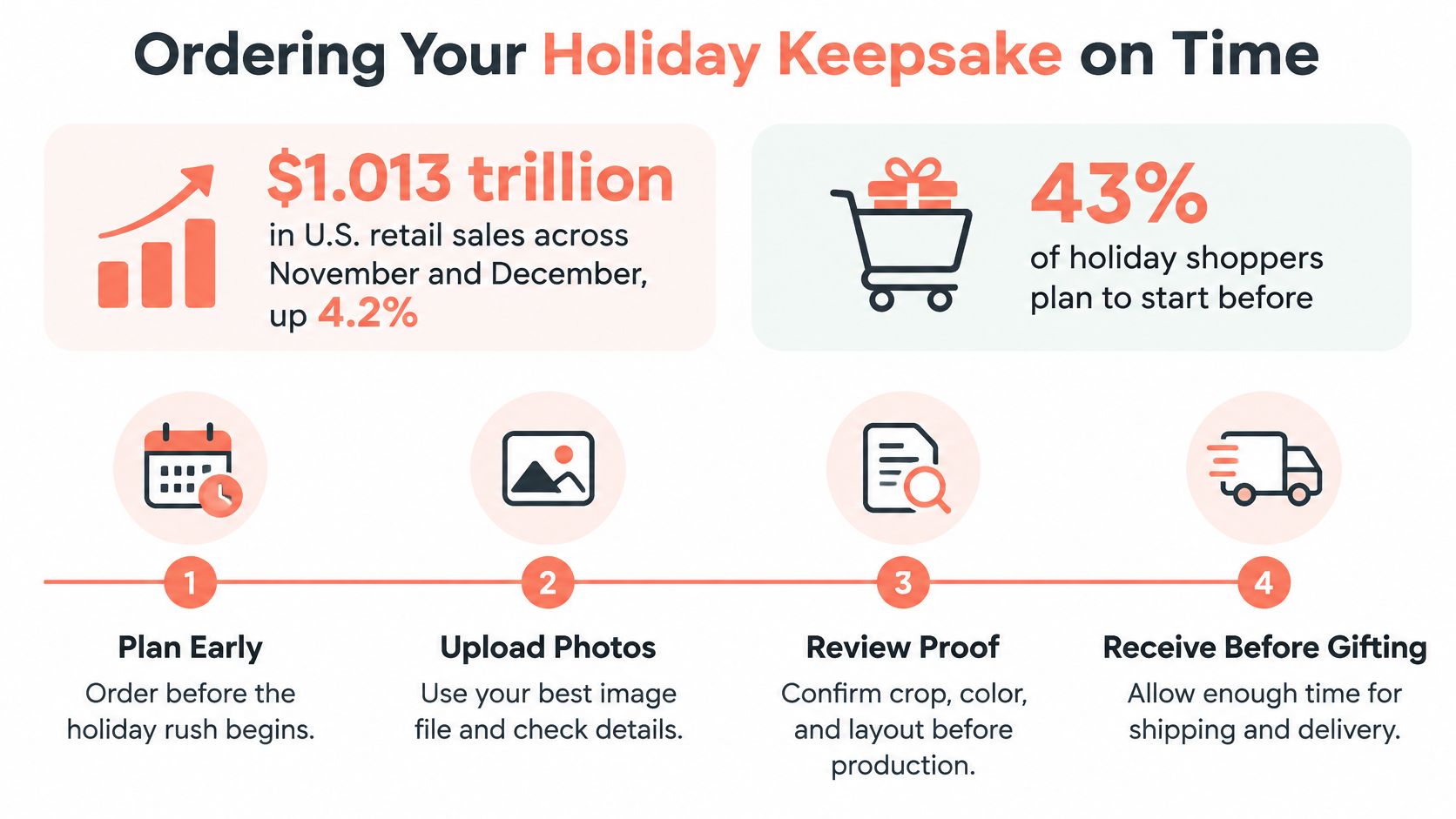
The National Retail Federation forecasts $1.013 trillion in U.S. retail sales across November and December, up 4.2%, and reports that 43% of holiday shoppers plan to begin browsing or buying before November. For personalized gifts, that's a good reason to make decisions before the busiest shopping period, not a reason to rush the artwork.
November and December should be about holiday gifting. Choose the family memory, pet portrait or shared milestone that belongs in the recipient's home, then set an ordering date.
Use a calendar, not a last-minute guess
- Now to mid-November: Choose the recipient, material and size, gather the original photographs and upload the artwork. Ask relatives for missing pictures while there's still time to replace weak files.
- Mid-November: Check the final crop and layout, then place the order. Each blanket is made to order, so production must happen before shipping begins.
- Late November: Treat this as a busy buying window, not a guaranteed delivery cushion. Check the current estimate before paying, especially if the gift needs to reach you before onward travel.
- Early December: Consider this the last comfortable planning window only when the displayed delivery estimate supports it. Don't assume another shopper's arrival date will match yours.
- Mid-December onward: Last-minute gifting becomes riskier. Confirm the current delivery window and avoid promising a holiday arrival that hasn't been supported.
This timeline keeps photo preparation separate from the shipping decision.
Control the order date
We create, print and cut blankets at our Michigan production facility, and they're made in the USA. Domestic production still involves making the item before a carrier delivers it, so don't confuse a shipping estimate with total order-to-door time.
For a holiday keepsake, start the customization process while you can still make thoughtful choices. We show the design preview before ordering, which gives you a clear opportunity to approve the artwork before production.
Count backward from when the recipient needs the gift. A family gathering, flight or early gift exchange may require arrival before the holiday itself. Include time to receive, inspect and wrap the blanket.
Pick the recipient, upload the best photo and order before the late-November rush. The order date is the part you can control.
That Blanket Co offers Custom Photo Blankets that turn family portraits, pet photos and milestone memories into useful keepsakes. Visit That Blanket Co to choose your blanket, upload your original images and review the design preview before placing your gift order.