


Sherpa Blanket for Baby: Warmth, Safety, and Gifts
It's late, the room feels cooler than it did at dinner, and your baby is finally settled against your chest. On the arm of the chair sits a plush blanket that looks perfect for this exact moment. The question isn't whether it's soft. It's whether soft is enough of a reason to use it, and where it belongs once the cuddle ends.
Why Parents Reach for a Sherpa Blanket for Baby
You're holding two blankets and they couldn't feel more different. One is a thin receiving layer, light enough to fold into a diaper bag pocket. The other is a sherpa blanket for baby use, thick and curly on one side, the kind of thing your hand sinks into. Most parents reach for the plush one first, and that's understandable. It reads as warm before you even unfold it.
That instinct is worth slowing down. A blanket can be a lap layer during a feed, a cover for a chilly stroller walk, a soft surface for supervised play, or a folded accent on a nursery chair. Those are four different jobs, and sherpa doesn't suit all of them in the same way. The same loft that feels reassuring on your own legs can be a lot of fabric against a small body.
The Pull Toward Plush
New parents often shop by touch because touch is what they can judge in a store or from a product photo. Softness also carries an emotional message. A plush blanket looks like care, which is why it shows up at showers and in newborn photos. There's nothing wrong with that impulse. It just shouldn't be the only test.
- Comfort in your arms: Sherpa works well as a layer between you and the room while you're holding your baby awake.
- Warmth on the move: It can add insulation over legs in a stroller when you're outside and watching.
- A nursery accent: Folded over a chair, it adds texture without needing to be near your baby at all.
Where a Keepsake Fits
Some families want that plush throw to carry a memory as well. Custom Photo Blankets let you put a baby portrait, a name, or a nursery motif on a blanket meant for cuddling and display. That changes the purchase from a generic warm layer to an object grandparents keep on their sofa. It doesn't change how the fabric behaves, though. A printed photo doesn't make thick pile thinner or cooler.
The right question isn't "is it soft," it's "what job will this blanket do, and who will be awake while it does it."
From here, it helps to work in order. First, what sherpa is and why it feels warmer than ordinary fleece. Then how that warmth plays out in real rooms, which settings suit it and which don't, how sizes and formats differ, when it makes sense as a seasonal gift, and how to wash it so it stays in good condition. By the end, you'll be able to pick up that plush blanket and know exactly where it belongs in your day.
How Sherpa Fabric Gets Its Plush Warmth
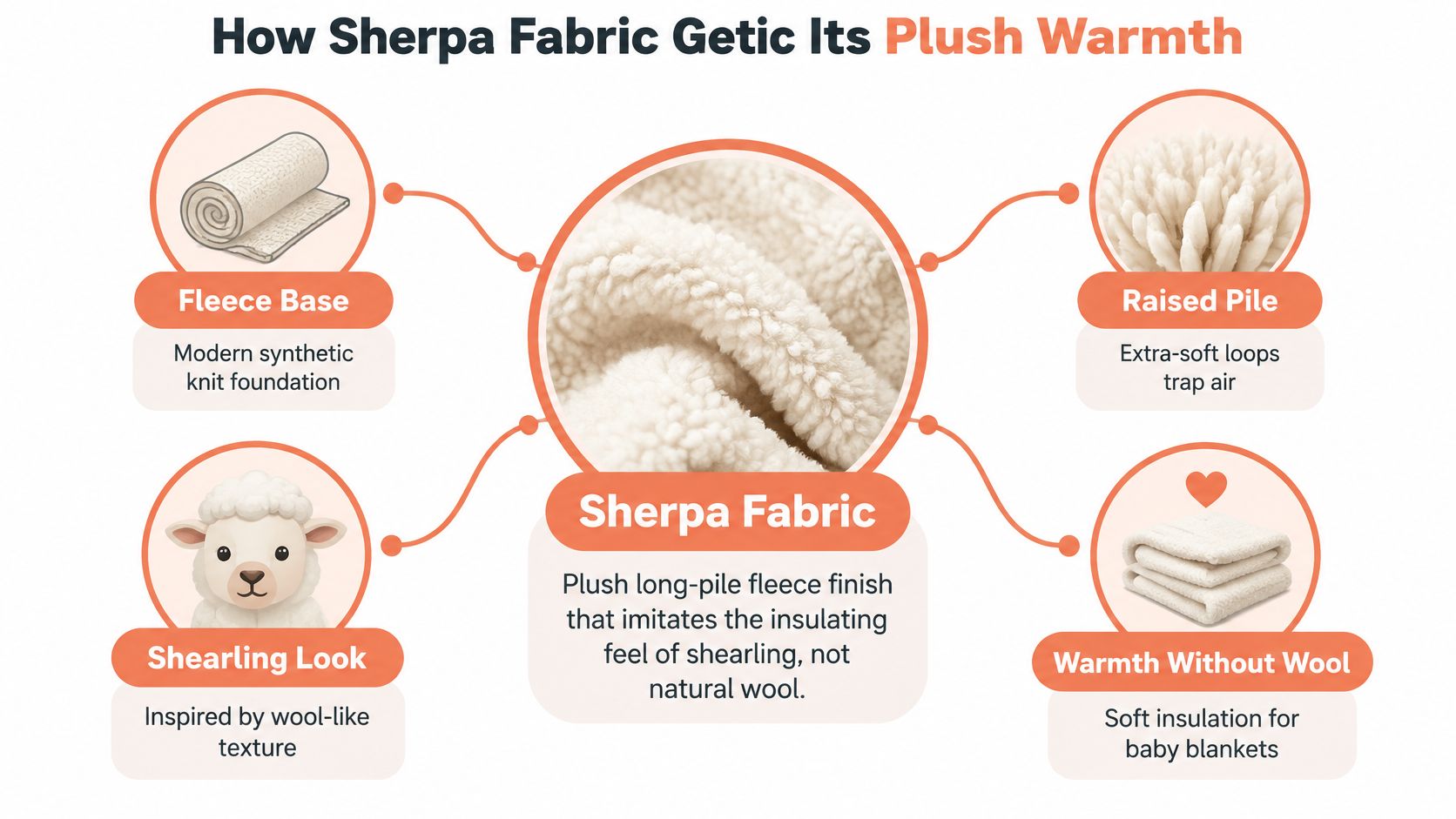
Sherpa isn't a fiber. It's a finish. Sherpa is a plush, long pile form of fleece designed to imitate the texture and insulating feel of shearling, and it should be understood as a textile construction, not a natural wool product, as explained in a textile guide to what fleece is and how sherpa is constructed. That distinction trips up a lot of shoppers, because the curly surface looks like lambswool. What you're touching is polyester that's been raised and curled to copy that look.
The history helps. Modern fleece emerged in 1979, when Malden Mills introduced polar fleece as a washable synthetic alternative to wool. Sherpa builds on that base. Instead of a flat, brushed surface, it uses raised, curly fibers that stand up from the knit. Those curls trap still air between them, and trapped air is what insulates. Think of the pile as thousands of tiny air pockets. More pockets, more warmth, and also more bulk.
Weight Is the Number to Look For
Fabric weight explains the difference you feel in your hands. Typical sherpa sits at roughly 300 to 400 grams per square meter, or GSM, while ordinary polar fleece runs about 200 to 260 GSM, according to the textile guide linked above. GSM measures how much a square meter of the fabric weighs, so a higher number means more material packed into the same area.
For a baby product, that gap has two sides. Higher weight brings loft, softness, and heat retention, which is lovely for a supervised cuddle on a cold evening. It also brings a heavier blanket that's less breathable and slower to release warmth. If you're comparing materials before you buy, a materials guide comparing fleece, sherpa, and woven blanket constructions can help you match construction to how you plan to use it.
What Polyester Means in Practice
Polyester is the workhorse here. It represented about 59% of worldwide fiber production, with approximately 88% of polyester production still based on fossil feedstocks, based on the figures in that same guide. So sherpa's appeal is practical rather than natural. You get machine washable fibers, a plush hand feel, and strong insulation at a manageable price.
Judge a sherpa blanket on four things together, not softness alone:
- Construction: How dense and even is the pile across the whole surface?
- Weight: Does the GSM suit a lap layer, or does it feel heavy for a newborn?
- Wash durability: Will the curls stay soft after repeated laundering?
- Ventilation: Can heat escape, or does the loft hold it in?
Softness Warmth and Breathability in Real Rooms
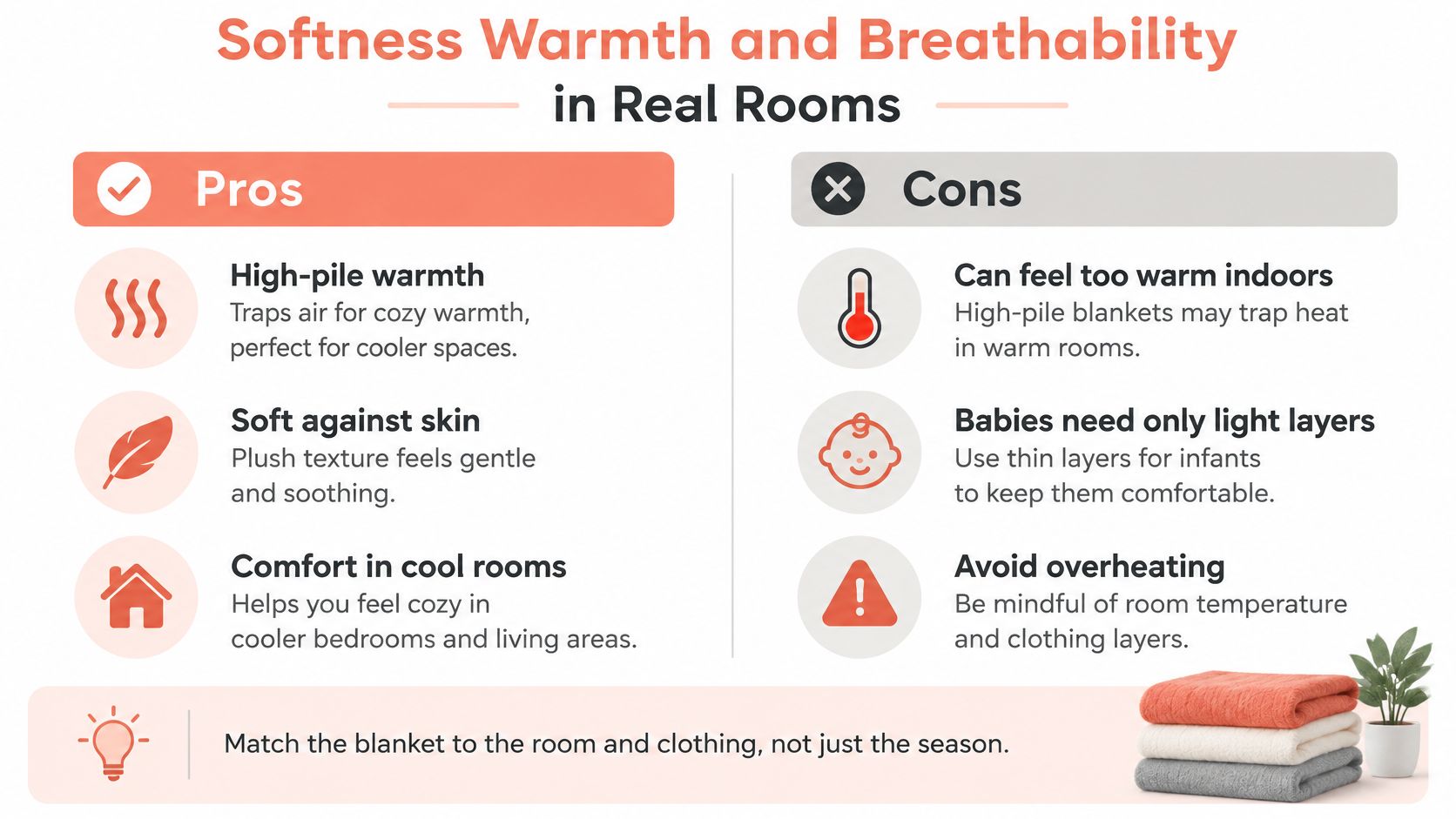
A thick pile creates a real thermal barrier. That's the point of it, and also the risk. When you lay sherpa over a baby who's already dressed in a footed sleeper, you've added a second insulating system on top of the first. In a cool room that can be welcome during awake cuddle time. In a warm room, a car seat, a stroller in direct sun, or against your own body heat, it can become too much very quickly.
The American Academy of Pediatrics advises that babies generally need no more than one additional clothing layer compared with a comfortable adult in the same setting, as set out in its parent guide to safe sleep and dressing babies for the room. Use yourself as the gauge. If you're comfortable in a light top, your baby doesn't need a heavy plush layer on top of warm clothing. If you've pulled on a sweater, one extra layer for the baby is the working rule.
Reading Your Baby Instead of the Thermostat
There's no single room number that settles this. Authoritative guidance doesn't establish a universal safe room temperature or a standardized warmth rating for consumer sherpa blankets, so treat claims like "temperature regulating," "all season safe," or a specific TOG value with skepticism unless a product has been independently tested. Your baby's skin gives you better information than a label does.
The AAP identifies sweating, flushed skin, damp hair, rapid breathing, or a hot chest as overheating indicators, per the parent guide linked above. Build a simple habit around those signs:
- Feel the chest or back of the neck: Warm and dry is fine. Hot or damp means remove the layer.
- Keep the blanket below the shoulders: During supervised use, never let it cover the head or face.
- Recheck after transitions: Coming indoors from a cold walk changes the equation within minutes.
Hands on check: If the skin under your palm feels hot or sweaty, the blanket comes off, whatever the room thermometer says.
A Quick Decision Before You Reach
Ask three things. What is my baby already wearing? How warm is this space for me right now? How long will this layer stay on, and will I be watching the whole time? If the outfit is already layered and the room is warm, sherpa is probably more insulation than the moment needs. Treat loft as heat, not as proof of comfort. A thinner layer you can adjust easily often serves better than the plushest option in the drawer.
Where a Sherpa Baby Blanket Belongs
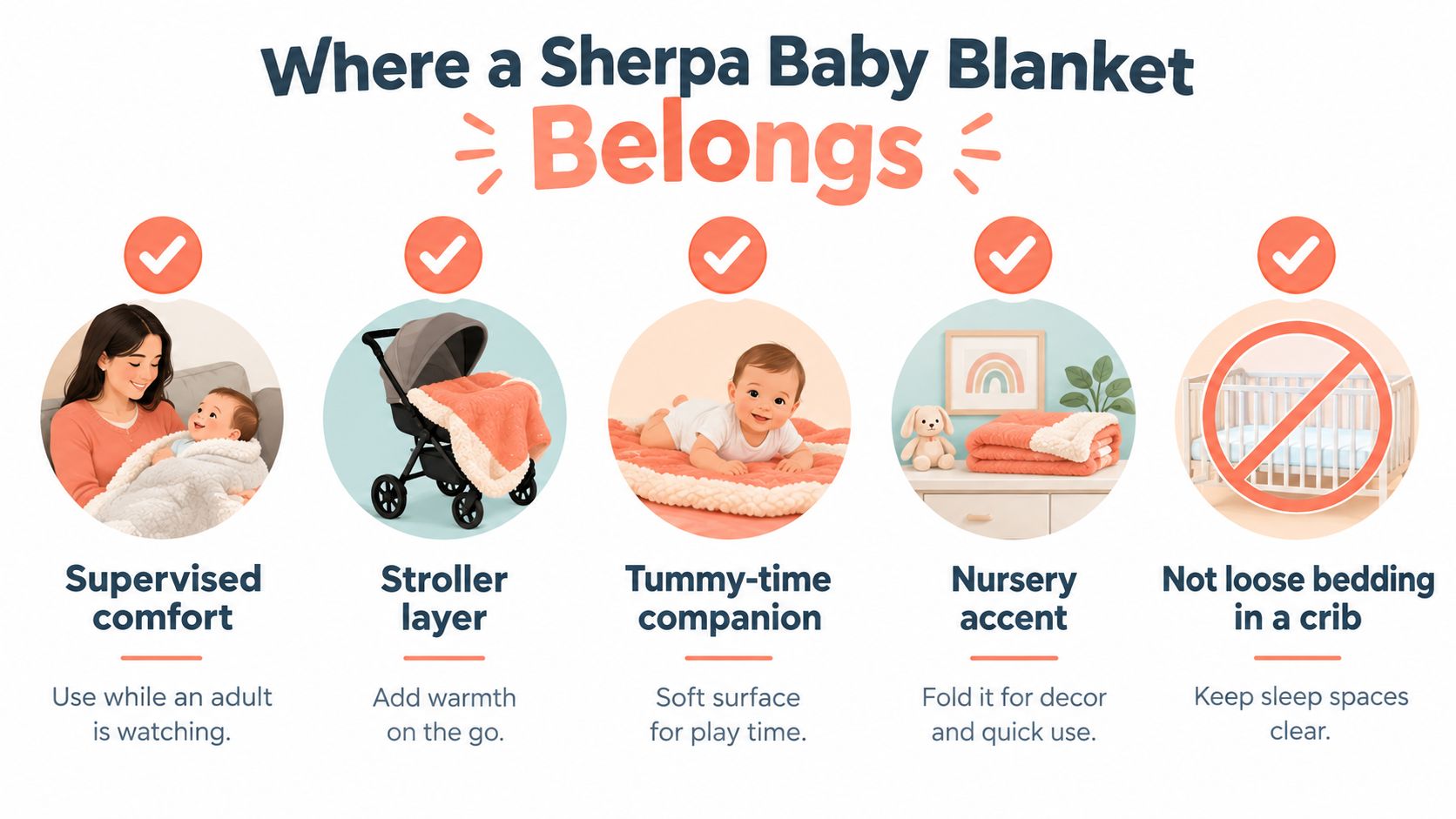
Place matters more than fabric. A sherpa blanket for baby time belongs in supervised settings: cuddling on a lap, a stroller ride with an adult watching, supervised tummy time, or folded as a nursery accent. It does not belong as loose bedding in a crib, bassinet, or play yard. That line can feel surprising when product photos show plush blankets draped inside cribs, so it's worth being direct about why the line exists.
The American Academy of Pediatrics recommends keeping loose blankets, pillows, stuffed toys, and other soft objects out of an infant's sleep space, because of risks that include suffocation, entrapment, wedging, strangulation, and overheating, as summarized in CDC guidance on how babies sleep and soft bedding risks. An AAP evidence review cited a study of accidental infant suffocation deaths from 2011 to 2014 in which 69% were attributed to soft bedding obstructing the airway, and CDC guidance reports that infants sleeping on soft bedding had a 16 times higher chance of sleep related suffocation than infants not sleeping on soft bedding, both noted in that CDC resource.
Why Pile Raises the Stakes
Remember the curly fibers that trap air for warmth. Against a sleeping baby's face, that same bulk can cover the nose and mouth, and a young infant may not be able to lift their head or push fabric away. Softness doesn't reduce that risk. If anything, a fabric that feels gentle and breathable to an adult hand can give false confidence.
Blankets in sleep spaces are still common despite the guidance. Illinois PRAMS data recorded blanket use during sleep at 40.2% in 2020, 39.1% in 2021, and 33.5% in 2022, figures included in the CDC resource above. Many caregivers haven't been told clearly, which is why plain language on product pages and gift notes matters.
What to Use for Sleep Warmth Instead
For warmth during sleep, pediatric guidance favors appropriately sized wearable sleep clothing rather than a loose blanket. A wearable layer moves with the baby and can't ride up over the face. If you're sorting options for the earliest weeks, a roundup of blanket choices suited to newborn routines and supervised use can help you separate daytime comfort items from sleep items.
Avoid describing or using a sherpa blanket as a crib blanket or sleep solution for babies under 12 months. Remove it before unattended sleep, every time, even for a short nap. And note that personalization doesn't shift the boundary. A photo print makes a blanket a keepsake. It doesn't certify it for a crib.
Swaddles Throws and Sizes for Everyday Use
Format follows the moment. Once you know a sherpa throw is a supervised item, the next decision is shape and size, and the simplest way to choose is to picture who will hold the blanket. In many homes, the honest answer is the adult. The baby rests against you, and the blanket covers your lap, your legs, and the baby's lower body while you watch.
A swaddle or wearable sleep layer works differently. It's clothing like, fitted to the baby, and it's the warmth format associated with sleep guidance. A sherpa throw is the opposite in spirit. It's loose, plush, and generous, made for a chair, a stroller, or the floor during play. Confusing the two is where trouble starts, because a throw's extra fabric is exactly what a sleep space shouldn't have.
Three Everyday Scenes
During a feed, you might pull sherpa across your own lap for warmth while your baby is awake in your arms. The blanket is serving you as much as the baby, and that's a good use. At playtime, you might fold it under a supervised play mat for cushioning on a hard floor, then pick it up and move it to a chair before any nap. On a walk, it can sit over stroller legs as an outer layer, then come off once you're back inside and the baby's chest feels warm.
Larger sizes change the audience. Throw, twin, and queen photo blankets suit family cuddling on a sofa and display across a bed far more than they suit anything to do with infant sleep. A big plush blanket can overwhelm a newborn with bulk and coverage, even when a lighter layer would be fine. Bigger is a family purchase, not a baby upgrade.
Choose the size for the person who will hold it most, and the room where it will live, not for the crib it should stay out of.
Sherpa Baby Blanket Uses by Setting
| Setting | Better Format | Sherpa Role | Before Sleep |
|---|---|---|---|
| Lap feeding and cuddling | Small throw | Lap layer for adult and baby | Remove and set aside |
| Supervised floor play | Throw, folded | Cushioned play surface | Clear the sleep space fully |
| Stroller walk | Throw | Outer layer over legs | Take off for any unattended nap |
| Family sofa time | Twin or queen | Shared cuddling and display | Keep out of crib and bassinet |
| Sleep warmth | Wearable sleep layer | Not used | Use the wearable layer instead |
Read the last column as the rule that ties the table together. Whatever the setting, the sherpa piece leaves before unattended sleep begins.
Choosing a Custom Photo Blanket as a Gift
Timing shapes what makes a good gift. The National Retail Federation defines the U.S. winter holiday retail season around November and December, months that accounted for approximately 19% of total annual retail sales over the previous five years, according to an NRF holiday survey release on seasonal spending patterns. That same survey found 60% of shoppers expected to finish their holiday shopping in December, even though 42% planned to begin browsing or buying before November. A personalized blanket fits that late year window well, because it feels considered but can still be ordered on a deadline.
For November and December, frame a sherpa blanket as a holiday present for new parents, grandparents, or the whole family. A baby's first portrait, a name with birth details, or a nursery image turns a warm throw into something people unwrap and immediately understand. If you're comparing ideas for a shower that falls in the same season, browsing personalized baby shower gifts can help you see how a keepsake blanket sits alongside other customized presents.
April and May Belong to Mother's Day
In spring, the same product carries a different message. NRF projected total Mother's Day spending of $38 billion in 2026, with average spending of $284 per person, compared with a 2025 benchmark of $34.1 billion, in its NRF Mother's Day spending data and seasonal trends. A Custom Photo Blanket with a family photo, a baby portrait, or milestone imagery suits mothers, new mothers, and grandmothers without assuming everyone wants the same design. For more angles on matching a design to a recipient, see these ideas for personalized baby gifts for family occasions.
What You Can Customize
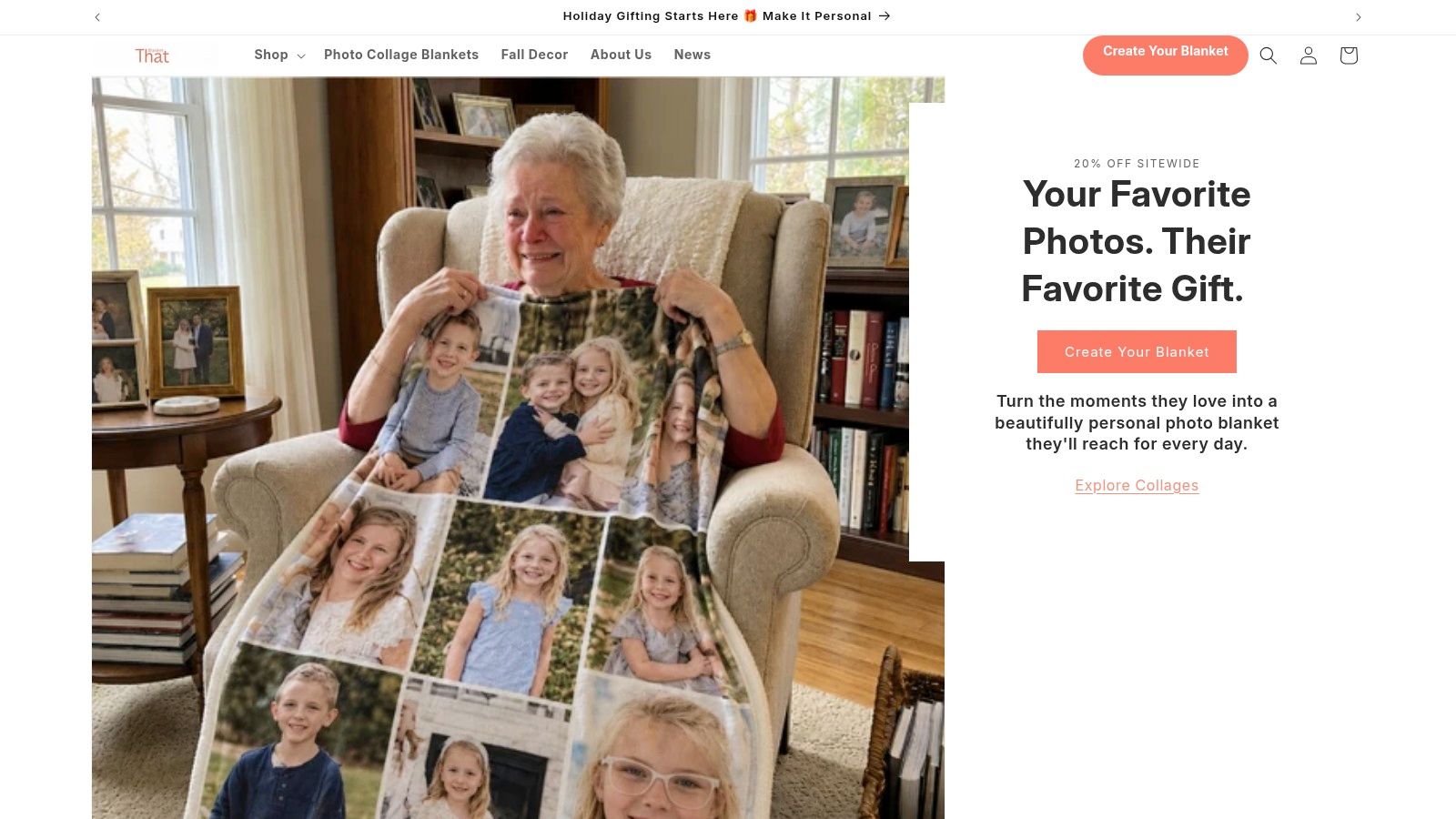
That Blanket Co lets you upload a photo and choose throw, twin, or queen sizes, with styles that include collage layouts, all over photo and text designs, star maps, monograms, heart and floral motifs, and kids or nursery themes. Sherpa styles and baby swaddles are part of the range, with gallery quality printing on machine washable fabric. Production typically takes 2 to 3 business days and shipping is free, which matters when a holiday or Mother's Day date is close. Pick the image for the recipient's sofa, not the baby's crib, and the gift lands exactly as intended.
Washing Care and the Blanket to Order Next
Care is where good intentions meet spit up. A polyester sherpa blanket will need washing, probably often, and the fiber label is your instruction sheet. Follow it as directed for water temperature and drying, because pile that gets scorched or matted loses the softness you bought it for. Don't guess based on how sturdy it feels. Plush fabric can look unchanged while heat damages the fibers.
The step parents skip comes after the wash. Before the blanket goes back near your baby, run your hands over it and inspect the seams, binding, and pile for loosened threads, fraying edges, or any component that could come away. A binding edge can start to lift while the surface still looks perfect. Catching that early is part of safe supervised use, not fussiness.
A Short Post Wash Check
- Seams: Tug gently along each edge and look for gaps or loose stitching.
- Binding: Check corners, where wear tends to show first.
- Pile: Feel for clumps, shedding patches, or anything caught in the curls.
- Print side: Confirm the surface is smooth, with nothing peeling or raised.
If something has loosened, set the blanket aside for repair or retire it from baby use. It can still live on your sofa. It just shouldn't be the layer near small hands and mouths until it's sound again.
Your Decision in Four Steps
Pull the whole purchase together in order. First, confirm the job: cuddling, stroller time, supervised play, or display. Second, pick the format, swaddle for a fitted wearable layer, throw for lap and stroller use, or a larger family size for shared cuddling. Third, match thickness to your baby's clothing and the room, and plan to check the chest or neck rather than trusting a warmth claim. Fourth, add a photo only when the blanket is meant as a keepsake or gift.
That sequence turns a vague wish for something soft into a finished plan. Choose your favorite image, pick a sherpa style or baby swaddle in the size that fits the setting, and order with the calendar in mind, whether that's a December holiday deadline or a Mother's Day in May. You'll know where the blanket belongs the day it arrives.
Ready to turn a favorite baby photo into a plush sherpa keepsake for supervised cuddles, stroller walks, and family display? That Blanket Co offers Custom Photo Blankets in throw, twin, and queen sizes with sherpa styles and baby swaddles, machine washable fabric, and designs from collages to nursery themes. Upload your image today and create a holiday or Mother's Day gift that arrives ready to be held, folded over a chair, and kept for years.