


What Is a Star Map Capturing a Moment in the Cosmos
A star map is a beautiful snapshot of the night sky, capturing the exact alignment of stars and constellations from a specific location on Earth at a single, unforgettable moment. Think of it as a celestial photograph of a memory, freezing a cherished event in time.
A Snapshot of the Heavens
At its heart, a star map is a deeply personal representation of the cosmos. Modern tools use precise astronomical data to recreate the sky from any date, time, and location you choose. This allows you to capture the heavens as they appeared during life's biggest moments—a first date, a wedding anniversary, or the birth of a child.
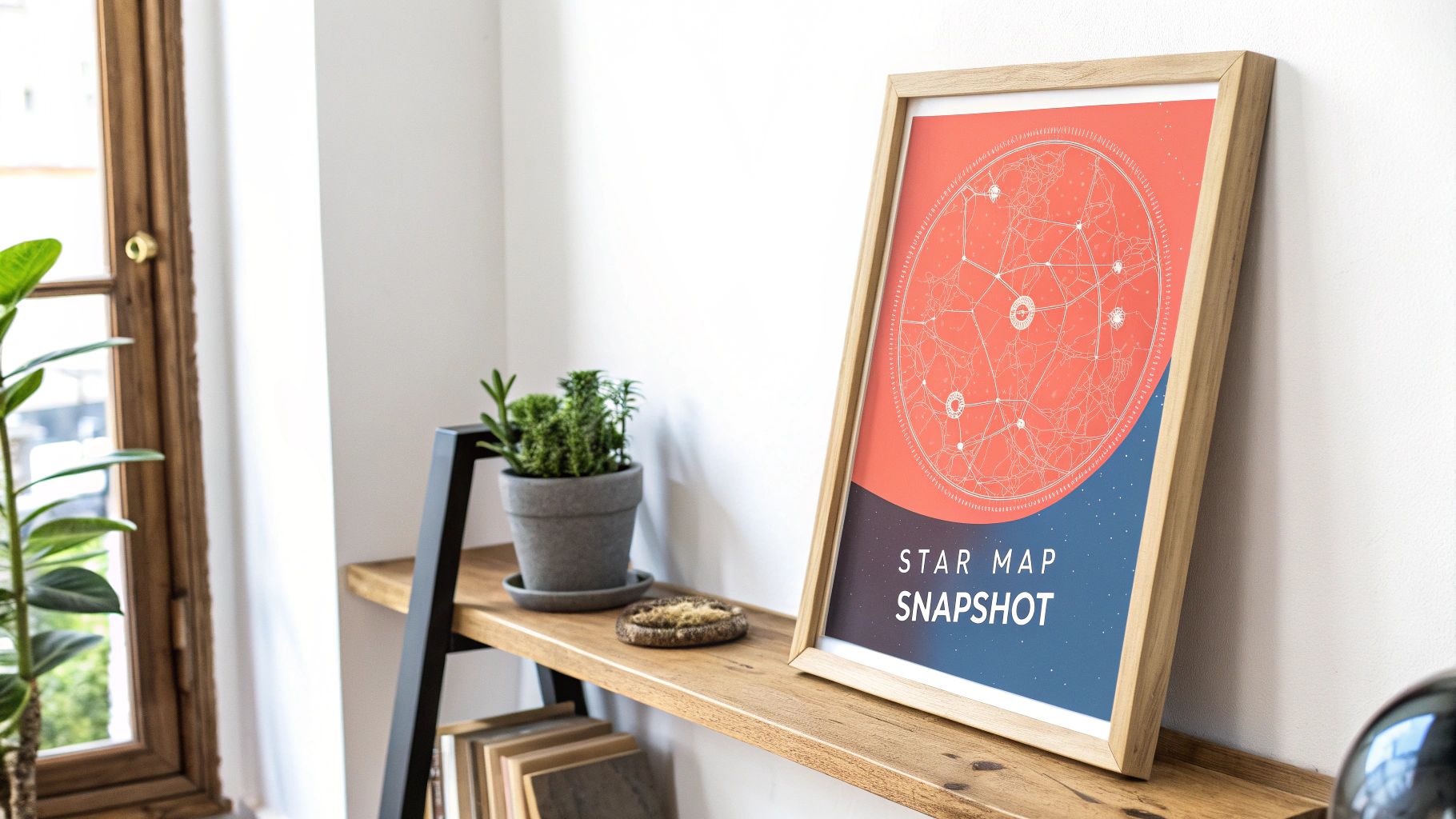
But before you dive in, it’s important to understand there are really two kinds of star maps out there. They both pull from the same celestial data, but they serve completely different purposes—one is highly technical, the other deeply sentimental.
Scientific Charts Versus Personal Keepsakes
Scientific star charts, also known as astronomical charts, are the workhorses of astronomers and astrophysicists. These are dense, technical documents packed with coordinates, magnitudes, and spectral classifications. Their goal is pure function: helping researchers navigate, identify, and study celestial objects with pinpoint precision. They are the blueprints of the universe, designed for research, not decoration.
On the other hand, a personalized or commemorative star map transforms that same scientific data into a work of art. The focus shifts from raw technical detail to pure emotional connection. While still astronomically accurate, the design emphasizes aesthetics and personal meaning above all else.
A personalized star map isn't just about what the sky looked like; it's about what that moment felt like. It's a visual reminder of a core memory, translated into the timeless language of the stars.
This is what makes them such thoughtful gifts, especially during the holidays. A custom star map freezes a moment in time, offering a unique way to celebrate a special connection. Just like Custom Photo Blankets turn a beloved picture into a warm, tangible memory, a star map hangs that memory on the wall for everyone to see.
To help clear things up, let's look at how these two types of maps stack up side-by-side.
Two Worlds of Star Maps A Quick Comparison
| Feature | Scientific Chart | Personalized Map |
|---|---|---|
| Primary Purpose | Research and celestial navigation | Commemoration and home décor |
| Audience | Astronomers, researchers, hobbyists | Gift-givers, families, couples |
| Design Focus | Data-rich, functional, complex | Aesthetic, minimalist, emotional |
| Key Information | Coordinates, star magnitudes, names | Constellations, planets, personal text |
| Common Use | In an observatory or lab | As a gift or wall art in a home |
As you can see, one is a tool for study, while the other is a tool for storytelling.
What Goes into a Personalized Map
Creating a commemorative map is a beautiful blend of art and science. It all hinges on a few key pieces of information to generate an accurate sky view:
- Date: The specific day, month, and year of your special event.
- Time: The exact hour and minute, if you know it, for maximum precision.
- Location: The city or coordinates where the event took place.
From these simple inputs, sophisticated software cross-references astronomical databases to plot the positions of thousands of stars, constellations, and sometimes even planets. The result is a stunning and scientifically sound depiction of that one-of-a-kind night sky, ready for you to customize with colors, text, and design elements that tell your unique story.
The Ancient Art of Mapping the Heavens
Long before they were personalized gifts, star maps were our ancestors' guide to the universe. The desire to chart the heavens is a timeless human impulse, connecting a modern commemorative map to thousands of years of people looking up in wonder. It’s a tradition that began not with telescopes, but with the naked eye and a deep curiosity about our place in the cosmos.
Ancient civilizations looked to the stars for more than just navigation; they saw meaning, divinity, and a cosmic clock that governed their lives. The predictable movement of celestial bodies helped them track seasons for farming, perform religious ceremonies, and build entire societies.
From Mythology to Measurement
Early cultures like the Babylonians were meticulous observers. They recorded the movements of the sun, moon, and visible planets, developing some of the first known astronomical records. This knowledge allowed them to create calendars and predict celestial events, laying the groundwork for centuries of discovery to come.
The ancient Egyptians wove the stars directly into their mythology and architecture. Just look at the pyramids—their alignment with specific stars is a stunning testament to their advanced understanding of the sky. For them, a star map was both a practical tool and a sacred text, a guide to the heavens that the souls of pharaohs would one day traverse.
This rich history is filled with incredible artifacts. The earliest surviving star map, discovered in Ancient Egypt, dates back to approximately 1534 B.C., making it the oldest accurately dated star chart known to historians. These Egyptian maps were more than simple guides; they intricately combined astronomy with mythology, showing stars surrounded by depictions of deities. You can learn more about the history of ancient star maps and their profound influence on later civilizations.
The night sky has been humanity's first and greatest storybook. Every culture looked up and saw different heroes, gods, and cautionary tales written in the stars, creating a shared heritage of celestial storytelling.
This practice of interpreting the heavens led to the creation of constellations. Our ancestors saw patterns in the chaos, like the familiar zodiac constellations, an art form now celebrated in modern accessories like beautiful zodiac constellation stud earrings. These recognizable shapes made the vast, complex sky easier to understand, remember, and pass down through generations.
The Greek Revolution in Stargazing
The legacy of these early observers was later inherited and systemized by the ancient Greeks. Greek astronomers like Hipparchus and Ptolemy shifted the focus from purely mythological interpretation to mathematical precision. They are credited with creating the first systematic star catalogs, and it was a game-changer.
- Hipparchus (c. 190 – c. 120 BC): Often called the "father of trigonometry," he compiled a catalog of over 850 stars, classifying them by their brightness. His work introduced a level of rigor and measurement that was groundbreaking for the era.
- Ptolemy (c. 100 – c. 170 AD): Building on Hipparchus's work, Ptolemy wrote the Almagest, a comprehensive astronomical treatise that became the authoritative text on the subject for more than 1,400 years. His catalog listed over 1,000 stars and became the undisputed foundation for astronomy in Europe and the Islamic world well into the Renaissance.
This transition from mythological storytelling to scientific cataloging was a pivotal moment. It marked the birth of modern astronomy and established the principles that still inform how we map the sky today. Understanding this long, rich history adds another layer of meaning to a modern star map. It's not just a piece of decor but a connection to an ancient human tradition of capturing the cosmos. This tradition of preserving memories is also at the heart of other personalized gifts, like Custom Photo Blankets, which turn a special moment into a warm and lasting keepsake for the holidays. Every star map is a small piece of this grand legacy.
How a Modern Star Map Is Made
Ever wonder how we can capture the exact night sky from a special moment in your life? It’s a beautiful mix of age-old astronomy and modern tech. The process turns raw celestial data into a stunning, personal keepsake, and it all starts with three simple but crucial pieces of information: a specific date, a precise time, and a meaningful location.
Think of these details as the coordinates for a celestial time machine. Sophisticated software takes your input and cross-references it with massive astronomical databases, like the European Space Agency's Hipparcos catalog. This catalog contains precision measurements for over 118,200 stars, allowing us to accurately reconstruct the heavens just as they were for you.
The Three Pillars of a Star Map
Every single custom star map is built on the same foundation. Each element is non-negotiable, playing a vital role in making sure your map is a true snapshot of the sky.
- The Date: This is the anchor for your memory—a birthday, an anniversary, or the day you met. The software uses this to pinpoint Earth's exact position in its orbit around the sun.
- The Time: This fine-tunes the map's view. Because the Earth is constantly rotating, the stars overhead shift from one hour to the next. Knowing the exact time locks in that specific celestial arrangement.
- The Location: Your spot on the globe, whether it’s Paris, Texas, or Paris, France, determines your viewing angle. The stars you can see from the Northern Hemisphere are completely different from what’s visible down south.
Once these three inputs are locked in, the system calculates the exact positions of thousands of stars, constellations, and sometimes even planets, plotting them onto a chart. You can learn more about how this all comes together by exploring the step-by-step process for creating personalized keepsakes.
From Sphere to Flat Surface
One of the biggest hurdles in map-making, celestial or otherwise, is figuring out how to represent a 3D sphere on a 2D surface. Imagine trying to peel an orange and lay the skin perfectly flat without any stretching or tearing—it’s impossible. Cartographers get around this with a clever technique called projection.
A common method for star maps is the stereographic projection, which maps the sphere onto a flat plane. This approach is fantastic because it keeps the shapes of constellations looking right, especially near the center of the map. It's the perfect marriage of scientific accuracy and aesthetic appeal, bridging the gap between the real, spherical sky and the art on your wall.
A star map is more than just data points; it is the scientific rendering of a memory. It confirms that the universe itself bore witness to your most important moments, with every star in its proper place.
This process ensures your beautiful map isn't just a pretty picture—it's rooted in real astronomical science. For anyone interested in seeing these stars for themselves, understanding the right tools is the next step. You can discover more about how to use telescopes for stargazing to get started.
The infographic below shows how the foundational knowledge for mapping the stars was passed down through ancient civilizations, creating the basis for the astronomy we use today.
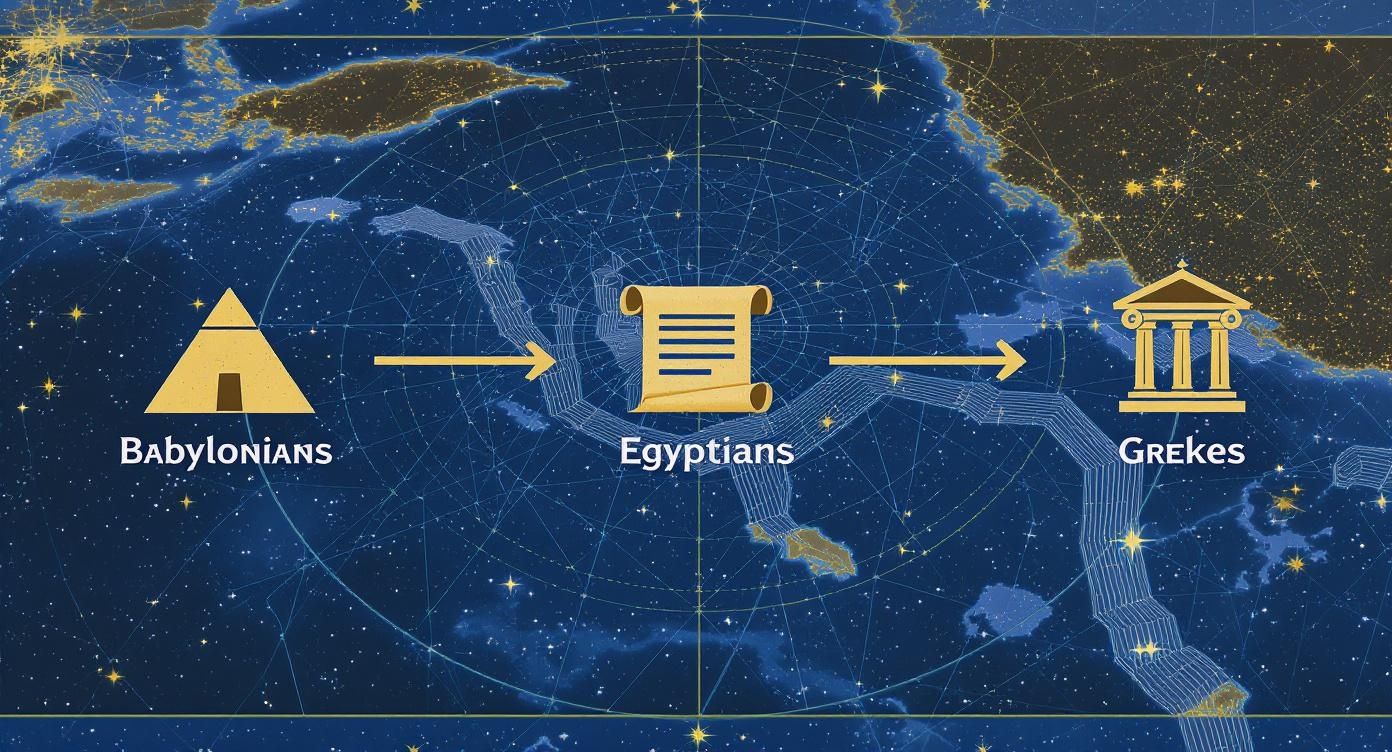
This visual journey highlights the crucial handoff of astronomical wisdom from the Babylonians to the Egyptians and finally to the Greeks, whose systematic approach laid the groundwork for everything that followed.
Creating Your Personal Piece of the Cosmos
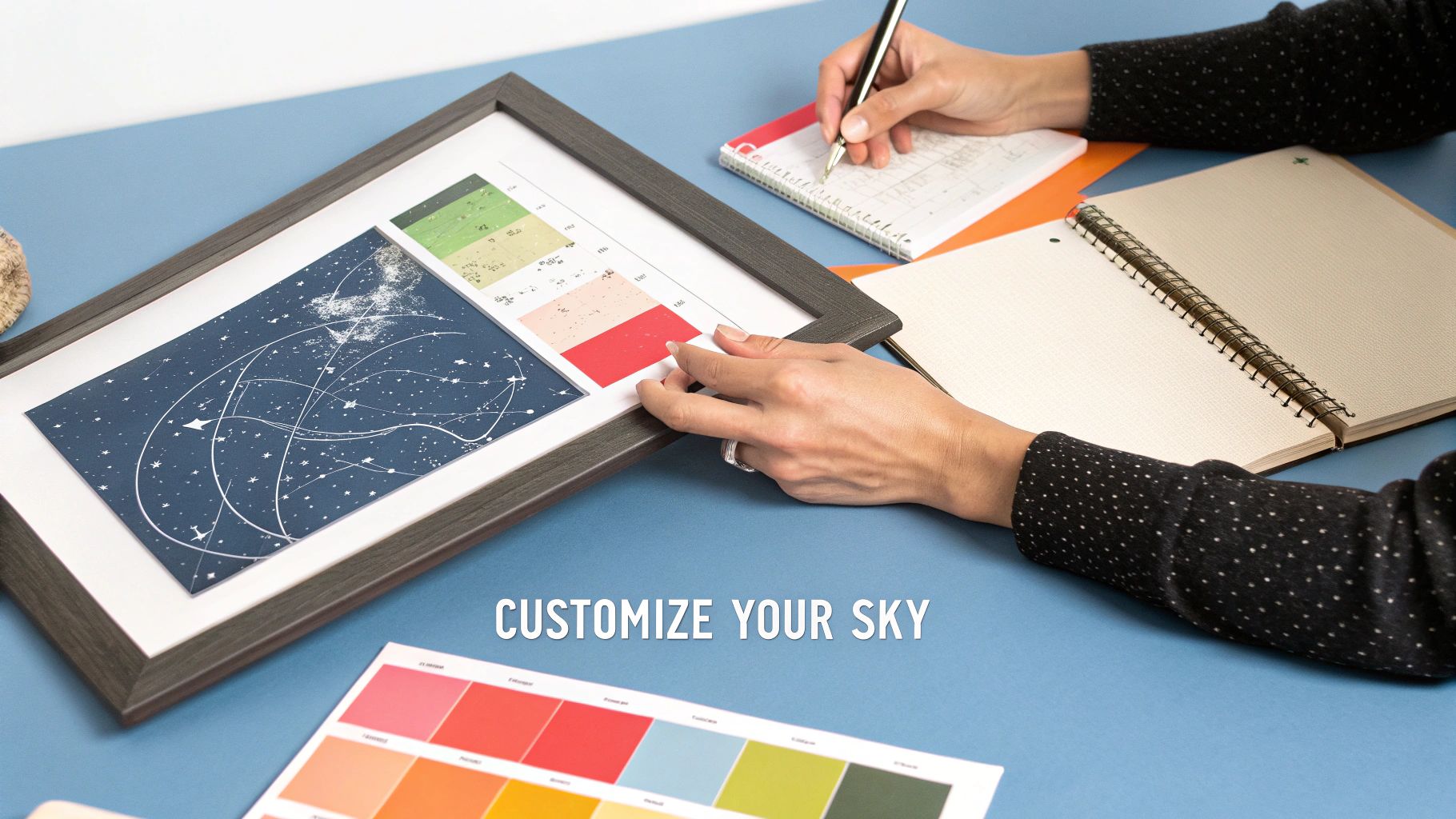
The scientific data gives your star map its backbone, but the real magic happens when you make it yours. This is the fun part, where you get to transform a snapshot of the heavens into a work of art that tells a deeply personal story. It’s what turns a cool product into a cherished memory.
The journey kicks off with aesthetics. Every detail, from the color to the text, can be tweaked to reflect your personal style or match your home decor. This step ensures your star map feels like it truly belongs, making it more than a gift—it becomes a centerpiece of your home's story.
Designing Your Night Sky
The visual elements are your first layer of personalization. You can pick from a huge range of options to create a look that is entirely your own, whether you’re going for bold and modern or subtle and classic.
Here are the main design choices you’ll make:
- Color Palette: Do you want a classic navy that mimics the real night sky? Or maybe a soft, modern pastel to complement your living room? The color you choose sets the entire mood.
- Design Style: You could opt for a minimalist design that lets the stars speak for themselves, creating a clean, elegant look. On the other hand, a more traditional style might include constellation lines, names, and a grid for extra layers of detail.
- Constellation Overlays: To show constellation lines or not—that is the question. Including them makes the map easier to “read,” helping you spot famous patterns like Orion or Ursa Major. Leaving them out creates a more abstract and artistic impression of the starfield.
This level of creative control means you can craft something that truly resonates with your personal taste. It guarantees the final piece isn't just a map, but a reflection of you.
Adding Your Personal Story
While the design makes it beautiful, the text is what gives your star map its heart. This is where you spell out the meaning behind that specific moment in time. The personal message is arguably the most important element, turning a beautiful image into a powerful story.
Every star map tells a story. The date and location set the scene, but the personal message is the dialogue—it's what speaks directly to the heart and captures the emotion of the memory.
Think about what you want your map to say. Here are a few ideas to get you started:
- Names and Dates: Simple and often the most powerful. "Amelia & Thomas | May 21, 2023" instantly grounds the map in a shared experience.
- Meaningful Quotes: A favorite line from a poem, song, or book can add a profound layer of meaning. "Under these stars, our adventure began."
- Specific Event: Clearly state the occasion you're commemorating, like "The Night We Got Engaged" or "Welcome Home, Little One."
- Coordinates: Adding the precise latitude and longitude of your special spot lends a wonderfully technical yet romantic touch.
This is the kind of personal touch that transforms a gift into a timeless keepsake. It’s the same idea behind other beloved personalized items, like how a Custom Photo Blanket wraps a favorite picture in cozy fabric to create a tangible memory for the holidays. You can even find a custom star map blanket that combines the beauty of the cosmos with comforting warmth. The goal is always the same: capture a feeling and make it last forever, whether it’s hanging on a wall or wrapped around your shoulders.
Why Star Maps Make the Perfect Holiday Gift
When November and December roll around, the hunt for the perfect holiday gift is officially on. In a season that's often filled with generic presents, a custom star map is a breath of fresh air—a deeply personal and thoughtful choice that truly stands out. It's more than just a gift; it's a moment frozen in time, a story told by the cosmos, making it an unforgettable way to show someone you care.
This holiday season, you could commemorate a couple's first Christmas together with a map of the sky from that magical evening. Or maybe capture the stars from the night of a winter proposal, preserving the cosmic witnesses to that life-changing question. It’s a beautiful way to celebrate the moments that truly define our lives.
A Gift for Every Milestone
While star maps are an incredible holiday present, their real beauty is in their versatility. They’re the perfect way to celebrate any significant life event, all year long. The power of a star map lies in its ability to freeze a single, meaningful moment in a visually stunning and permanent form.
Think about all the occasions where a star map tells a powerful story:
- Anniversaries: Capture the night sky from your wedding day or the moment you first met.
- Birthdays: Show someone the unique alignment of the constellations on the day they were born.
- New Beginnings: Commemorate the day a family moved into their forever home or the start of an exciting new career.
- Graduations: Mark the culmination of years of hard work with a map of the sky on graduation night.
Each map is a testament to a specific time and place, making it a unique chronicle of a personal journey. This power to encapsulate a memory is why personalized gifts have such a strong emotional impact. For those looking for more inspiration, exploring various custom photo gift ideas can spark even more creative ways to celebrate loved ones.
The Emotional Connection of a Celestial Keepsake
What truly sets a star map apart is the profound emotional connection it creates. It’s not just another piece of decor; it's a conversation starter and a daily reminder of a cherished memory. Every time you glance at it, you’re transported right back to that moment—the feelings, the sounds, the sheer joy.
A star map does more than decorate a room; it anchors a memory in time and space. It’s a declaration that a specific moment was so important, it deserved its own corner of the cosmos.
This unique blend of scientific accuracy and personal sentiment makes it a gift that resonates on a much deeper level. It shows a level of thoughtfulness that goes far beyond a typical store-bought item. You’re not just giving an object; you’re giving someone a piece of their own history, beautifully rendered for them to see every day.
More Than a Map, a Piece of Your Story
Ultimately, a personalized star map becomes an integral part of a home’s story. It hangs on the wall as a beautiful piece of art that invites questions and shares a narrative. It speaks to the moments that shape us, from quiet, personal triumphs to loud, joyful celebrations.
This is the same principle that makes other custom items so special. Just as a Custom Photo Blanket wraps someone in the warmth of a favorite memory, a star map allows them to hang that memory on their wall for all to see. Both transform a fleeting moment into something tangible and lasting—a perfect sentiment for the holiday season and beyond. By choosing a gift that tells a story, you give something that will be treasured for a lifetime.
Common Questions About Custom Star Maps
As you get ready to create your own celestial keepsake, a few questions might pop into your head. It’s completely normal to want to get every detail right. To make sure you feel confident, we’ve put together answers to the most common questions we hear about custom star maps, covering everything from accuracy to privacy.
How Accurate Are These Star Maps?
This is one of the most important questions, and the answer is simple: they are exceptionally accurate. A personalized star map isn’t just an artist's dreamy interpretation of the night sky; it's a scientifically generated chart, built on vast and precise astronomical data from official scientific catalogs.
Sophisticated software uses this data to calculate the exact positions of stars and constellations for any given moment—past, present, or future. This ensures the celestial view on your map is a true and faithful snapshot of the heavens from your chosen date and location. It's a beautiful blend of art and verifiable science.
Can I Make a Map for a Future Date?
Absolutely! One of the most fascinating things about astronomy is its predictability. The movements of celestial bodies follow precise, well-understood mathematical laws, which means we can accurately project their positions far into the future.
This opens up some truly wonderful gifting possibilities for upcoming events:
- Weddings: Create a map for a future wedding date as a one-of-a-kind engagement gift.
- Due Dates: Commemorate the anticipated arrival of a new baby with a map of the sky for their expected birthday.
- Future Milestones: Celebrate a big anniversary on the horizon or another planned life-changing event.
Making a map for a future date is a beautiful way to show hope and anticipation, capturing the stars that will be shining down on a moment that’s yet to come.
What Information Do I Need to Create a Star Map?
Creating your personalized star map is remarkably straightforward. You only need three key pieces of information to generate an accurate view of the sky:
- Date: The full date (day, month, and year) of your big moment.
- Time: The specific time of the event gives you the highest level of precision. If you don't know the exact time, noon is often used as a great default.
- Location: The city or specific address where the memory was made.
These three details are the essential coordinates that allow the software to pinpoint the exact celestial alignment for your special moment, ensuring your map is a true snapshot in time.
Is My Personal Location Data Kept Private?
Privacy is a totally valid concern, and you can rest easy knowing your personal data is handled securely. To create the map, the system only needs a general geographic location—like a city name or a set of coordinates—to figure out the correct viewing angle of the sky.
Your exact street address or other personal details are not stored or used for anything beyond generating the map. The focus is purely on the astronomical calculation needed to render the sky, so your privacy is always protected.
This process guarantees you can create a deeply personal keepsake without ever compromising your security.
How Did We Get So Good at Charting Stars?
Our ability to create such precise star maps today stands on the shoulders of centuries of astronomical breakthroughs. A major leap forward happened with the development of the Hertzsprung-Russell diagram (H-R diagram) in the early 20th century. In 1911, Ejnar Hertzsprung plotted the brightness of stars against their color, revealing a fundamental link between a star's luminosity and temperature. This conceptual shift fueled countless discoveries and remains a cornerstone for understanding stars. You can explore more about how this diagram changed our view of the universe.
This deep scientific heritage is what powers the accuracy of every custom map. Whether you're creating one for a holiday gift or a personal memento, you're tapping into a long tradition of looking up at the sky in wonder. Much like a Custom Photo Blanket transforms a personal photo into a tangible, warm memory, a star map turns a moment in time into a beautiful piece of art, forever captured under the stars.
Ready to capture your own special moment in the cosmos? At That Blanket Co, we make it easy to create a stunning, personalized star map that tells your unique story. Whether as a gift for a loved one or a treat for yourself, it’s a beautiful way to remember the moments that matter most.