


Personalized Blankets for Wedding Favors: A 2026 Guide
You've chosen the venue, the menu is nearly settled, and then someone asks the question that derails an otherwise tidy wedding plan: “What are we giving guests to take home?” Edible favors are easy, but they disappear quickly. Experience-based favors create a memorable moment, but they can be difficult to carry home. Personalized blankets for wedding favors sit in a more strategic category. They can keep guests comfortable during the event, create a visible design moment, and remain useful after the last dance.
That doesn't make blankets right for every wedding. They work when the guest profile, season, venue, and distribution plan support them. They also demand better planning than a jar of honey or a boxed cookie. The right question isn't whether a blanket looks charming in a styled photograph. It's whether your guests will use it, whether your budget can absorb the production details, and whether the order can arrive with enough time for inspection.
Why Personalized Blankets Work as Wedding Favors in 2026
A blanket favor works when the favor has a job, not just a nice look. That is why personalized blankets for wedding favors keep showing up in practical planning conversations. Zola defines favors as keepsakes or thank-you gifts for guests, and its 2026 survey found that 37% of couples chose personalized keepsakes as their favor type, which puts customization firmly in the mainstream (Zola's wedding favor guide). A separate market estimate values the global wedding favors market at $3.6 billion in 2020 and projects it to reach $10.7 billion by 2033, with a 9.10% CAGR over that period (wedding favor market overview).
Use blankets when they solve a real comfort problem. I'd shortlist them for weddings with roughly 80 to 200 guests, especially late-fall through early-spring celebrations, indoor receptions with cool corners, destination weekends, and venues where guests may sit outside after sunset. A blanket on ceremony chairs or in a lounge is doing two jobs at once. It is a favor, and it supports the guest experience.
The keepability test
Edibles and interactive favors still have an obvious edge. Guests can use them right away, and they do not create a storage problem. Blankets win when your guest list values usefulness and sentiment more than novelty. That usually means a family-heavy crowd, several generations in one room, a weekend-long celebration, or a reception where people will need something warm.
A couple's photo or restrained monogram also looks better than a generic trinket. Guests using the blankets during the ceremony, lounge hour, or bonfire send-off create natural, shareable scenes without forcing anyone into a staged moment. The return comes from usefulness, visible personalization, and a decent chance the item stays in the home.
My rule: If the blanket will not be useful during the wedding, reserve it for a smaller VIP group instead of giving it to everyone.
2026 Wedding Favor Spend vs. Keep Rate
| Favor Category | Relative Spend Per Guest | Estimated Keep Rate |
|---|---|---|
| Edible favors | Low | Low to moderate |
| Experience-based favors | Moderate | Not applicable, experienced on site |
| Personalized keepsakes | Moderate to premium | High when functional |
| Personalized blankets | Premium keepsake tier | High when matched to season and guest profile |
Spend tiers here are qualitative guidance, not sourced price points. The useful verified figures are the broader spending patterns. The Knot's 2026 Real Weddings Study reported that 51% of couples provided wedding favors, while average total spending on all guest favors and wedding-party gifts was $480 (The Knot 2026 Real Weddings Study). Many couples spend $1 to $5 per favor, which makes a blanket a better fit for a smaller guest list, a one-per-couple approach, or a premium gift for selected guests.
For cultural and presentation inspiration, browse this Princess Apulia favor guide, especially if you want your favors to feel tied to a broader hospitality tradition. Couples who want the blanket concept to show up in guest-facing visuals can also use these wedding photo display ideas.
Deciding If Blankets Fit Your Wedding
Don't contact vendors until you've passed four filters. Couples who skip this step usually end up debating fabric samples when the problem is that the favor doesn't fit the wedding.
Filter one, guest profile
Start with the people, not the product. A family-heavy guest list with parents, grandparents, and children is more likely to appreciate a useful keepsake than a friend-only list made up largely of younger guests. Friend groups can still love blankets, but they're less forgiving of bulky items that don't fit easily into a car, suitcase, or welcome bag.
Then identify who needs a blanket. If most guests will sit outdoors after dark, think one per guest. If blankets are mainly decorative or intended for a lounge, one per couple may be enough. For a bridal-party gift, parents' gift, or welcome-room surprise, a premium personalized design makes more sense than a large uniform order.
Filter two, favor purpose
Choose one clear job:
- Comfort favor: Guests use it during the ceremony or reception.
- Keepsake favor: Guests take it home after a meaningful celebration.
- Welcome gift: The blanket introduces a destination or weekend-long event.
- VIP gift: The blanket marks a role, relationship, or family connection.
A blanket with no defined job becomes an expensive object people must carry around. That's a planning failure, not a design issue.
Filter three, venue and climate
Blankets suit cool-weather ceremonies, mountain or coastal venues, indoor ballrooms during shoulder seasons, and outdoor receptions after sundown. They underperform at summer beach or tropical weddings where guests don't need warmth and the inventory becomes a storage burden.
Filter four, ceremony flow
Late-evening receptions, after-dinner lounges, and bonfire send-offs give the favor a natural handoff moment. A blanket table at the entrance can work, but only if someone keeps it tidy and explains what guests should do.
Before shopping, lock three decisions:
- Quantity: Base it on the actual use case, then add a 10% to 15% overage for late RSVPs, replacements, and uneven distribution.
- Budget: Set a maximum per guest before looking at premium fabrics.
- Distribution: Decide whether guests receive blankets at arrival, at their seats, during the lounge portion, or at departure.
Don't let a beautiful sample create the budget. Set the guest tier and spending ceiling first, then choose the design that fits.
Designing Blankets Guests Will Actually Keep
The design should feel like a keepsake, not a stretched invitation printed on fabric. The most successful blankets I've seen use one strong visual idea, readable personalization, and a palette that belongs to the wedding without turning the blanket into disposable event branding.
Start with one hero image
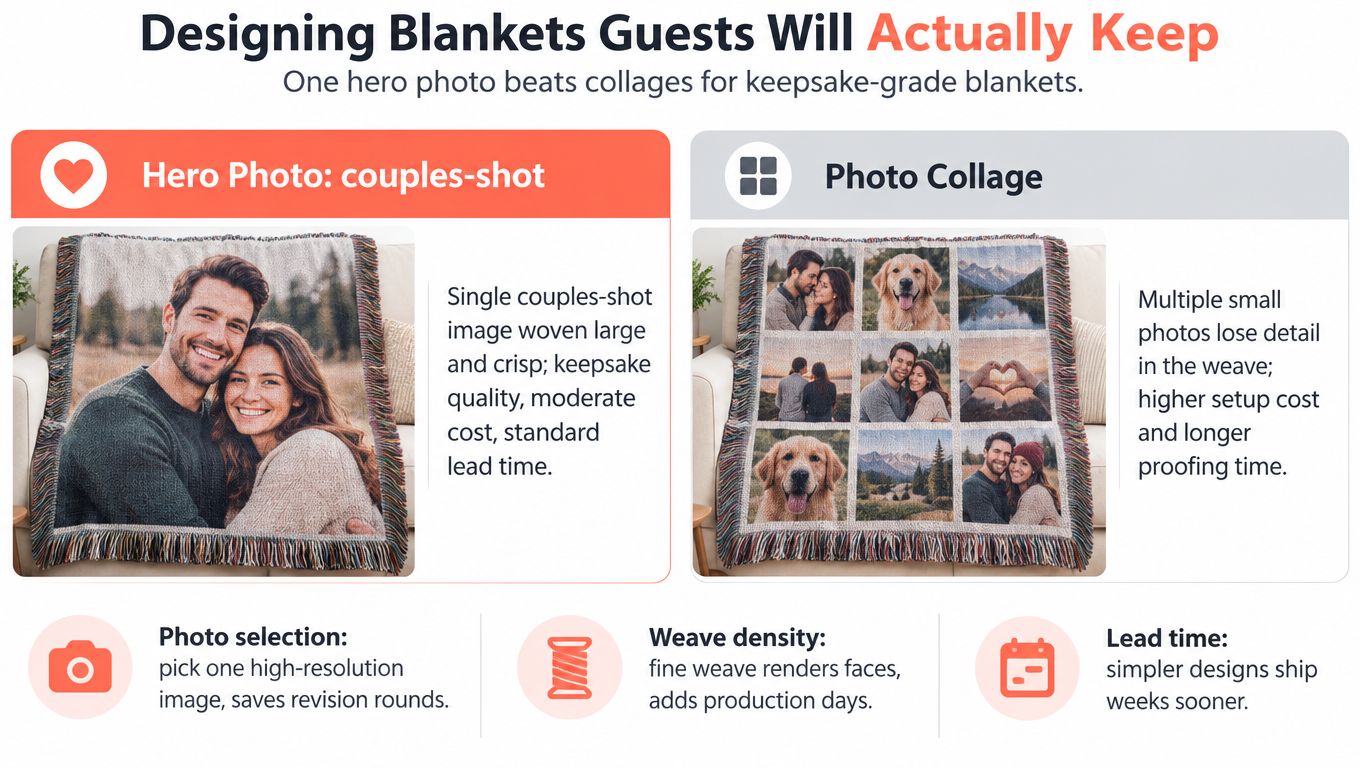
Use one high-resolution couples-shot photo when the blanket is meant to feel personal and heirloom-worthy. Faces remain recognizable at a useful scale, and guests immediately understand why the image matters. Group photos can be meaningful to you, but they often lose impact when every face becomes small.
Collages are tempting because they appear to offer more value. In practice, multiple small images can compete for attention and lose detail in the weave. If you want several memories represented, use a restrained layout with one dominant image and a small text element instead of filling every inch.
Choose the personalization format
A center monogram is the cleanest choice for traditional ceremonies and formal receptions. It usually requires less artwork preparation than an all-over photo, and it keeps the blanket visually calm. Names, initials, and a wedding date can sit at the center or near a corner, but don't crowd the design with a full paragraph.
An edge-to-edge photo carries more emotional weight and works well for intimate weddings, bridal-party gifts, and welcome gifts. It also requires more careful proofing because color, contrast, and facial detail cover the entire surface. A woven label at the hem is the most discreet option. It adds a maker-like finish without dominating the blanket.
For a deeper comparison of fabric behavior and texture, use this custom blanket materials guide before approving the final material.
Control color and material
Pull two colors from the wedding palette and pair them with a neutral backing. More colors don't automatically create a richer result, especially when woven edges or repeated production steps add complexity. A restrained palette also makes leftovers easier to use at home.
Fabric changes the message:
- Plush or sherpa: Feels luxurious and suits intimate or formal gifting.
- Fleece: Feels casual, practical, and appropriate for large outdoor receptions.
- Cotton: Reads more like an heirloom and works for a quieter, textile-led design.
Ask the vendor exactly how the personalization will age. A centered monogram remains legible when the blanket is folded. An edge-to-edge photo should have enough contrast to survive repeated use. A hem label offers the safest long-term branding because it doesn't compete with the image or pattern.
Ordering, Proofs, and Production Timing
The order isn't complete when you upload a photograph. It's complete when the vendor has approved artwork, confirmed the material, produced a representative sample, and provided a delivery date that leaves time for inspection.
Prepare files before upload
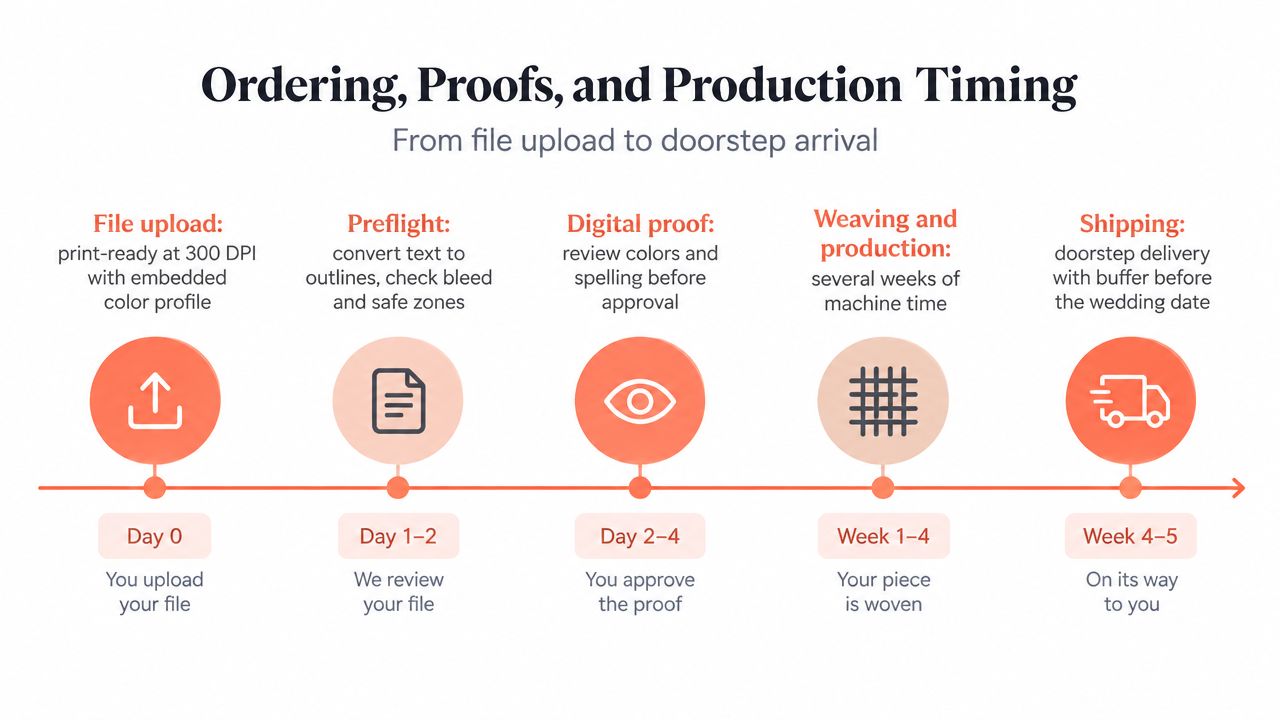
Work from the original photo rather than a compressed social-media download. Prepare the artwork at 300 DPI, embed the required color profile, convert text to outlines, and check bleed and safe zones. The production guidance for custom textiles recommends CMYK color mode, a custom palette, and preflight checks for bleed and supported backgrounds to reduce screen-to-print mismatch (print-on-demand blanket preparation guidance).
Two file problems cause avoidable rejection. Low-resolution photos become pixelated when enlarged, and light text placed on pale backgrounds loses contrast. Check both before submission, not after a proof arrives. This photo resolution guide for printing can help you evaluate image quality before you commit to a layout.
Use three proof stages
Request a digital mockup first. Check names, initials, dates, image cropping, placement, and spelling. A digital proof is useful, but it won't show the exact softness, weave density, or physical scale of the finished blanket.
Next, request a physical swatch or sample. Use this step to verify that skin tones, pale neutrals, and fine details behave acceptably on the chosen material. Finish with a final production proof after any revisions. Plan for 24 to 72 hours per proof stage, and keep feedback consolidated so the vendor isn't working from conflicting comments.
Work backward from delivery
Use this planning sequence:
- 12 to 16 weeks out: Source suppliers, compare materials, and review a sample.
- 8 to 10 weeks out: Lock the design and begin bulk production.
- 4 weeks out: Allow for shipping, receiving, and quality inspection.
- 2 weeks out: Keep a buffer for reprints or replacements.
Vendor lead times often exclude proof approval, weekends, customs processing, or holiday congestion. Ask whether production begins at payment, artwork approval, or physical sample approval. If your wedding falls near a major gifting season, confirm holiday capacity and rush-fee thresholds before placing a deposit.
For gift-shop presentation and complementary packaging supplies, this Aroma Warehouse wholesale supplies resource offers useful planning context, even when your main order is textile-based.
Packaging, Presentation, and Guest Distribution
A blanket can look generous or awkward depending on how you hand it over. Packaging should reveal the printed face, keep the fold secure, and tell guests whether they should use the blanket during the reception or take it home.
Pick one presentation system
| Method | Cost Per Unit | Assembly Time | Best For |
|---|---|---|---|
| Fabric ribbon and kraft tag | Moderate | Moderate | Rustic, garden, and formal welcome tables |
| Clear cello sleeve and custom label | Moderate | Low to moderate | Clean displays and easy guest selection |
| Welcome-bag placement with insert card | Moderate to premium | Low on site | Destination weddings and weekend events |
Ribbon ties have the strongest tactile effect, but they can loosen during transport. Use a tag that passes through the ribbon rather than sitting loosely on top. Cello sleeves show the artwork immediately and protect the blanket from dust, though they can feel less warm than fabric wrapping. Welcome bags are efficient for destination events, but the blanket must fit without crushing other essentials.
Fold the blanket so the primary photo or monogram sits on the outside panel. Avoid placing a sharp crease across a face or central text. Roll-style presentation works for fleece and casual designs, while a broad, flat fold usually suits woven or cotton blankets better.
Make the handoff self-explanatory
A distribution table needs a sign that answers the guest's question without requiring a coordinator. Use direct wording such as “Take a blanket if you're chilly, and keep it as our thank-you.” Place the table where guests naturally pause, not in the narrowest part of the entrance.
Assign one person to replenish the display and keep extras hidden beneath the table. If guests need blankets during the reception, distribute them at arrival or place them on chairs. If the blanket is primarily a departure gift, hand it out near the send-off, but schedule enough time to avoid a final-minute queue.
Unused blankets need a destination before the wedding. Keep a labeled storage bin for family gifts, bridal-party replacements, and shipping extras after the honeymoon. Don't leave the couple to decide this while loading the venue. A simple inventory sheet with quantities distributed, reserved, and remaining prevents confusion.
Budget Traps and Scaling Bulk Orders
Blankets are not automatically the smart spend. They're smart when the item solves a comfort problem or carries enough personal meaning to justify its size. If you're adding them only because the favor table feels empty, spend the money elsewhere.
Read the quote beyond the unit price
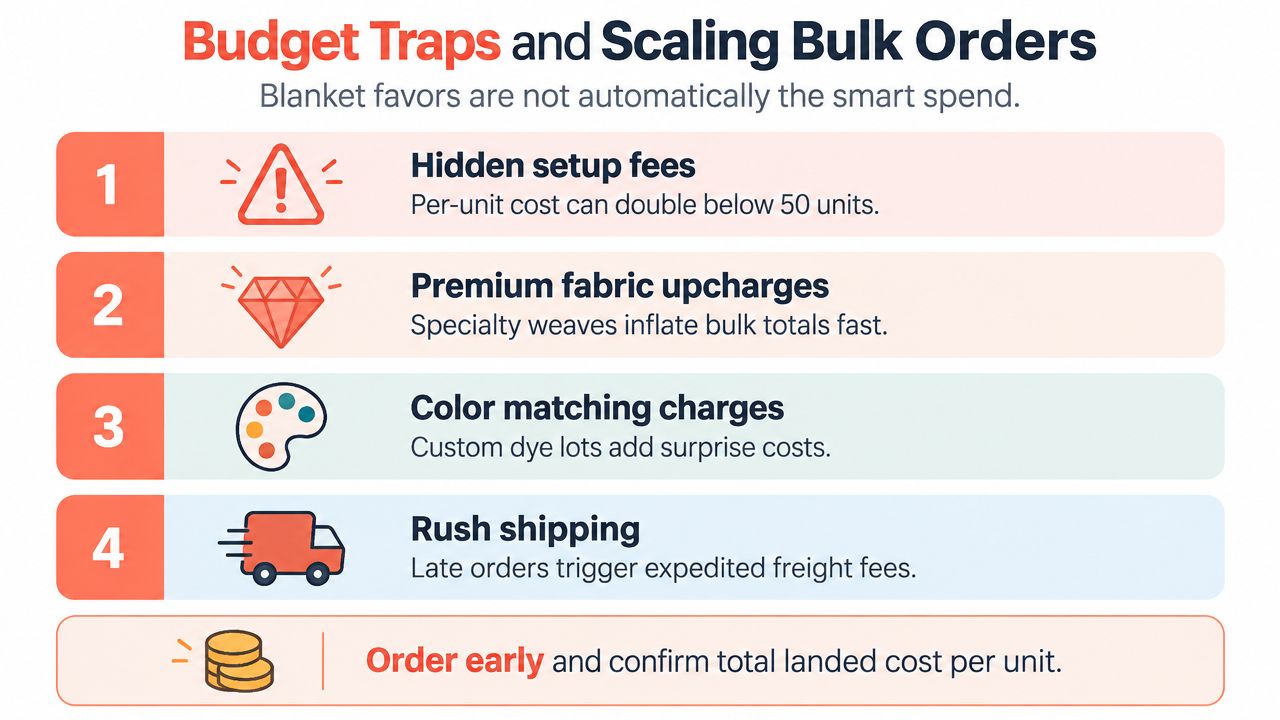
Ask for the full landed cost per blanket, including setup, artwork handling, sample production, packaging, shipping, and taxes where applicable. A low unit price can become unattractive when a small order carries fixed setup charges. Specialty fabric can also change the economics quickly, particularly when the production tier is designed for larger quantities.
Rush production is another predictable trap. A delayed guest count, late design approval, or missed proof can force expedited production and shipping. Confirm the exact date on which rush fees begin, whether the vendor can split shipments, and whether a reprint follows the original schedule or enters a new queue.
Scale with purpose
Doubling the number of units doesn't guarantee a proportional discount. Printers set pricing tiers, and the meaningful savings may stop after a threshold. Oversizing the order creates another problem, bulky inventory that may be difficult to store safely and easy to forget after the event.
Avoid three common mistakes:
- Ordering to the exact guest count: Build an overage for replacements and late changes.
- Ignoring production location: Domestic and overseas production can have very different timelines.
- Skipping the sample: A sample reveals material, color, and finishing problems before they multiply across the batch.
Budget rule: Order about 10% over the final count, keep a 15% cost buffer, and choose blankets only when the guest profile supports actual use.
The personalized gifting market provides context for the category's commercial scale. One market report values global personalized gifts at USD 33.42 billion in 2025 and projects USD 64.51 billion by 2034, while North America represents 33.63% share and weddings account for about 22.3% of personalized-gift revenue (personalized gifts market report). Those figures support the category's relevance, but they don't justify buying favors your guests won't use.
Your Blanket Favor Planning Checklist
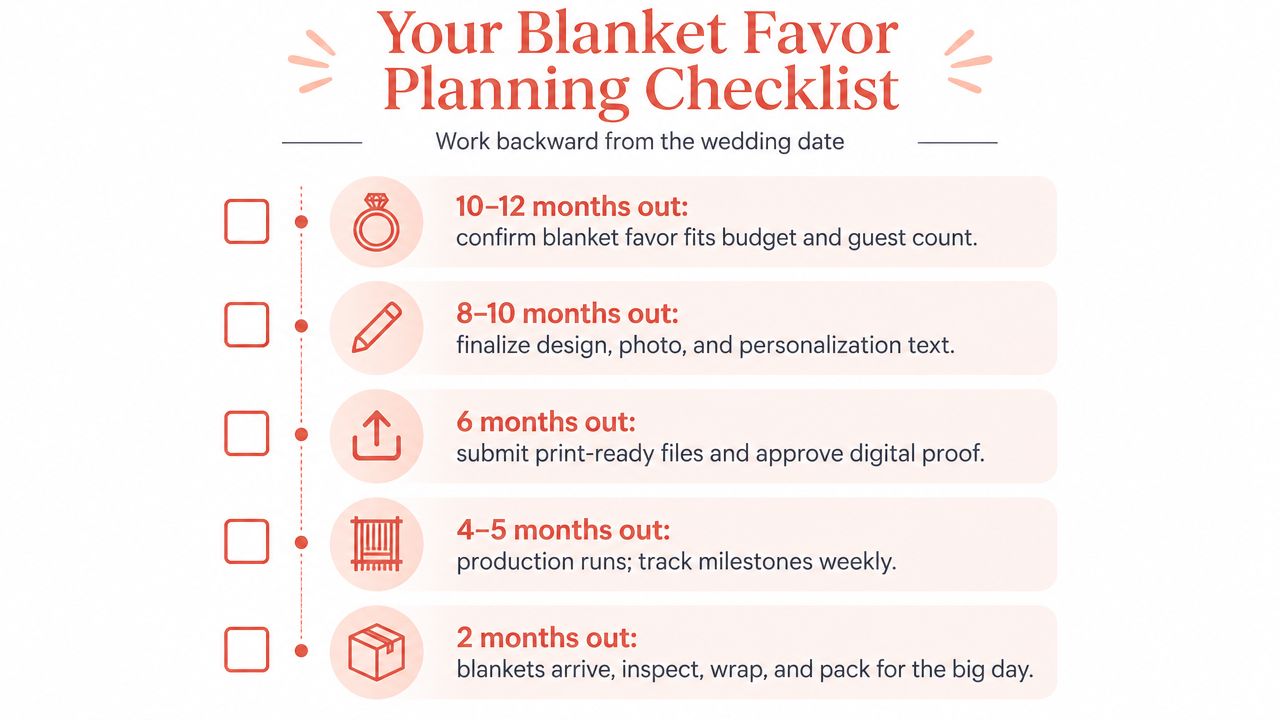
Pin this sequence to your wedding binder and make every milestone a decision checkpoint. You're not trying to finish every task early. You're trying to prevent one unresolved choice from delaying every task after it.
10 to 12 months before
Confirm that the blanket fits the wedding style, climate, guest profile, and favor budget. Divide your guest list into practical tiers, such as one per guest, one per couple, or selected gifts for family and the wedding party. Decide the maximum spend before you browse fabrics or personalization tools.
8 to 10 months before
Shortlist two or three suppliers and request material swatches plus printed proofs. Lock the design direction, including photo resolution, monogram versus repeat pattern, image placement, and edge finishing. If you're considering a custom photo layout, select the hero image now and ask how the vendor handles cropping and contrast.
6 to 8 months before
Approve the final proof and place the bulk order with a 10% to 15% overage for late RSVPs and replacements. Confirm production and shipping milestones in writing, including the date artwork is locked and the point at which changes become chargeable.
1 to 2 months before
Receive the shipment and inspect every blanket for print defects, color shifts, stitching flaws, loose finishing, and incorrect personalization. Sort the inventory by ceremony role if certain blankets are reserved for parents, the wedding party, or welcome rooms. Photograph any defects and report them immediately while the order record is accessible.
One week before
Fold and package the blankets, attach tags, prepare signage, and stage the inventory in labeled boxes. Give the venue coordinator a distribution map and assign one person to replenish the display. Keep a small reserve separate from the public table so replacements don't become a scramble.
Seasonal timing matters beyond the wedding calendar. November and December should be planned around holiday gifting, when NRF says retail sales in those two months account for about 19% of average total retail sales and consumers expect to spend about $890 per person on holiday gifts, food, decorations, and seasonal items (NRF winter holiday data). Another holiday outlook reports that 39% of planned holiday gift spending occurs between Thanksgiving and Cyber Monday, with nearly 80% of holiday gift budgets spent by the end of Cyber Monday (PwC holiday outlook). If you're buying a wedding gift or ordering a wedding-related blanket during that window, act before seasonal demand tightens production and shipping capacity.
April and May should be planned around Mother's Day gifting. Northwestern Medill reports average Mother's Day spending of $284.25 per person and a total economic impact of $38.0 billion in 2026, while search interest based on Google Trends observations remains high from the final week of April through early May (Northwestern Medill Mother's Day report). That makes a personalized blanket a strong option for mothers of the couple, grandmothers, or family thank-you gifts, but you should place the order before the seasonal rush rather than waiting for the final week.
If you're ready to compare designs, Custom Photo Blankets can be evaluated alongside monogram, woven, sherpa, and other formats based on the guest tier you selected. That Blanket Co offers custom photo blankets in throw, twin, and queen sizes, with photo, text, monogram, star-map, heart, floral, and children's themes, plus machine-washable fabric options and free shipping. It reports production and shipping typically within 2 to 3 business days, so verify the current timing for a wedding batch before relying on it for a fixed event date.
That Blanket Co offers custom photo blankets in multiple sizes and styles, including personalized photo, monogram, woven fringe, and sherpa options that suit wedding favors and family gifting. Visit That Blanket Co to upload your image, review the design, and choose a blanket format that matches your guest list, season, and presentation plan.