


Personalized Collage Photo Blanket Guide for 2026
You've found the perfect family photos for a gift, but one question keeps getting in the way: will they look beautiful on fabric, or blurry and crowded? A personalized collage photo blanket isn't just a collection of uploaded images. It's a small design project where image quality, cropping, spacing, fabric texture, and printing method all shape the final result.
The strongest blanket feels intentional from across the room and rewarding up close. This guide will help you choose the right concept, prepare photos, compare materials, review your proof, and care for the finished keepsake.
Why a Personalized Collage Photo Blanket Feels Like the Perfect Gift
On a holiday morning, a child may notice the blanket's softness first. Then they find a familiar face. They trace a grandparent's smile with one finger, point to a family pet, and recognize a photograph from a beach trip that happened years ago. The blanket becomes more than something warm. It becomes a story they can hold.
That emotional combination explains the appeal of a personalized collage photo blanket. It gathers separate moments into one useful object, allowing a recipient to revisit memories while relaxing on a sofa, reading in bed, or settling into a favorite chair. Unlike a generic gift, it reflects the recipient's actual relationships, places, and milestones.
A grandparent might receive a family collage that brings children and grandchildren into the same visual space, even when everyone lives far apart. A graduate might receive a timeline of school memories, family portraits, and celebratory moments. A couple might see their relationship unfold through engagement photographs, wedding memories, travel snapshots, and quiet everyday scenes.
The format also works especially well for wedding gifting. If you're collecting ideas beyond conventional registry items, a thoughtful creative wedding gift guide can help you consider how a useful home object can also carry a personal story.
Design principle: The blanket should feel like a curated memory collection, not a folder of photographs transferred onto fabric.
Personalized gifts are now a substantial commercial category. One estimate places the global personalized gifts market at USD 33.70 billion in 2025, with a projection of USD 69.20 billion by 2033 and a projected 9.40% CAGR, while another estimate values it at USD 30.79 billion in 2025 and forecasts USD 45.09 billion by 2030 (Data Bridge Market Research). Those figures cover a broad category, not collage blankets alone, but they show why memory-driven home goods have room to develop as meaningful, practical gifts.
What Makes a Collage Photo Blanket Different
A single-image blanket gives one photograph the entire surface. A repeating-pattern design tiles the same photograph across the fabric. A collage blanket takes a different approach by arranging several photographs into one visual composition.
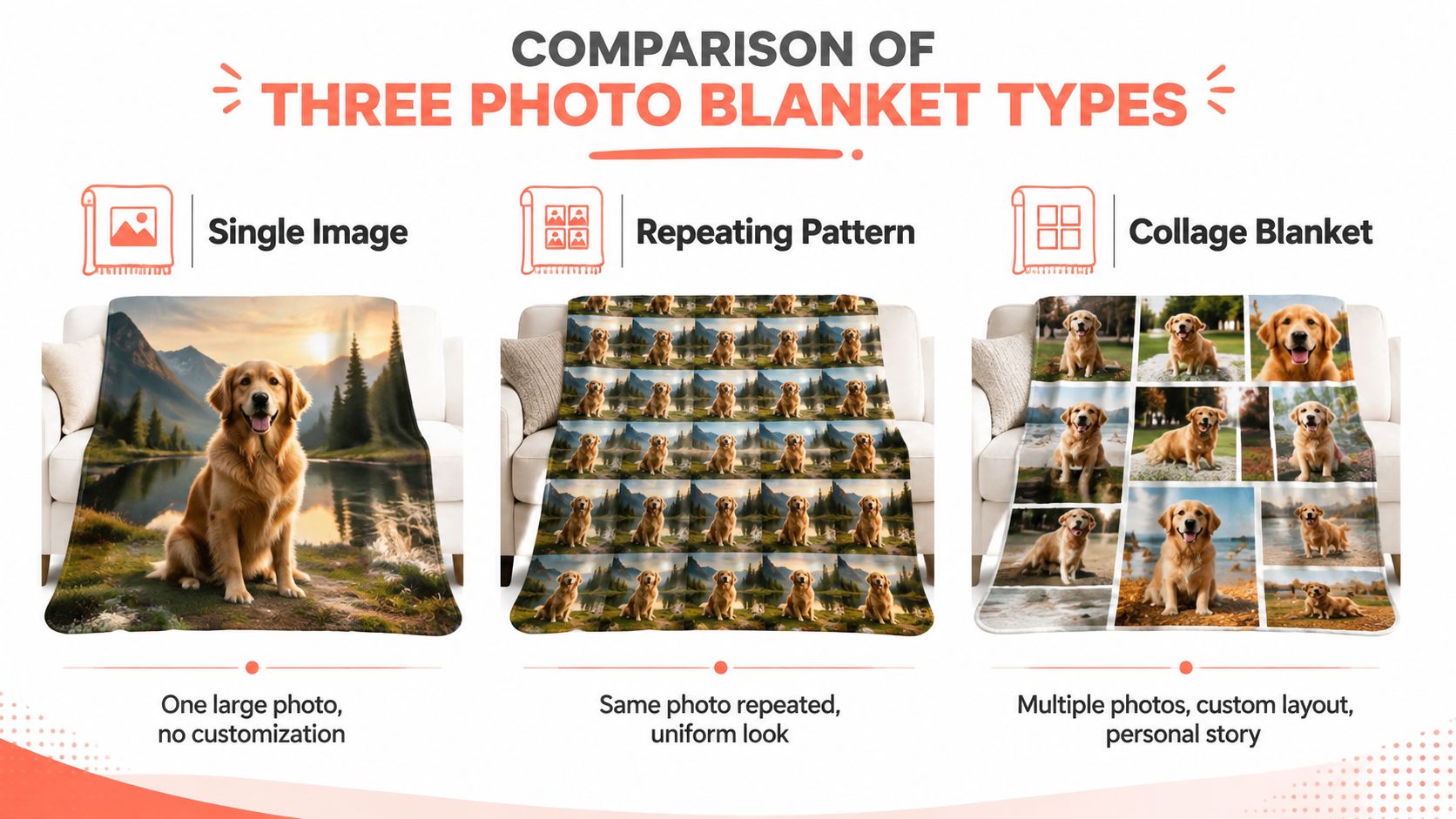
The collage format gives you more storytelling power, but it also gives you more decisions to make. Start with the number of images. A small set of strong photographs usually looks more polished than a crowded arrangement where every face becomes tiny. If you're making a family gift, group photographs by relationship, life stage, or event rather than uploading images at random.
Build the layout around the story
A grid layout creates order. It works well for portraits, school milestones, or a family collection where each photograph deserves similar visual weight. Shape-based designs, such as hearts or initials, create a more decorative effect, but their irregular spaces can crop photographs differently.
Choose the background with contrast in mind. A light background can create a gallery-like border around colorful photos, while a darker background may make bright images stand out. Optional names, dates, or a short message can identify the story, but text should support the images rather than compete with them.
Edge finishing matters, too. A clean bound edge gives a polished appearance, while fringe or a softer decorative finish can make the blanket feel more relaxed. The best choice depends on whether the blanket will function mainly as a display layer, a comfort item, or both.
Choosing Sizes, Fabrics, and Print Quality
Size determines how the blanket will live in the home. A throw suits a sofa, reading corner, or armchair. A twin-sized blanket offers more coverage for a child's bed or single sleeper. A larger blanket can work as a bed layer, but the design needs enough source detail to remain clear across the wider surface.
Fabric changes both touch and image presentation. Smooth polyester fleece generally gives photographs a flatter printing surface, while sherpa adds warmth and texture but can make the overall item feel bulkier. Plush fabrics prioritize softness, and woven cotton can create a more traditional textile appearance, though woven construction may represent photographic detail differently from a smooth printed surface.
Print method deserves equal attention. Dye sublimation infuses dye into polyester fibers instead of leaving a coating on top, which helps the image resist cracking or peeling during normal use. Digital printing can support detailed artwork on suitable textiles, while woven jacquard creates the image through the structure of the fabric itself. Each method balances softness, texture, color, and detail in a different way.
Expert guidance for large-format textile printing recommends approximately 300 DPI at the intended blanket size, while artwork below roughly 150 DPI can appear soft or pixelated after scaling (RareCustom's photo blanket printing guidance). For a 50 × 60 inch blanket, optimal sharpness would require artwork around 7,500 × 9,000 pixels, although the exact requirement depends on the printer and design system.
| Size | Fabric | Print Method |
|---|---|---|
| Throw for sofas and chairs | Smooth fleece for clearer photographic detail | Dye sublimation for an infused print |
| Twin for beds and personal comfort | Sherpa or plush for added warmth | Digital print or dye sublimation, depending on the textile |
| Larger bed layer | Fleece, sherpa, plush, or woven cotton according to use | Dye sublimation or woven jacquard, depending on the desired finish |
For a deeper material comparison before choosing, consult this fleece, sherpa, and woven blanket materials guide. Custom Photo Blankets should state the fabric and print process clearly, because shoppers shouldn't have to guess whether they're choosing a photo-forward surface or a texture-forward blanket.
Getting the Best Photos for Your Collage Blanket
Good phone photographs can work well, especially when they were taken in natural light and saved at their original quality. The important question isn't whether a photo came from a professional camera. It's whether the file contains enough information for the space it will occupy.
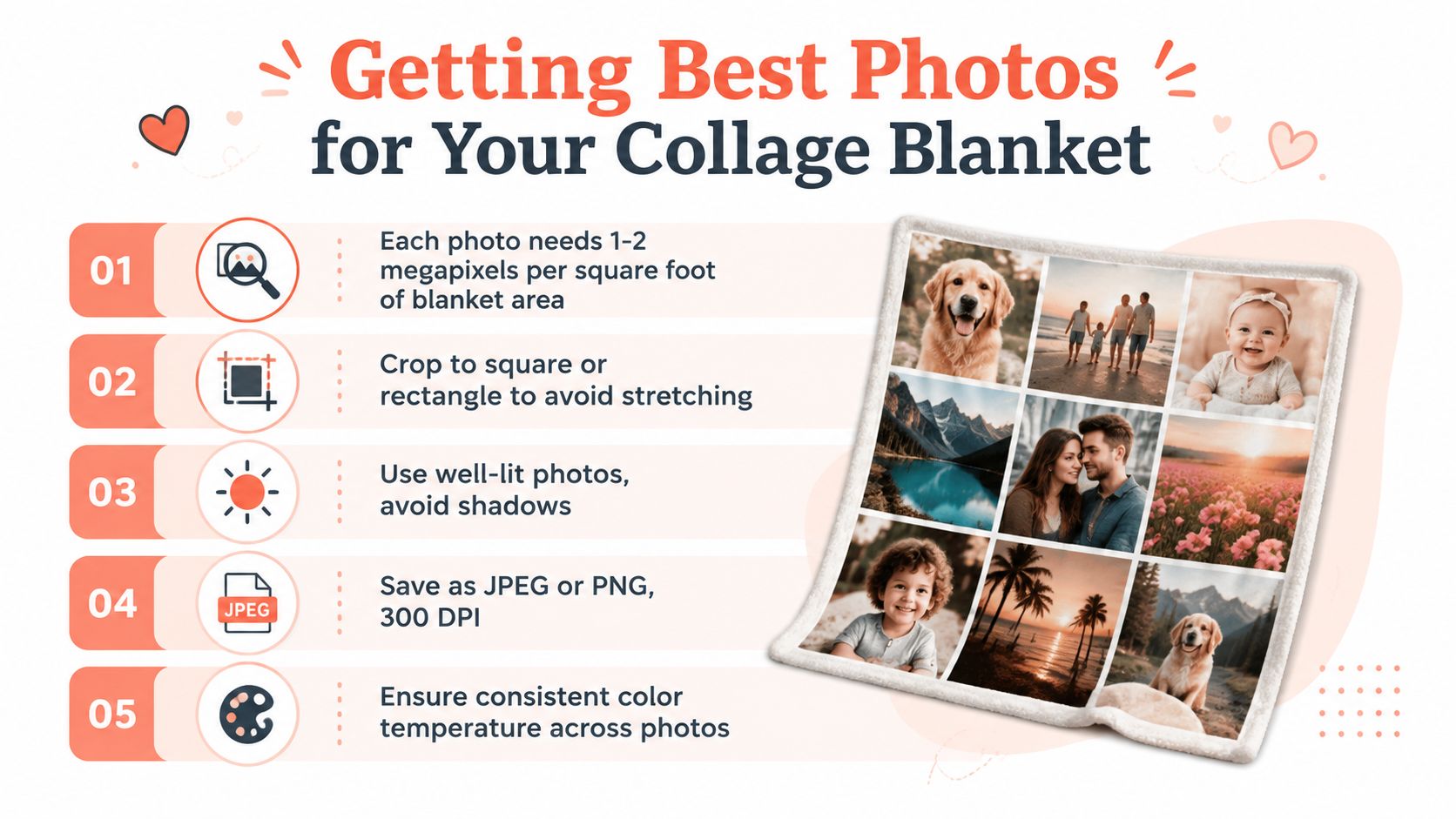
A practical rule of thumb is 1 to 2 megapixels per square foot of blanket area, as reflected in the supplied photo-preparation guidance. Large-format textile printing guidance also recommends approximately 300 DPI at the intended size, so review the printer's upload warnings rather than relying only on how sharp an image looks on your phone.
Prepare each image before uploading
Crop portraits and images deliberately. A vertical photograph may need a portrait panel, while a wide travel scene belongs in a horizontal space. Keep faces away from the outer edge of a panel, because trimming, seams, and rounded design elements can remove important details.
Use balanced exposure and consistent color. A very dark image may lose facial detail on fabric, while heavy filters can produce uneven skin tones or oversaturated colors beside unedited photographs. Saving images as JPEG or PNG and keeping a backup folder protects your original memories during the design process.
Avoid screenshots, social media downloads, and heavily compressed files whenever possible. Those versions may contain less detail than the original camera file, even if they look acceptable in a small digital preview. The photo resolution guide for printing offers useful preparation context before you begin.
Use this short checklist:
- Resolution: Choose the original file and check the design tool's quality warning.
- Framing: Crop to the panel shape without stretching faces or bodies.
- Lighting: Favor images with visible facial detail and controlled shadows.
- Color: Keep exposure and color temperature reasonably consistent.
- Backup: Save the selected files separately before uploading.
Popular Ways to Use a Custom Photo Blanket
A custom photo blanket works best when the design matches the recipient's daily life. A grandparent's blanket might use a family-tree arrangement, with portraits grouped by household or generation. A soft fleece surface can keep smaller facial details clearer, while a larger size gives the collection enough room to breathe.
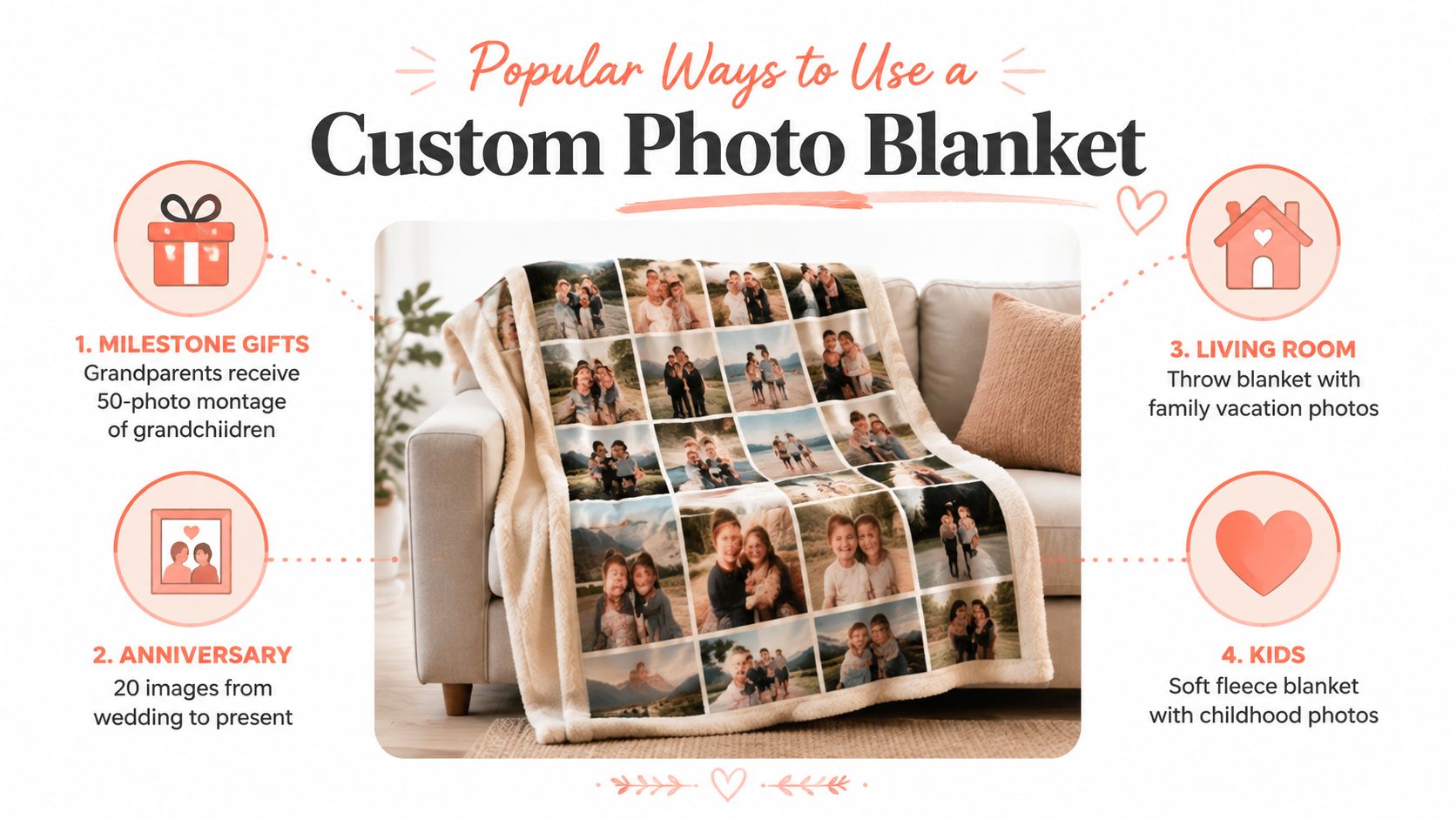
For a couple, build a visual timeline rather than selecting only formal portraits. Start with an early photograph, add travel memories and shared celebrations, then finish with a recent image. A symmetrical grid can make the progression easy to follow, while a heart or monogram design gives the blanket a more decorative role in a bedroom.
Graduation gifts benefit from a clear beginning and ending. Combine childhood photographs, school activities, family support, and the graduation moment. A throw works for a dorm room or first apartment, while a larger blanket can become a lasting family keepsake.
Match the design to the season
November and December should center on holiday gifting. A family collage, pet portrait collection, or year-in-review blanket gives the recipient something personal and useful during the holiday season. Order early enough to allow for design review and production, especially if you're working with many contributors.
April and May are natural months for Mother's Day gifting. Mother's Day in the United States falls on the second Sunday in May, and mother-focused blanket promotions commonly appear from late April into early May (Zazzle's Mother's Day blanket collection). Include children, grandchildren, family traditions, or photographs that show ordinary moments rather than only posed occasions.
Other strong concepts include:
- Nursery décor: Use a restrained set of family, pet, or milestone photos and choose a soft fabric suitable for gentle everyday use.
- Pet memorials: Build the design around expressive portraits, favorite places, and a discreet name or date.
- Housewarming gifts: Use travel scenes or family photographs that complement the recipient's room colors.
- Group gifts: Ask relatives or friends to contribute photographs for an anniversary, retirement, or milestone celebration.
The collage becomes most successful when every image has a reason to be there.
How the Ordering Process Works Step by Step
Most custom blanket orders follow a straightforward path, but careful review matters at every stage. You're not only buying a size and fabric. You're approving a visual arrangement that will be reproduced at a much larger scale than the screen preview.
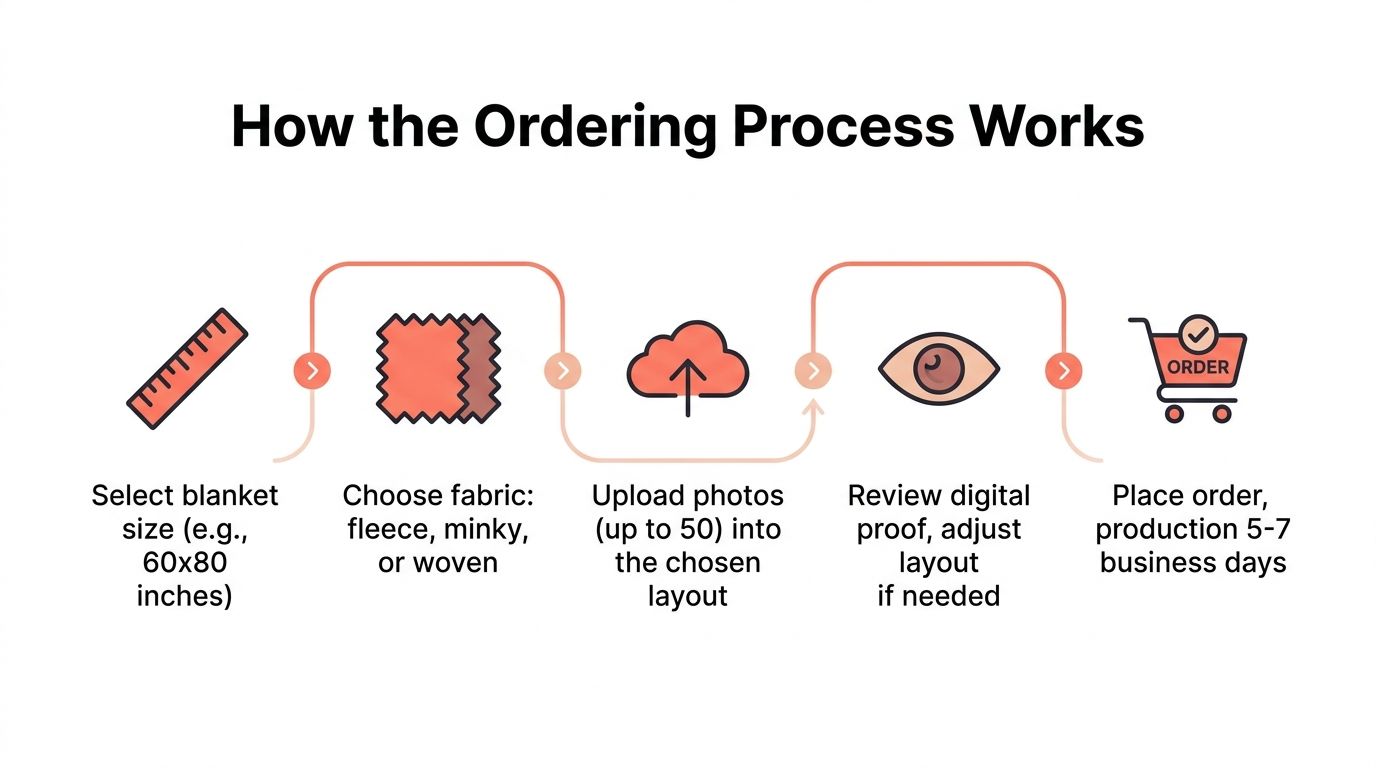
- Select the dimensions. Decide whether the blanket belongs on a sofa, a single bed, or a larger sleeping surface. Think about coverage before choosing the design, because the available area determines how large each photo can appear.
- Choose the textile. Compare fleece, sherpa, plush, and woven options according to warmth, texture, and image clarity. Read the care label before ordering if the recipient will wash the blanket frequently.
- Upload and arrange. Add your images to a design tool or template. Check every frame for the correct orientation, especially when portrait and horizontal photographs are mixed.
- Inspect the digital proof. Look for faces near edges, missing text, awkward crops, dark photographs, and uneven spacing. A proof is the moment to request adjustments, not after production begins.
- Confirm the order. After payment, keep the confirmation email and tracking details. Production and shipping estimates vary by supplier, and rush options may be available during busy gifting periods.
If a photograph looks wrong in the preview, contact customer support through the available chat, email, or design-assistance channel before approving the order. The custom blanket ordering process can also clarify what happens between customization and delivery.
When the package arrives, inspect the blanket before washing it. Check the overall layout, edge finishing, colors, and any printed wording. If something appears damaged or differs from the approved design, photograph the issue and contact the supplier promptly.
Caring for Your Personalized Blanket
The first wash sets the tone for long-term care. Follow the supplier's label, but personalized blankets are commonly washed on a cold or gentle cycle and dried with low heat or air circulation to protect the printed image (Bags of Love's personalized blanket care guidance).
Use mild detergent and avoid bleach, fabric softener, ironing, and high heat. Bleach can damage color, softener can leave residue on fleece fibers, and direct heat can weaken synthetic fibers or reduce the blanket's soft finish. Washing the blanket alone, or with similar fleece items, can also reduce snagging and friction.
Let the fabric guide the routine
A smooth fleece blanket is usually easier to wash and dry than a thick sherpa style. Sherpa may need more room in the washing machine and more careful drying so the fluffy backing doesn't mat. Woven cotton may respond differently to moisture and shrinkage, so its care label deserves particular attention.
Treat a fresh stain locally instead of immediately subjecting the entire blanket to aggressive cleaning. Blot the area with cool water and a small amount of mild detergent, working from the outside toward the center. Test any cleaning approach on an inconspicuous area first, and avoid scrubbing directly across printed faces.
Dye-sublimation printing can improve wash resistance because the dye becomes part of the polyester fiber rather than forming a surface coating. Industry specifications commonly call for 300+ DPI artwork and report colorfastness in the 4+ range, while one manufacturer states that it saw no visible fading after 50 normal wash cycles (CanvasDiscount's custom photo blanket specifications). These are supplier-specific claims, not a universal guarantee, so gentle care still matters.
A blanket ages normally when the fabric gradually softens, edges show ordinary wear, or light pilling appears from friction. Blotchy color loss, peeling, cracking, or a print that separates from the surface indicates a potential production or care problem.
Store the blanket clean and fully dry, folded loosely in a breathable cupboard. Don't compress it under heavy objects for long periods, and keep it away from direct sunlight when it's displayed continuously. For an heirloom piece with sentimental value, professional cleaning may be worthwhile if the label permits it and a serious stain cannot be treated safely at home.
The practical expectation is simple: a personalized blanket is made to be used, but gallery-like appearance depends on matching the fabric to the purpose and treating the printed surface gently.
That Blanket Co lets you upload favorite images and create collage layouts in throw, twin, and queen sizes, with machine-washable fabric options designed for personalized home comfort. Visit That Blanket Co to start arranging your photos into a custom blanket for a holiday, Mother's Day, milestone, or everyday family keepsake.