


Personalized Letter Blankets: Styles, Designs & Care
A personalized letter blanket turns everyday comfort into a meaningful keepsake by combining readable typography, carefully chosen photos, and soft materials in one gift. The best designs balance emotional detail with long-term usability, so the blanket still feels right as a child grows or a family's home changes.
You may be choosing a baby gift, preparing for the holiday season, or trying to make a family photo feel more substantial than a framed print. A name, initial, or short message can change how someone experiences an ordinary blanket. Instead of serving only as a cover, it becomes something they recognize by touch and sight, then keep close through naps, bedtime, travel, or quiet moments on the sofa.
The strongest designs don't begin with every available customization option. They begin with one question: what should the recipient feel when they see and use this blanket years from now?
Why Personalized Letter Blankets Make Meaningful Gifts
A grandmother opens a gift box and finds a blanket marked with her grandchild's name. She may notice the lettering first, but the emotional response usually comes from the combination of details: the familiar name, the softness of the fabric, and the sense that someone selected each element for her. A photo can preserve a face, while a blanket creates a repeated physical ritual around that memory.
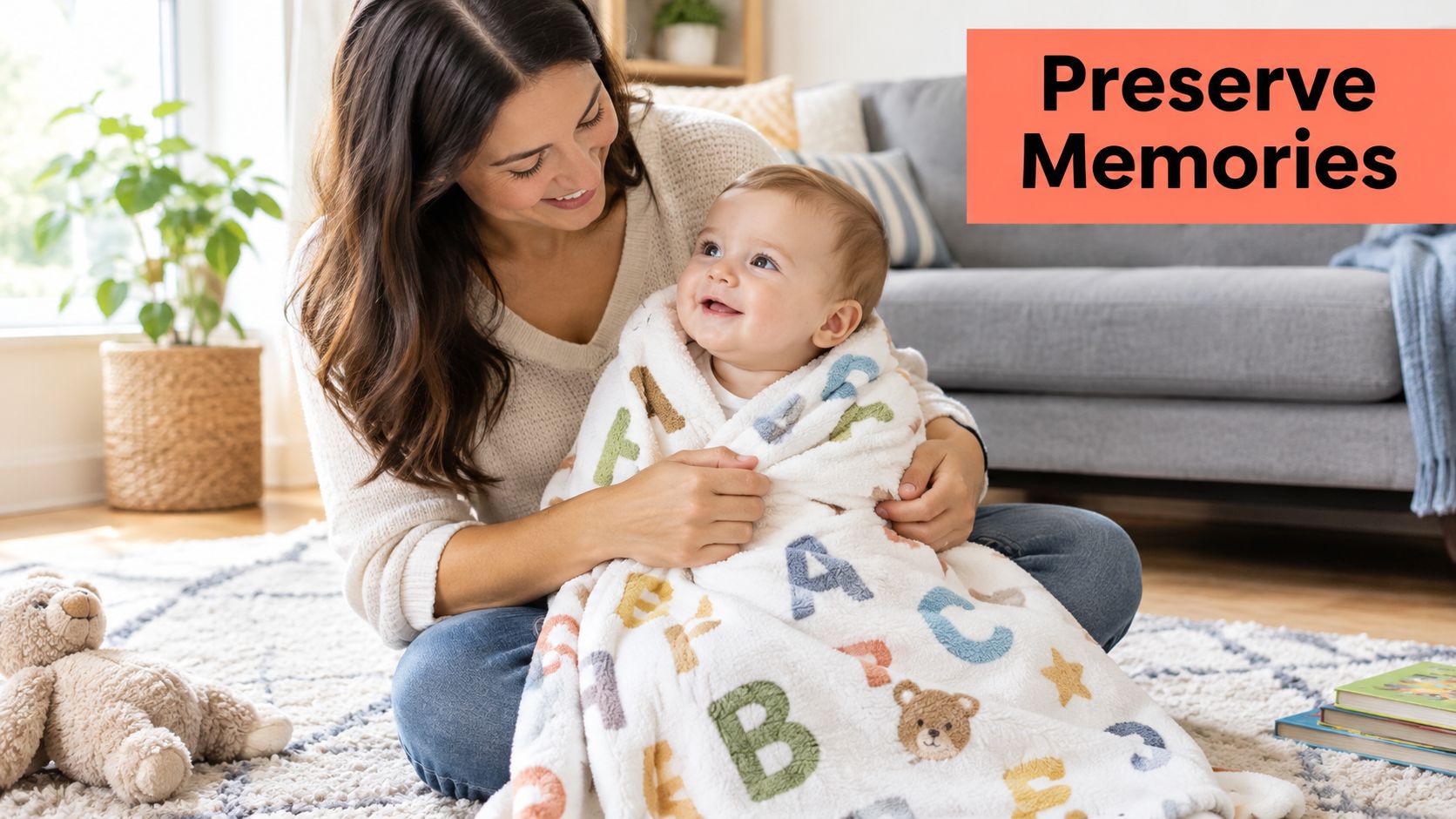
Personalized bedcovers have served this role for generations. A documented 1883 American quilt included a dedication embroidered in red wool cross-stitch around its central star, reading, “To Edna from J. C. McK. Dec. 25th 1883.” The quilt functioned as household equipment, but it also recorded a relationship, a gift, and a specific occasion. The documented quilt example shows why names and initials feel more significant on textiles than they might on a disposable object.
Why texture changes the memory
A letter blanket engages more than visual memory. The recipient sees a name or initial, feels the fleece or woven surface, and associates the object with familiar places such as a nursery chair, a shared sofa, or a child's bed. That repeated contact can make the keepsake part of daily life rather than something stored for special occasions.
The historical appeal is also practical. A 1935 issue of Home Arts, Needlecraft published instructions for crocheting letters onto towels and blankets, describing handmade lettering as adaptable to a textile's border and color scheme. Modern blankets may use digital printing, embroidery, or appliqué, but the underlying purpose remains similar: utility, identity, and memory in one object.
Practical rule: Choose the personalization that tells the clearest story, not the design with the greatest number of elements.
Match the style to the recipient. A single initial can suit someone with a restrained, traditional taste. A full name with playful shapes may work better in a child's room. For a wedding or anniversary, a shared initial, date, or short phrase can feel more intentional than a collage crowded with unrelated images. For a grandparent, a carefully selected family photo with a simple name band may feel warm without becoming visually busy.
Understanding Monogram and Name Blanket Styles
The first choice is usually between a monogram blanket and a full-name or name-banding blanket. Both can be personal, but they communicate identity differently.
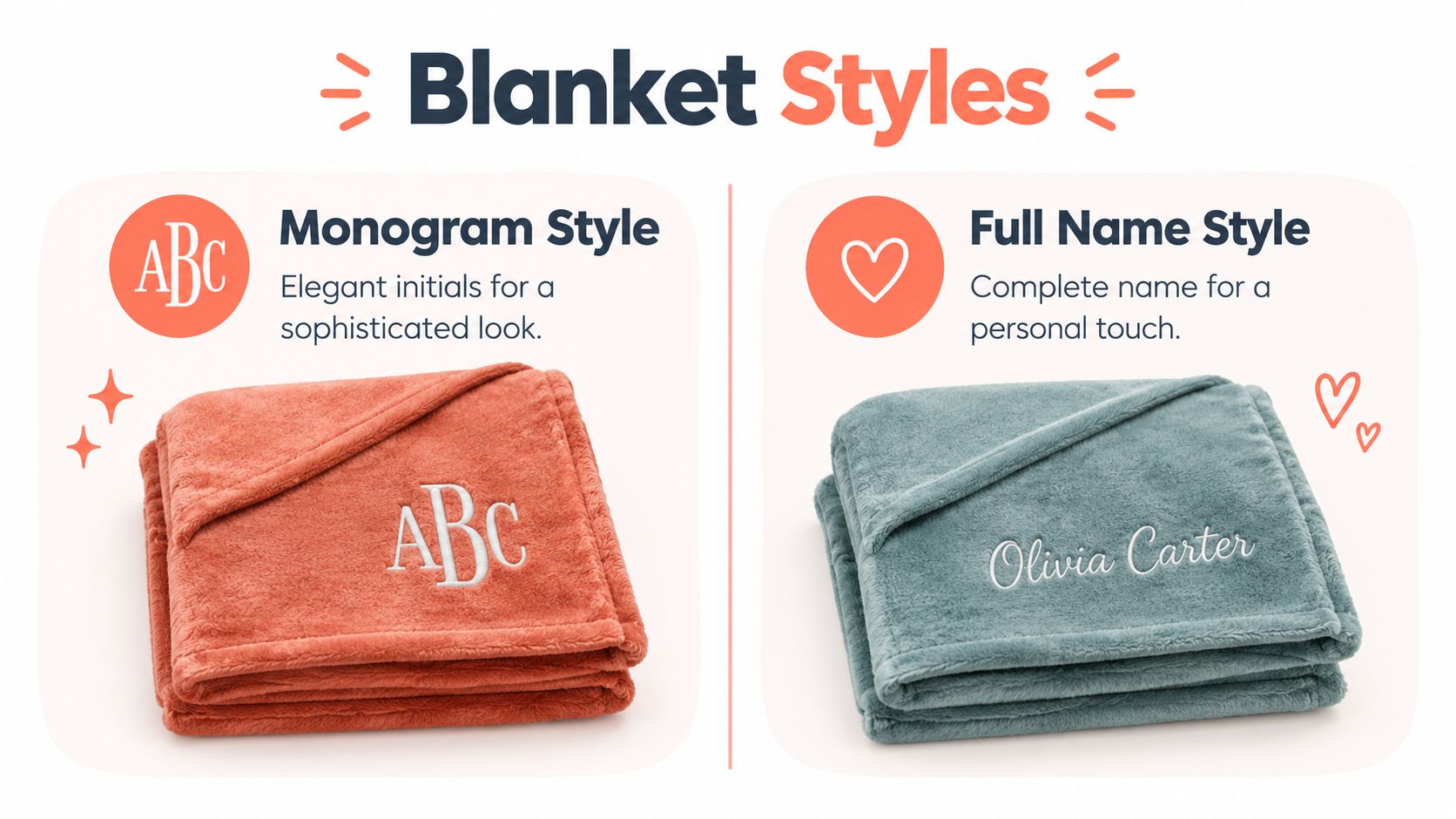
Monogram style
A monogram uses one or more initials as the visual focal point. It creates a quieter, more decorative result because the viewer interprets the letters as a symbol rather than reading a complete word.
Choose this approach when:
- The room has a classic look: Serif lettering and restrained colors can suit traditional furniture, heirloom décor, or a refined nursery.
- The recipient values subtlety: A single initial feels personal without covering the blanket in text.
- The blanket will stay useful for years: An initial can remain appropriate through changing ages, room themes, and family routines.
- You want a strong centerpiece: Place the letter in the center, then give it generous empty space so it feels deliberate rather than isolated.
Check the order of initials before approving a traditional monogram. Some monogram conventions place the surname initial in the middle, while other designs use initials in ordinary name order. If the recipient may interpret the arrangement differently, a full first name or a clearly labeled initial can prevent confusion.
Full-name and name-banding style
A name band places a first name, family name, phrase, or short dedication along an edge, across the middle, or inside a border. It makes the message immediately readable and often feels more welcoming for babies and children.
Use it when:
- The recipient is young: Children respond to seeing their own name, especially in a nursery or bedroom.
- You're marking a family event: A short date or phrase can identify a birth, wedding, anniversary, or new home.
- The blanket includes a photo: Text can frame the image instead of competing with it.
- You want recognition from across the room: Larger, simpler lettering reads more reliably than fine script.
Overcrowding is the most common mistake. A long name, several photos, decorative motifs, and multiple fonts may each look attractive in isolation, but together they weaken hierarchy. Decide which element should be noticed first, then make the other elements support it.
A useful resource for comparing personalized textile concepts is staff gift blanket ideas, especially when you're considering a consistent visual style for several recipients. For more inspiration around age-appropriate monogram choices, browse monogrammed blankets for girls, then simplify the idea to fit the recipient rather than copying every decorative detail.
Selecting Fonts and Colors for Your Design
Typography determines whether a blanket feels timeless, playful, formal, or modern. Color determines whether the lettering stays visible after printing and whether it belongs naturally in the room.
A serif font has small finishing strokes and often gives initials a traditional, bookish character. It works well for a grandparent gift, a classic nursery, or a wedding keepsake. A sans-serif font has cleaner lines and usually feels more contemporary. It can make a child's name easier to read and pairs well with simple geometric motifs.
Script fonts create warmth, but they need caution. Thin connections, flourishes, and tightly joined letters can disappear against a textured fleece surface or become difficult to read from across a room. If you love a script style, use it for a short word or small accent, not a long message.
| Desired impression | Font direction | Color approach |
|---|---|---|
| Traditional and refined | Serif capitals | Deep lettering on a light ground |
| Clean and contemporary | Simple sans-serif | Strong contrast with limited decoration |
| Playful and youthful | Rounded display lettering | Cheerful accent color with clear outlines |
| Soft and sentimental | Moderate script for short text | Muted background with dark, readable text |
Compare the design at two distances
Look at the design as a thumbnail first. This reveals whether the main letter or name has enough visual weight. Then view it at room distance, because a blanket placed on a bed or sofa won't always be examined close up.
Contrast matters more than matching every color in the room. A pale letter on a pale fleece may look elegant in an online preview but lose definition on the finished textile. Dark lettering against a light background, or light lettering against a darker field, usually gives the recipient a clearer reading experience.
For a photo-and-text arrangement, choose a text color that appears in the image without blending into its busiest area. More guidance on combining imagery and lettering appears in this custom photo blanket with text reference. Keep the typeface count restrained. One primary font and one supporting style are usually easier to understand than several competing treatments.
Layout Options and Customization Choices
Layout isn't merely decoration. It determines where the eye lands, how easily someone reads the name, and whether the design can adapt to a different room later. A nursery blanket can handle a more playful arrangement, while a living-room throw usually benefits from a calmer focal point.
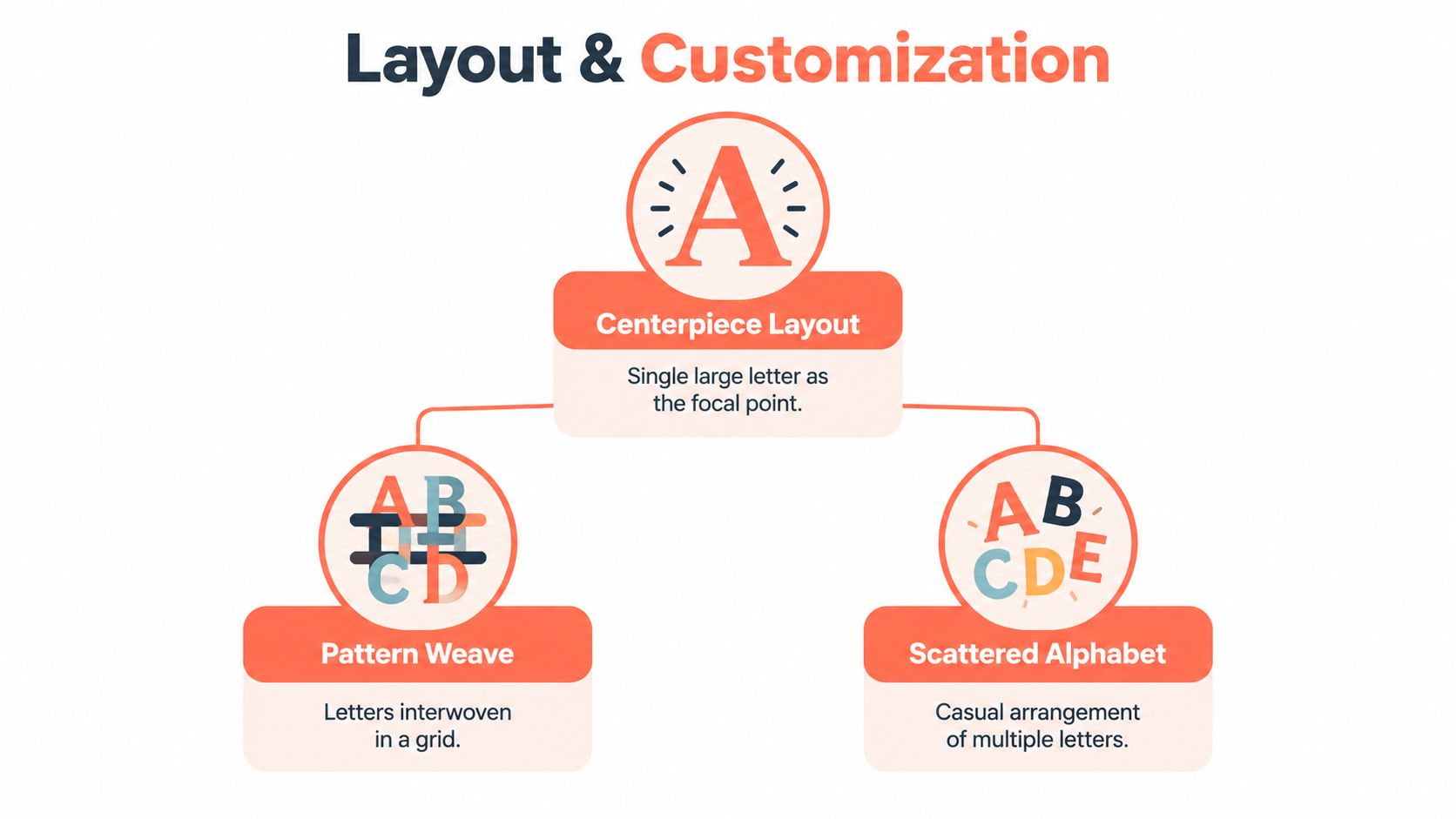
Centerpiece layouts
A single large letter creates a clear visual anchor. This format suits a monogram gift, a neutral bedroom, or an older recipient who may prefer restrained personalization. Leave breathing room around the letter. Empty space isn't wasted fabric, it gives the main symbol authority.
Pattern weaves
A repeated grid of letters can create rhythm across the surface. It works especially well for alphabet learning, coordinated siblings' blankets, or a nursery where the pattern needs to feel active without relying on a large photograph. Keep the repeated letters consistent in scale and spacing so the design looks intentional.
Scattered alphabets
A casual arrangement of letters feels playful and works naturally for children's rooms, reading corners, and baby gifts. It can include an initial, surrounding alphabet characters, or a few words. The risk is visual noise, so group related elements and reserve a quiet area for the child's name.
The recipient's age should guide the density. Babies and toddlers may benefit from high-contrast, simple forms that remain legible as they grow. Older children may enjoy a more energetic pattern, but they still need one unmistakable focal point. Adults often appreciate a layout that behaves like home décor first and personalization second.
Material changes the visual result as well. Smooth fleece can show fine printed detail clearly, while sherpa adds texture that may soften small letter edges. Woven surfaces can create a more structured appearance, and fringe contributes movement around the perimeter. Select the material according to use, then adjust the typography to suit its surface rather than assuming every font will reproduce identically.
Before ordering, check the safe margins, spelling, crop points, and the way the blanket will look when folded. A name near an edge may disappear under a pillow or over a sofa arm. A centered design usually survives folding more gracefully because the primary message remains visible.
Best Occasions for Gifting Personalized Blankets
A personalized blanket fits occasions where the gift needs to feel both useful and memorable. A new parent may receive a name blanket for the nursery, a couple may choose a shared initial for an anniversary, and a grandparent may value a family photo more than another decorative object.
November and December holiday gifting
Holiday shoppers often start earlier than the final rush. The National Retail Federation's holiday FAQ reports that November and December holiday sales have averaged approximately 19% of total annual retail sales over the past five years, and about two out of every five holiday shoppers have started browsing or buying before November. That timing makes a personalized letter blanket a strong planning choice for family gifting, especially when several names, photos, or addresses need checking.
A name blanket for a child, a monogram throw for a couple, or a Custom Photo Blankets style featuring a family portrait can each carry more emotional meaning than a generic seasonal accessory. Order early enough to review the preview, confirm the spelling, and allow time for production and delivery. Last-minute shoppers should choose a simple layout, because fewer design decisions make approval easier.
Business buyers can also use the same principle for thoughtful team gifts. If you're comparing personalized blankets with smaller engraved presents, a resource about find engraved money clips for resellers can help you think through personalization, recipient lists, and presentation, even though the products serve different purposes.
April and May Mother's Day gifting
Mother's Day planning belongs in April and May, when families are actively choosing gifts for mothers, grandmothers, and mother figures. The National Retail Federation's Mother's Day research reported expected U.S. consumer spending of $34.1 billion in 2025, following an estimated $33.5 billion in 2024 and a $35.7 billion estimate in 2023. These figures establish the occasion's scale, not blanket-specific demand, but they support treating the season as a major gifting window.
A blanket can combine a mother's name, a family initial, a meaningful photograph, or a short dedication. For a grandmother, choose an image that includes the people she most enjoys seeing. For a new mother, keep the design adaptable so it still feels appropriate when the baby's nursery changes.
Personalized gifts also answer a clear emotional preference. A 2023 Holiday Gifting Survey summarized by Promotional Products Association International found that 77% of consumers considered it important for holiday gifts to reflect individual preferences, 39% preferred personalized gifts, and 51% highly appreciated receiving a personalized message with a gift. The survey included more than 500 U.S. consumers ages 18 to 74, so use the findings as broad gifting context rather than proof that every recipient wants the same blanket design.
Caring for Your Personalized Letter Blanket
Start with the maker's care label, because fleece, sherpa, woven fabric, and printed surfaces can respond differently to heat and agitation. In general, wash with a gentle detergent, avoid harsh bleaching products, and choose a mild cycle that limits friction. Dry according to the material guidance, using low heat when permitted, and don't iron directly over printed lettering.
Print durability should be tested, not judged only by looking at a new blanket. ISO 105-C06 evaluates washing colorfastness by laundering conditioned textile specimens with detergent, then grading color change and staining on a gray scale. Ratings of 4 to 5 indicate good-to-excellent retention. A direct-to-textile printing study reported Grade 4 to 5 wash and rub fastness after five wash cycles for tested direct-transfer prints on cotton and polyester, while finding better wash fastness than the tested screen-printing process. The textile printing study explains why a meaningful “fade-resistant” claim needs a defined protocol.
Abrasion and pilling require separate checks. ASTM lists D4157 for abrasion resistance and D3511/D3512 for pilling resistance, tests that help assess whether friction from sleeping, children, pets, and laundering will obscure fine letter edges. ASTM's textile standards listing provides the relevant framework. For everyday guidance, keep the blanket away from rough fasteners, wash it separately when necessary, and store it clean and completely dry. A machine-washable blankets guide can help you compare care habits, while this guide for style-conscious pet owners offers useful perspective on maintaining soft textiles in homes with pets.
That Blanket Co offers personalized letter blankets, Custom Photo Blankets, monogram and name designs, nursery styles, and soft machine-washable options for meaningful home décor. Choose your photos, lettering, layout, and blanket style, then visit That Blanket Co to create a keepsake for your next holiday, Mother's Day, birthday, or family milestone.