


Pillow Covers with Photo: A Complete 2026 Buying Guide
You've found the photo you want: your child grinning beside the family dog, your parents on their anniversary, or a wedding moment that never made it into a frame. Putting it on a pillow sounds simple, until the ordering page asks you to choose a fabric, crop the picture, and decide whether the file is sharp enough.
The most satisfying pillow covers with photo combine a meaningful image with the right printing process, a comfortable fabric, and a fit that works in your home. You don't need printing expertise to choose well. You just need to know what to check before you upload.
Why Pillow Covers with Photo Have Become a Keepsake
A grandmother unwraps a pillow showing her grandchild's school portrait. Before she notices the background color or the stitching, she recognizes the smile. That's the appeal of a personalized textile: an ordinary household object becomes connected to someone she loves.
Unlike a photograph stored on a phone, a photo pillow can become part of a familiar room. It might sit on a reading chair, brighten a bedroom, or mark a favorite corner of the sofa. The image doesn't have to be professionally posed to belong there.
Personal meaning meets everyday usefulness
Photo covers sit within a much larger personalized-gifting category. One estimate valued the U.S. personalized-gifting market at $9.69 billion in 2024, with a projected value of $14.56 billion by 2030, according to personalized-gifting market estimates compiled by GiftAFeeling. That context helps explain why shoppers encounter customized home textiles alongside more familiar keepsakes.
The emotional value, though, comes from choosing thoughtfully. A pet portrait might suit someone's favorite armchair; a family holiday photograph might belong in a shared living room. A quiet image can feel more personal than a crowded collage if it captures the right moment.
Start with the recipient: Choose a photograph they'll enjoy living with, not simply the newest picture in your camera roll.
Practical details make that emotional choice usable. A removable cover allows you to refresh the outside without replacing the whole pillow, while a carefully positioned image makes the design feel intentional rather than squeezed into a template.
It's also worth separating a decorative pillow cover from a sleeping pillowcase. Check the product description rather than assuming they serve the same purpose. The right purchase should suit both the memory you want to preserve and the way the recipient uses their home.
How Digital Printing Turns a Photo into Fabric
Digital textile printing works much like an office printer, except the equipment applies the design to fabric instead of paper, using a system matched to that material.
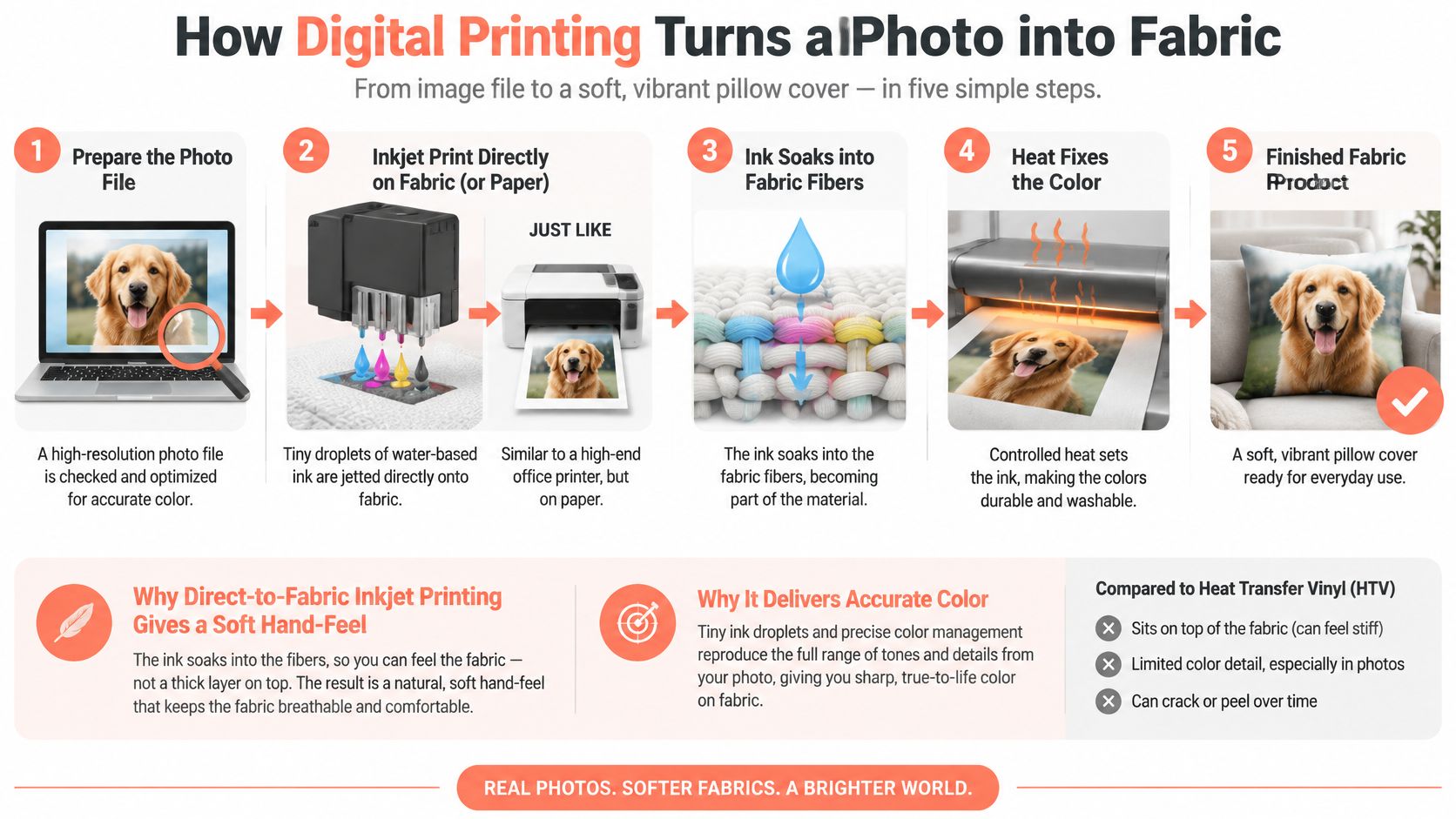
The path from upload to cover has a fixed order. First, software often called a RIP, short for raster image processor, translates the photo into ink instructions and color limits for the chosen cloth. Then the blank fabric passes through the printer flat. After printing, heat or another fixation step sets the ink, and only then are panels cut, seams sewn, and closures added.
Digital methods support personalization because each cover can carry different artwork without requiring separate traditional printing screens. The global digital textile printing market was worth approximately $9.3 billion in 2025 and is projected to reach about $24.2 billion by 2033, with home textiles, including cushion and pillow covers, among its growing applications, according to Grand View Research's digital textile printing market report.
Why the method matters
Ink, fabric, and color fixation work together. Fixation means setting the color so the finished design can withstand its intended use. Reactive printing, for example, is valued for vibrant, durable designs on natural fabrics, but that doesn't mean every photo cover uses reactive inks.
Other products use a different approach. This explanation of sublimation printing on fabric provides useful context when a product description names that process.
For a broader home-interiors reference, Lewis and Sheron Textiles' resource on Atlanta upholstery fabric printing offers another place to explore fabric-printing services. Treat it as background reading, not evidence that all custom textiles are manufactured identically.
A useful detail to watch for is that the fabric travels through the printer flat, which is why seams and closures are added after printing, not before.
Before ordering, ask which printing method is used, which fabric it's designed for, and what care instructions apply. Also ask how large your file will print at the finished cover size, because effective resolution drops when a small photo is enlarged. The printing method is a major quality decision, but it can't rescue a blurry original or compensate for unsuitable fabric.
Choosing the Right Fabric and Cover Construction
Fabric is never a neutral backdrop. A visibly textured weave stays part of the image even after printing, the way a canvas texture shows through a painting.
Don't choose by fiber name alone. Substrate means the material receiving the print, and the finished result depends on that material's weave, surface, thickness, and compatible printing process. Request a close-up product photograph or a sample when available.
Photo Pillow Cover Materials at a Glance
| Material | What You Get | Photo Appearance | What to Verify | Best For |
|---|---|---|---|---|
| Polyester | Typically a smooth, flat finish | With no weave interrupting the surface, fine lines and small details tend to render sharply | Ask whether the finish is smooth, brushed, or textured, and request a printed photo on the actual fabric | Buyers prioritizing a clear photo presentation |
| Poly-linen blend | A visible woven texture with a relaxed hand feel | The weave can soften faces and fine lettering, which suits rustic or casual images | Examine how the weave affects faces and lettering; check blend details and seam construction | A relaxed living-room accent |
| Cotton | A natural fiber with a matte look | Colors often read softer than on polyester, depending on the printing system used | Ask which printing system the fabric is paired with and look for dimensional-stability information | Buyers who prefer a natural-fiber option |
| Minky | A plush, raised pile surface | The pile sits above the print, so bold images read better than delicate detail | Inspect whether the pile obscures fine details and confirm how washing affects the surface | A cuddly decorative accent |
These are starting expectations, not universal performance rankings. A fabric label alone doesn't establish color vibrancy, breathability, durability, or value. Compare the finished specification and total price rather than assuming one material is always cheaper or better.
For a themed room, Bridle Up Hope Shop's equestrian pillow cover ideas can help you consider how a personal interest fits the surrounding décor. Use that styling perspective to decide whether your photo needs a plain background, a border, or a more textured setting.
Inspect the construction, too
Look closely at the seams, corners, and closure opening. Ask whether the back uses the same fabric as the front and whether the cover can be removed without forcing the insert through a narrow gap.
For a first purchase focused on colorful photography, I'd shortlist a smooth polyester option with a compatible printing process and clear care instructions. That's a starting point, not a guarantee: confirm its softness and printed appearance rather than relying on the material name.
Uploading a Photo That Prints Sharp Every Time
The number that matters isn't just how many pixels your file contains. It's how many remain available at the final printed size, after cropping. This is called effective resolution.
Pixels are the tiny building blocks of a digital image. Stretch the same image over a larger area and those building blocks have more ground to cover, much like spreading a small amount of paint across a larger canvas.
Check resolution at the finished size
FESPA's digital-textile color-management guidance recommends effective resolution well above 100 pixels per inch, with approximately 300 pixels per inch a common target for close viewing; for example, a 16-inch-wide photo area needs about 4,800 pixels across at that target, while a 1,600-pixel-wide image provides only 100 pixels per inch before cropping.
The checklist below highlights the checks that matter before checkout.
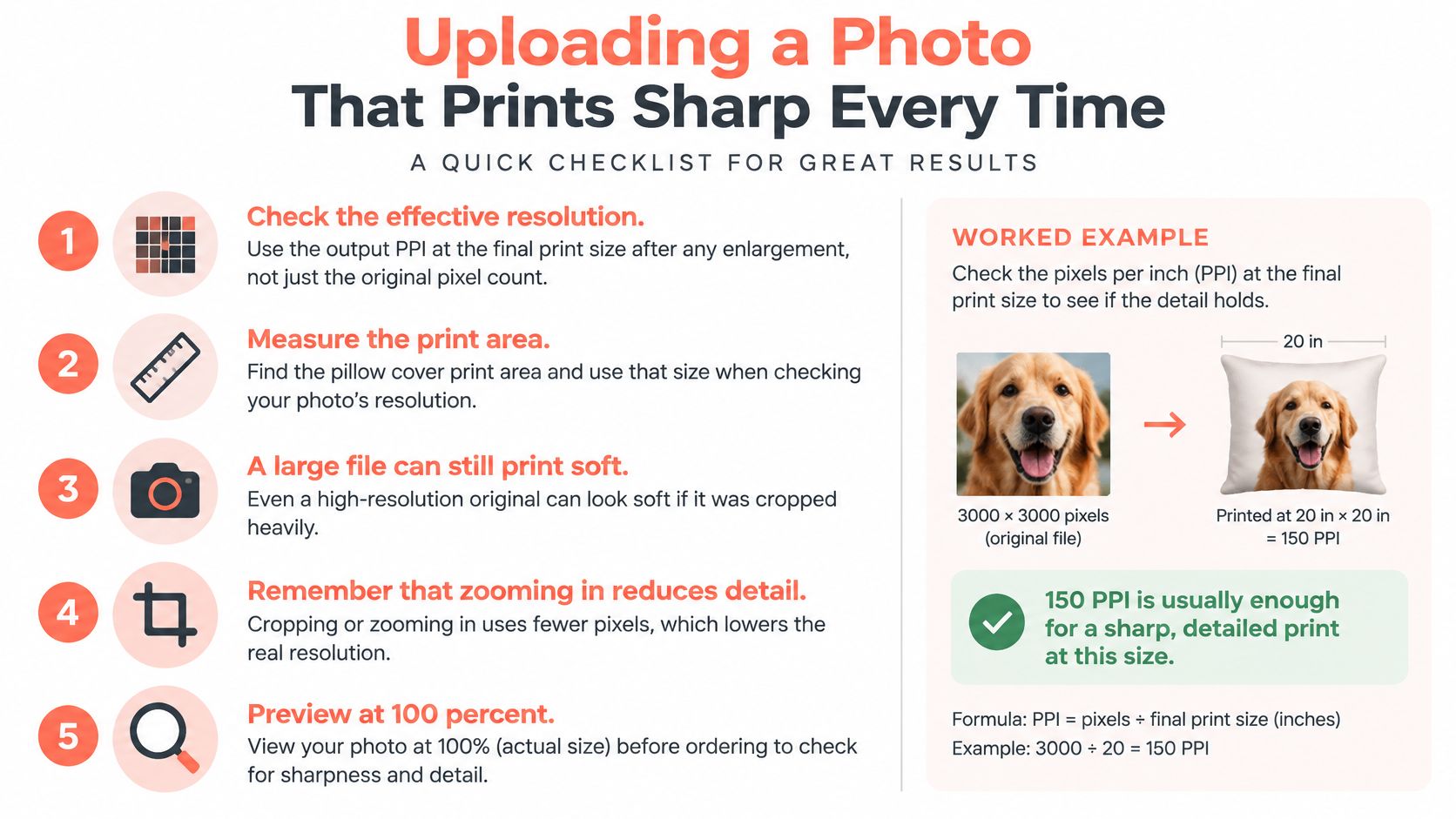
Cropping removes usable pixels. Zooming tightly into someone's face doesn't create more detail; it discards the surrounding image and enlarges what remains. If a favorite picture falls short, consider a smaller printed area, a border, or a layout that keeps the photograph smaller.
Prepare the file before uploading
- Find the original: Use the camera file rather than a screenshot or a copy saved from a message.
- Inspect the subject: Check eyes, hair, and other important details for blur.
- Match the shape: A wide group photograph may need a different layout from a square portrait.
- Review the crop: Keep faces and text away from edges that may disappear into seams.
- Respect warnings: Resolve a low-resolution alert instead of assuming printing will fix it.
The guide to choosing the best photo resolution for printing can help when you're comparing possible files.
A larger file isn't automatically a sharper photograph. Focus, motion blur, and the remaining pixels after cropping all deserve a check.
Sizing, Closures, and Getting the Fit Right
Before choosing a layout, check whether you're buying a cover only or a complete pillow with an insert. The cover is the removable outer layer; the insert is the filled cushion inside. Product photographs don't always make that distinction obvious.
If you're reusing an insert, measure it across the seams without compressing it. Don't estimate from the old cover, especially if that cover has stretched or changed shape through washing.
Match the shape to the photograph
Useful sizes to compare include 16 × 16, 18 × 18, and 20 × 20 inches for square covers, 12 × 20 inches for a lumbar shape, and 26 × 26 inches for a euro sham. These are shopping examples, not a promise that every store offers each option.
A square format can suit a centered portrait. A lumbar cover may give a wider photograph more room, while a large square accent needs enough visual space around it to feel deliberate.
| Closure | What to consider |
|---|---|
| Hidden zipper | A discreet finish, but check the opening and avoid forcing it |
| Envelope closure | No zipper to operate, but inspect the overlap and insert coverage |
| Buttons | A decorative detail that should suit the room and intended user |
A slightly oversized insert can create a fuller appearance, but more filling isn't always better. An undersized insert can leave loose fabric; an excessively large one can strain the closure and seams.
Ask about finished measurements
There's no universal tolerance band to assume across sellers. Ask whether dimensions describe the finished cover, how it's measured, and what variation the seller allows.
If you're also considering a separate protective layer, Protect-A-Bed's guide to zipped cotton pillow protectors is useful background for distinguishing protection from decoration.
Measure first, then follow the seller's pairing recommendation. Choose matching dimensions, or a slightly smaller cover only when the construction and insert support that fit.
Care and Washing That Actually Protects the Print
Machine washable doesn't mean unchanged by washing. A cover can retain its color yet lose its original shape, which is why both the printed image and the fabric deserve attention.
A peer-reviewed textile study using AATCC TM61 accelerated laundering recorded colorfastness ratings of 5 for tested cotton and polyester samples, indicating no observable color change, yet the cotton developed puckering and shrank 3.6% in the warp direction and 7.4% in the other measured direction after one accelerated wash. Those results describe the tested samples, not every photo pillow cover.
Build a label-led routine
Start with the product's care label. Where permitted, use cool water, a gentle cycle, and mild detergent; remove the insert and turn the cover inside out before laundering. Avoid high dryer heat, and don't assume bleach, steaming, or ironing is suitable.
Use this visual routine alongside the manufacturer's instructions, not instead of them.
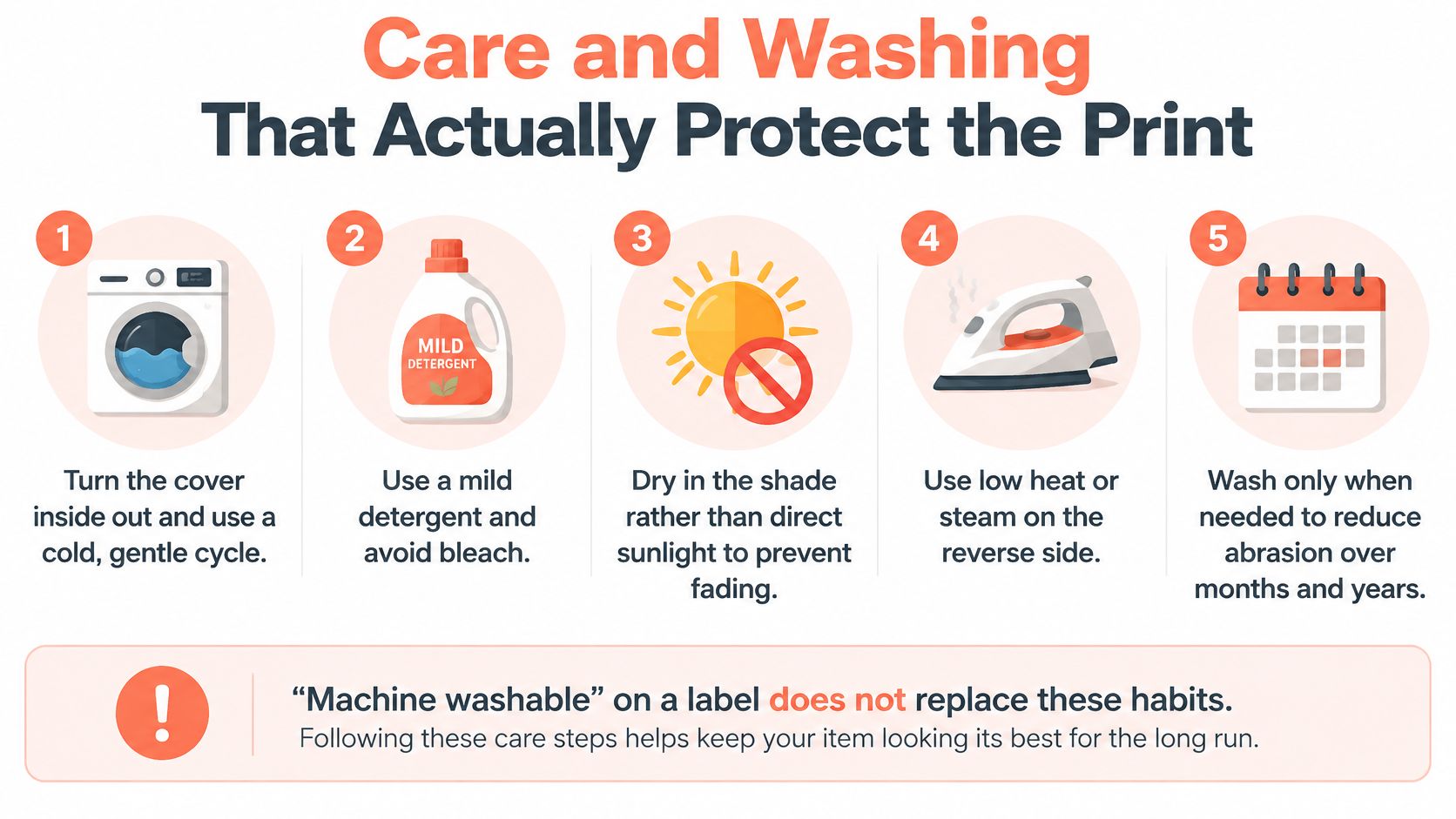
For family messes, choose a response that suits the stain and fabric rather than reaching immediately for a strong cleaning product.
- Baby spit-up: Remove the residue gently and follow the approved pretreatment instructions.
- Pet drool: Blot the damp area and check whether local cleaning is permitted.
- Snack spills: Lift away solids, avoid aggressive rubbing, and test any approved stain treatment discreetly.
Watch the fit as well as the image
After washing, check whether the seams twist, the surface puckers, or the insert becomes difficult to replace. These changes matter even when the photograph still looks colorful.
Care-label reality check: Ask for laundering information about the finished printed cover, not just a general statement about the unprinted fabric.
Wash when needed rather than automatically with every bedding change. For a sentimental cover, a realistic care routine is more useful than expecting it to tolerate any temperature, detergent, or drying method.
Gift Ideas for Every Season and Milestone
November and December are holiday-gifting months, so choose images that feel connected to the recipient's family life. A grandparent might appreciate a clear photograph of the grandchildren; a partner might prefer an ordinary shared moment over a formal portrait.
That timing has a practical basis: November and December holiday sales have averaged approximately 19% of annual U.S. retail sales, and 44% of holiday shoppers used online search for gift inspiration, according to the National Retail Federation's winter-holiday FAQs. For a coordinated gift, Custom Photo Blankets can complement a pillow without requiring identical artwork.
April and May are for Mother's Day memories
For Mother's Day, consider a photograph that means something specifically to the mother or grandmother receiving it. Children's artwork, a family gathering, or a shared outing can be more fitting than a generic seasonal design.
The National Retail Federation's Mother's Day spending projection put planned spending at a record $38 billion, averaging $284.25 per person, with 46% of shoppers prioritizing something unique or different and 39% prioritizing a special memory. These are spending projections and shopping intentions, not evidence that a particular gift suits every mother.
Let the milestone guide the design
- Weddings and engagements: Choose an image the couple already loves, and keep added wording restrained.
- Housewarmings: Match the design to the recipient's room rather than your own decorating preferences.
- Birthdays and grandparent gifts: Consider an everyday photograph with a shared story.
- New-baby gifts: Present the pillow as a decorative keepsake, not an infant sleep accessory.
- Pet memorials: Ask whether the recipient would welcome a visible remembrance before ordering.
For more ways to connect photographs with an occasion, browse these custom photo gift ideas.
Presentation can stay simple. Include a note explaining why you chose the image, and make clear whether the gift includes an insert. If you're pairing it with a blanket, choose complementary layouts rather than crowding both pieces with every available photograph.
Photo Privacy and Your Final Buying Checklist
A family photograph isn't just artwork for a product. It may also reveal faces, names, locations, or personal details you didn't intend to share beyond the order.
About 65% of consumers are concerned about how personal photos, names, and messages are stored or used, while more than half prefer brands that explain data-protection practices, according to Global Growth Insights' personalized-gifts market research. Before uploading, look for clear answers rather than relying on a reassuring badge.
Separate production needs from optional permission
A seller needs access to the artwork to manufacture your order. Permission to use that image in advertising, samples, or public reviews is a different matter.
Ask how long files are retained, which production partners can access them, how deletion requests work, and whether uploads are used to train artificial-intelligence systems. Don't assume automatic deletion or production-only use unless the policy explicitly confirms it.
The checklist below identifies privacy questions to verify. Its references to restricted use and automatic deletion are checks to make, not promises about every seller.
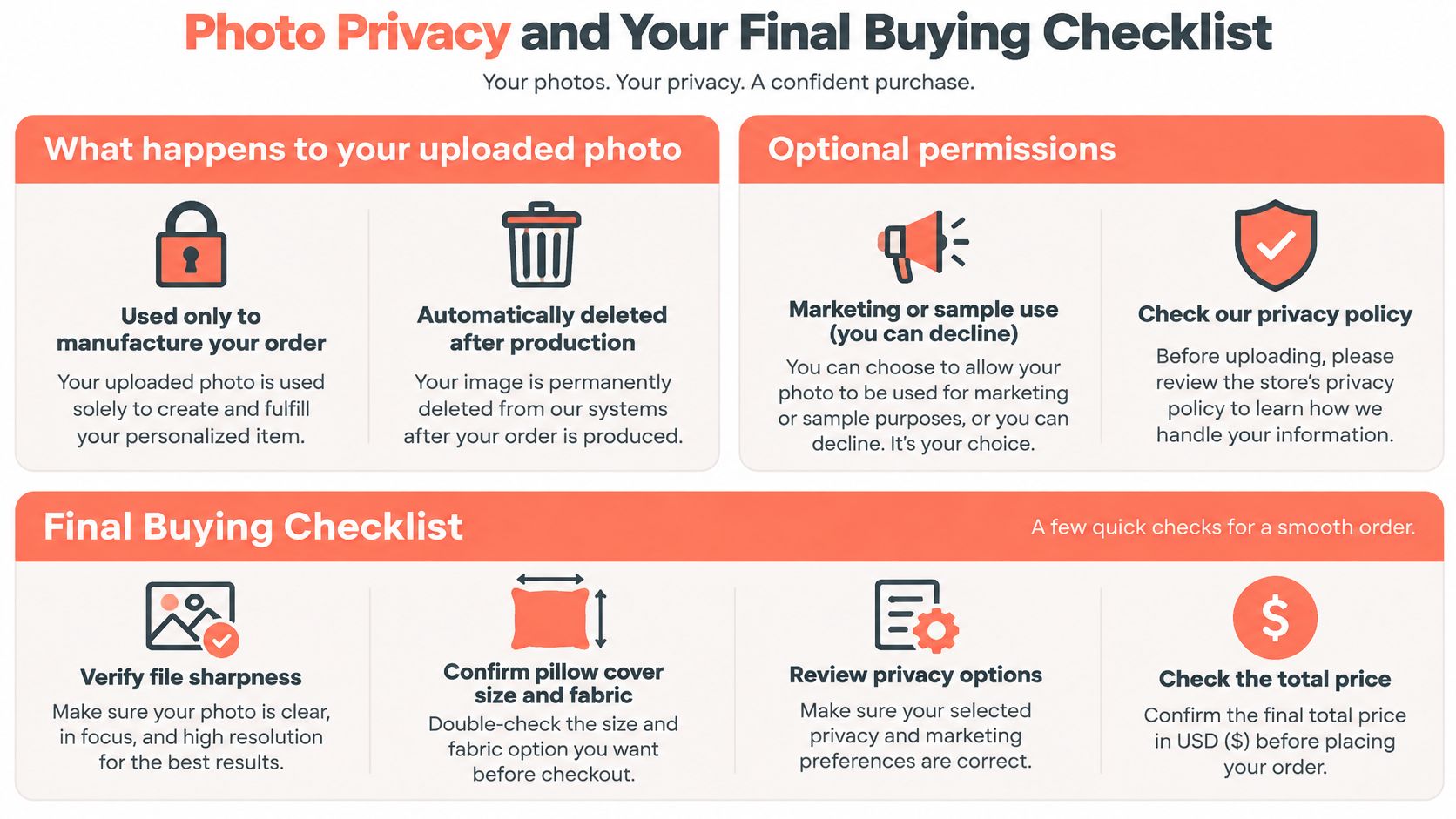
Inspect the photograph's background, too. Avoid visible addresses, school details, medical information, or other sensitive content that isn't necessary to the design.
Keep this beside the checkout page
- Print and fabric: Confirm the material, printing method, and finished appearance.
- Image: Resolve blur, crop, and effective-resolution concerns.
- Fit: Verify dimensions, closure, and whether an insert is included.
- Care: Make sure the instructions suit the recipient's routine.
- Privacy: Review retention, sharing, deletion, and optional permissions.
- Order details: Check spelling, total price, delivery information, and the final preview.
Keep this checklist open while you shop. A meaningful photo deserves the same attention to its finished cover as it received when you chose it.
That Blanket Co offers personalized photo blankets and complementary pillows for turning favorite images into home keepsakes. Visit That Blanket Co to explore the options, then use your photo, fit, and privacy checklist before completing your design.