


Polyester vs Cotton Blanket: Which Wins for Your Home
It's 9:40 on a Tuesday night. The sofa needs a throw before the weekend, a friend is asking what to send her mother for the holidays, and the product page in front of you shows two blankets that look identical in the photo. One is brushed polyester fleece. The other is a cotton weave, flatter in the light and a little more expensive to make.
Both listings say soft. Both say machine washable. What separates them is how each fiber handles water, heat and friction over a few hundred washes, and those differences are measurable rather than a matter of taste.
The decision splits into four parts: how the blanket feels and how warm it sleeps, how it behaves in the laundry, how long it holds its shape and color, and which room in your house it's for. Get those right and you won't be shopping for a replacement next winter.
Why Fabric Decides How Your Blanket Feels and Lasts
A photo blanket for a grandparent and a throw for a chilly living room face different demands. The first needs a surface that shows an image clearly and stands up to regular washing. The second may need more breathability, or a plush pile that holds warmth. Fiber matters, but so do the fabric's construction and the way you wash and dry it.
Polyester tends to suit frequent washing, detailed prints, and households with children or pets. It absorbs less moisture than cotton, which can help it dry faster, and it generally holds its shape well. Cotton feels natural and absorbent, with airflow that can be welcome in a warm room. The trade-off is that cotton can take longer to dry and may need more care to limit shrinkage.
The blanket's surface changes the experience, too. Pile and loft affect warmth and softness, while weave affects airflow and how a print appears. A smooth fabric can show a photo differently from a textured weave, even when the fibers are similar.
Polyester is a synthetic fiber made from polyethylene terephthalate, or PET. Cotton is a natural cellulose fiber grown on a plant. Those differences help explain how the materials handle moisture, friction, and heat, but they do not determine every blanket's performance on their own.
Polyester is the most-produced fiber globally, with cotton second. That broad availability makes polyester common in blankets and printed fabrics, but market share alone does not make it the right choice for every home.
For a custom photo keepsake, That Blanket Co prints custom blankets on premium fleece or sherpa. Its fleece blankets use lightweight 275 GSM fabric with a single-sided print and fleece backing. The company describes its blankets as non-shedding and non-pilling, shrink and fade resistant, and machine washable. The practical choice still depends on how the blanket will be used and laundered.
Polyester and Cotton Blankets Side by Side
Here's how the two fibers line up on the criteria buyers use.
| Criterion | Polyester blanket | Cotton blanket |
|---|---|---|
| Fiber type | Synthetic, made from PET | Natural cellulose fiber |
| Feel against skin | Smooth and plush, especially in fleece and minky | Soft, natural and familiar |
| Warmth | Insulating, traps heat well | Lighter feel, depends on weave |
| Breathability | Depends on weave and layers | Good airflow, suits warm rooms |
| Pilling and abrasion | Strong resistance | Good, wears faster under abrasion |
| Shape after washing | Stable, low shrink | Can shrink or stretch with heat |
| Care effort | Low, machine washable | Moderate, needs gentler cycles |
Start at the top row, because fiber type explains the rest. A textile study comparing polyester and cotton reports that polyester has lower moisture absorption, stronger abrasion and wear resistance, and better resistance to wrinkling, mildew, weather and light. Its thermal conductivity measured roughly three times lower than cotton's, so it moves heat less readily and feels warmer and more insulating in a plush construction.
Cotton's airflow advantage is measurable too. In the same study's air-permeability test, the cotton sample recorded 159.58 cubic centimeters per second per square centimeter against 139.85 for polyester, which means more air moves through the cotton. The materials work also reports cotton absorbing up to 27% of water in humid conditions without feeling wet.
Read the table as a trade, not a ranking. Polyester wins on durability, easy care and print stability. Cotton wins on natural hand feel and airflow. A 50/50 polyester-cotton blend sits between them and turns up often in printed blankets, because it balances softness with shape retention. One caution before you buy on fiber alone: a heavy cotton flannel and a thin cotton percale wear the same label and feel nothing alike.
Buying rule: match the column to the job. A couch throw and a nursery blanket are not the same purchase, even when the fiber is the same.
The same logic runs through furniture. If you've ever compared two sofas that looked identical and felt completely different, upholstery tips from Stahl Home Center explain how weave and fiber content drive durability in seating, and the reasoning transfers directly to the fabric you drape over it. For the constructions we print on, our guide to the best fabric for blankets covers the options in detail. Your first decision is which column matches your priority: durability and a sharp print, or airflow and a natural hand.
Matching Warmth, Breathability and Care to Your Household
Feel is the first thing anyone judges and the last thing a spec sheet tells you. Polyester fleece and minky have a smooth, faintly cool surface that warms up fast and stays plush, and the pile hides wrinkles and print edges. Cotton feels dry and slightly more textured from the first touch, soft the way a well-worn shirt is soft, without the faint slickness some people notice on synthetic pile.
Our blankets are made from ultra-soft fleece and premium polyester, which is the construction most households land on for a couch throw: light, warm and easy to wash.
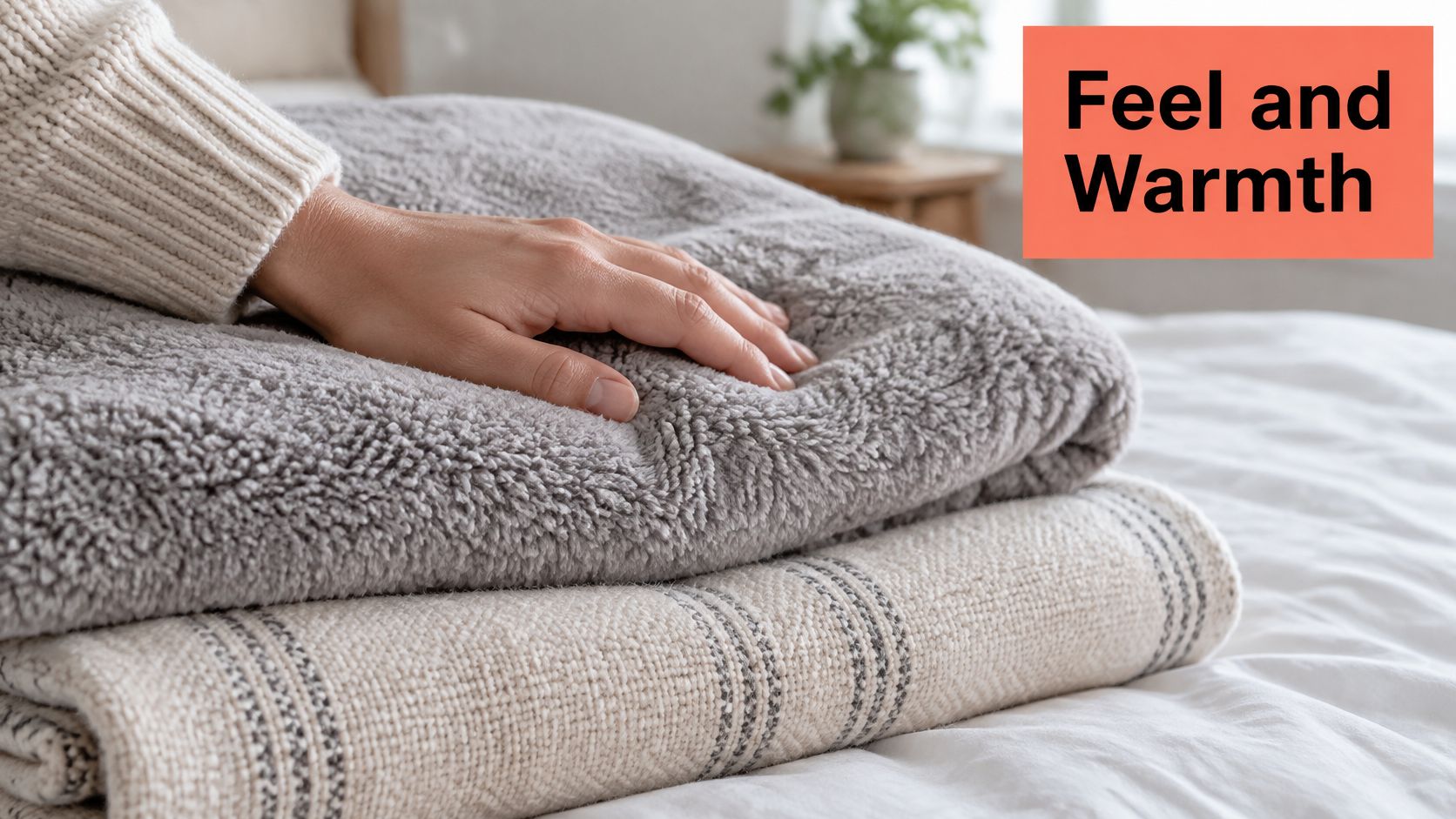
Warmth is where the marketing gets ahead of the physics, so match the material to the situation before you match it to a preference.
| Situation | Better fit | Why |
|---|---|---|
| Children and nursery use | Polyester fleece | Frequent washing and wear tolerance |
| Pet owners sharing a blanket | Tightly woven polyester fleece | Fast drying and less retained moisture |
| Hot sleeper or humid room | Cotton or lightweight, open weave | Absorbency and airflow |
| Daily couch throw | Polyester fleece or sherpa | Shape retention and easy care |
| Bed in a warm climate | Cotton or lightweight blend | Breathability and natural feel |
| Printed photo gift | Polyester fleece or sherpa | Vivid, fade-resistant print and easy care |
The warmth question has a measurement behind it
Wear-trial research published in Scientific Reports on fabric comfort found that cotton and cotton-polyester fabrics with higher thermal and water-vapor resistance produced higher microclimate temperature and humidity against the body. In plain terms, a dense cotton-rich blanket can run warmer and less dry than a shopper expecting a breathable natural fiber anticipates. Structure sets the number; the fiber only nudges it.
Run that across four settings and the advice stops being generic. On a couch, where you're sitting still and not generating much heat, a plush polyester throw holds warmth exactly as intended. Overnight, a heavy cotton weave can trap more heat than its label suggests. In a nursery, the blanket gets washed constantly and warmth is secondary to drying speed. In a humid room, a fiber that holds water is the last thing you want against your skin.
Where polyester surprises people
The counterpoint matters as much as the first finding. A microdenier polyester and cotton layered structure delivered strong wickability and moisture transport because each layer did a different job, and a 2025 comparison reported recycled-polyester layered blends with low water-vapor resistance and high air permeability. Engineered polyester can run cool and dry. A loose knit and a dense one behave nothing alike, even in the same fiber.
The honest test: if you run hot, judge a blanket by its weight and weave before you judge it by the fiber name on the tag.
Care under real conditions
Durability under washing favors polyester blends. In an industrial textile study of hotel sheets, 50/50 cotton-polyester sheets showed at least twice the abrasion resistance of 100% cotton sheets within the same fabric-weight range, according to laundering research on hotel sheets and wash-wear trials. After 100 industrial laundering cycles, average material loss was 2.6% for the blend against 1.6% for the cotton, so abrasion resistance and mass loss are separate measures rather than one durability score.
A separate wear investigation reported that 50/50 polyester-cotton garments kept good resistance to washing and wear across 60 wash-wear cycles, with treatment differences in appearance too small to be statistically significant. For a blanket that will meet a dog, a toddler and a washing machine every week, that's the relevant evidence.
Three checks on any product page
You can't feel a blanket through a screen, but you can read three numbers and skip most of the guesswork.
- Weight per square meter. Ask for grams per square meter and compare like with like. A 275 GSM fleece is a mid-weight throw; a summer cotton weave runs far lighter.
- Pile height. Deep pile traps air and feels warmer. Low pile or flat weave moves air and feels cooler.
- Weave tightness. Hold a photo up to a window, or read the description for a tight vs. loose weave. Tight weaves resist snagging on claws and keys; loose weaves breathe.
Washing, Drying and Durability Over Time
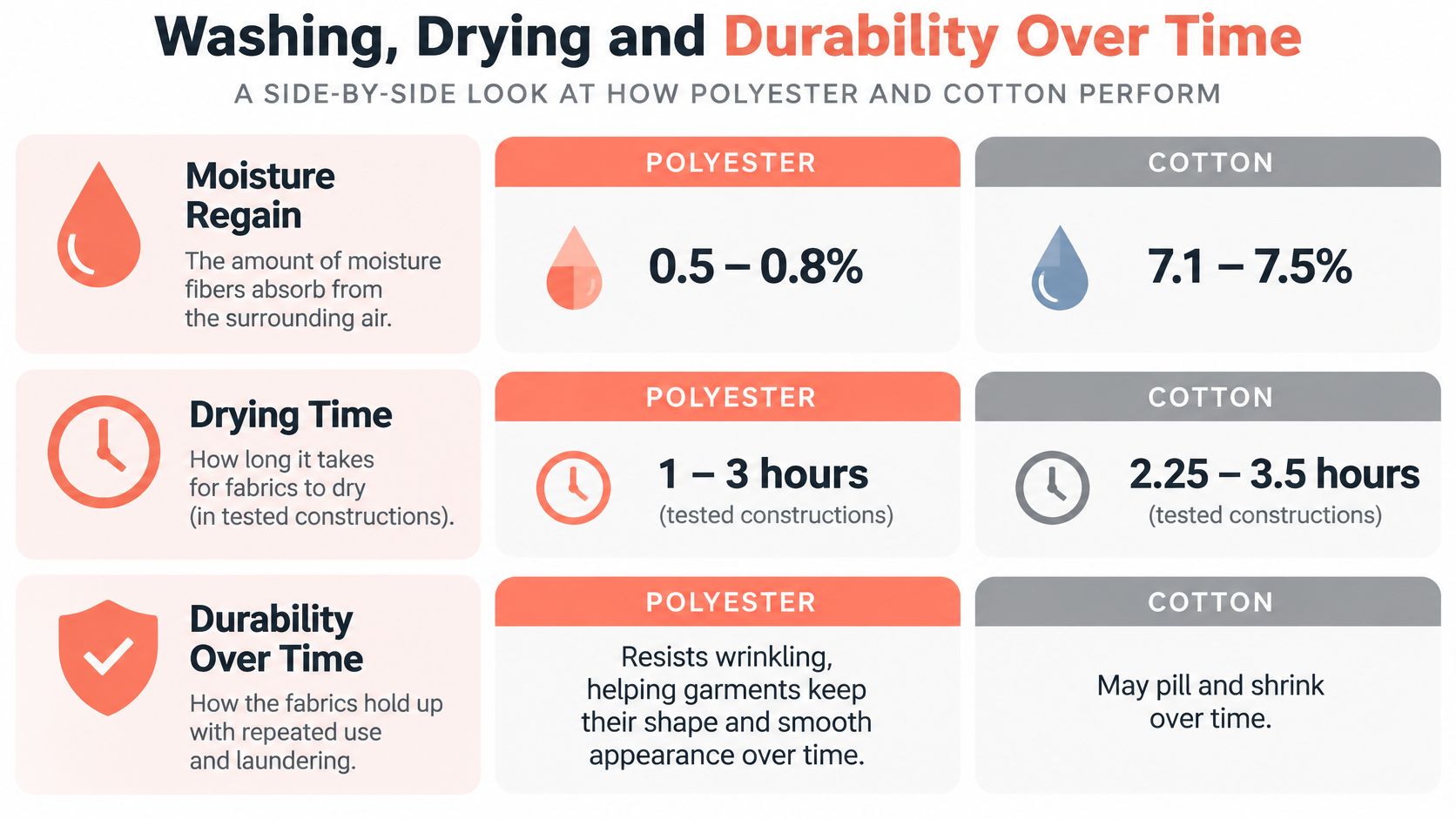
A blanket that comes out of the wash damp in the middle can take hours longer to dry than one that sheds water quickly. In a U.S. defense-laboratory fabric study, tested polyester constructions had moisture regain of roughly 0.5 to 0.8%, compared with 7.1 to 7.5% for cotton. Their drying times were about 1 to 3 hours for polyester and 2.25 to 5.5 hours for cotton.
| Measure | Polyester | Cotton |
|---|---|---|
| Moisture regain | About 0.5 to 0.8% | About 7.1 to 7.5% |
| Drying time after wash | About 1 to 3 hours | About 2.25 to 5.5 hours |
| Water retained after sweat and oil exposure | Holds less water | Holds noticeably more water |
Moisture regain describes how much water a fiber absorbs and holds. Polyester absorbs relatively little, so a polyester throw can shed much of its surface water during the spin cycle and dry faster on a line or in a dryer. Cotton fibers hold more water, which can leave the middle of a thick blanket damp after the edges feel dry. Once soiled with sweat and oil, cotton holds noticeably more water than polyester.
The fiber label does not tell the whole story. Fabric weight, thickness, weave or knit, airflow, and how much water remains after spinning all affect drying time. A heavy sherpa blanket and a lighter fleece blanket made from polyester can dry at different rates.
Shedding depends on construction, not just the label
Fiber type alone does not predict shedding. Research reviews report that cotton can shed more microfibers than polyester in some conditions, while cotton fibers tend to be shorter and more irregular. A study of blends found that cotton-polyester blends shed significantly more fibers than polyester alone. Compact woven polyester made with highly twisted continuous filaments released fewer fibers than looser knitted fabrics made with short-staple fibers.
Household laundering released an average of 5,849,943 microfibers per liter across 30 households in 2025 fiber-shedding research. Lower wash temperatures and shorter cycles reduced release in the study. For a buyer, construction and care routine both matter: a tight weave generally sheds less than a loose, fluffy knit.
A wash routine that protects the fibers
- Wash before first use. That Blanket Co advises washing blankets before use to remove excess lint produced during manufacturing.
- Wash when needed. Each wash adds friction. A couch throw may need washing less often than a nursery blanket.
- Use a shorter, cooler cycle. Cooler, shorter washes reduced fiber release in laundering research. Follow the care instructions for the blanket.
- Avoid overloading the drum. Give the blanket room to move through the wash.
- Protect the printed side. Turn the blanket inside out and use the lowest effective agitation to reduce rubbing against the printed face and edges.
- Dry until fully dry, then stop. Drying to very low residual moisture increased edge abrasion in laundering research, so avoid leaving the blanket in the dryer longer than needed.
For more practical care guidance, see these tips for washing machine-washable blankets. That Blanket Co fleece blankets are non-shedding and non-pilling. The video below also walks through blanket care:
A shorter cycle and a dryer that stops when the blanket is dry can help limit unnecessary wear.
The U.S. National Institute of Standards and Technology describes polyester as an “easy-care” fiber in its fiber guide. In normal use, it resists appreciable shrinking and stretching, abrasion, mildew, moths, perspiration, sunlight, and wrinkling. Over time, polyester fleece may flatten slightly in the pile. Cotton can soften, may shrink if exposed to high dryer heat, and can pill where the fabric rubs against itself.
Picking a Custom Photo Blanket for Holiday Gifts
A photo blanket needs time to be printed and shipped before it can go under the tree. That Blanket Co typically prints and ships orders within 2 to 3 business days, and offers free shipping on all orders. Ordering early in December leaves more room for delivery than waiting until the final days before the holiday.
Holiday shopping activity is concentrated in November and December. Deloitte's 2026 holiday retail survey reports that holiday retail sales have averaged about 19% of annual retail sales over the past five years. The National Retail Federation's 2026 forecast projected $1.013 trillion in November and December sales, a 4.2% increase from 2025. Deloitte's tracking found that 77% of shoppers were active in late November and 78% in early December.

Choose a material for the recipient's routine and room, not just the image:
- For a child or grandparent: fleece is a practical option for regular use. It is machine washable and dryer safe.
- For a couch gift: sherpa offers a plush, cozy feel suited to colder evenings.
- For someone in a warm climate: consider a woven blanket as a distinct material option. Its suitability depends on the recipient's preferences and how they plan to use it.
Custom blankets are printed on premium fleece or sherpa. The one-sided dye-sublimation print keeps photos crisp and vibrant in fade-resistant color. Blankets are also described as shrink and fade resistant, useful qualities for a keepsake that will be washed over time.
The five-step order:
- Choose a material. Pick fleece or sherpa for a soft, cozy blanket, or consider a woven style if that better suits the recipient.
- Pick the size. Choose a throw for a couch, or twin or queen for a bed.
- Upload a clear photo. A sharp phone photo can work; avoid screenshots of screenshots, which may lose detail.
- Check the layout. The guide to designing a blanket with photos explains how the image crop fits the blanket.
- Order early. Give printing and shipping time to fit the holiday schedule.
Choose Your Material and Order Before the Holiday Rush
Here's the verdict, sorted by household.
- Washed constantly, used by kids or pets, or printed with a photo: polyester.
- Airflow, a natural hand and absorbency first, especially in a warm room: cotton.
- Durability with more softness than pure polyester: a polyester-cotton blend.
Four checks before checkout: the material matches the recipient's situation, the weight and weave suit the season, the size fits the bed or sofa it's headed for, and the wash routine is one you'll keep. Every Custom Photo Blankets order is printed in the USA.
Compare cost per year of use, not sticker price. A throw that gets washed twice a month and comes out of the dryer flat is still earning its keep in year three; one that pills, stiffens and shrinks gets replaced. Check current prices on the product page rather than assuming a figure, and build the washing routine into the math.
Timing comes down to one date: the early-December ordering window, which leaves room for the print-and-ship lead time before the holiday.
Spring runs on the same logic. A 2026 analysis of Medill's Mother's Day spending data reported that 83.5% of consumers celebrate Mother's Day and that average spending reached $284.25 per celebrating consumer, with orders concentrating in the days right before the holiday. Order in April for May, in other words, instead of the week of.
Pick the material for the person who will use the blanket most, then order it before the calendar makes the decision for you.
That Blanket Co turns a phone photo into a printed keepsake, with fleece, sherpa, minky and woven options in throw, twin and queen sizes, printed in the USA with dye-sublimation color that holds up to washing. Orders are typically printed and shipped within 2 to 3 business days, with free shipping on all orders, so a gift ordered in the first days of December still arrives in time. Visit That Blanket Co to upload a photo, check the layout and start a Custom Photo Blankets design before the holiday window closes.