


Throw Pillow Size Guide: Dimensions and How to Choose
A pillow insert can be 1 to 2 inches larger than its cover, according to Wirecutter's guide to pillow covers and inserts. That small difference changes how full the pillow looks, but it doesn't tell you whether the finished pillow will leave enough room to sit.
A useful throw pillow size guide starts with your furniture, not the biggest cushion available. Measure the seat, choose the cover and insert separately, then check how your photo or name will sit on the front. For a holiday gift, those checks help you choose something the recipient can enjoy every day rather than move aside whenever they sit down.
Standard Throw Pillow Sizes at a Glance
Standard throw pillow sizes and typical uses
| Size | Centimeters | Shape | Typical use |
|---|---|---|---|
| 12 x 20 in | 30 x 51 cm | Lumbar | Dining chairs, armchairs, front row |
| 14 x 24 in | 36 x 61 cm | Lumbar | Benches, daybeds, front row |
| 14 x 36 in | 36 x 91 cm | Lumbar | Across a bed or long daybed |
| 16 x 16 in | 41 x 41 cm | Square | Accent chairs, children's rooms |
| 18 x 18 in | 46 x 46 cm | Square | General sofa, loveseats, apartment seating |
| 20 x 20 in | 51 x 51 cm | Square | Deep sofas, sectionals, substantial seating |
| 22 x 22 in | 56 x 56 cm | Square | Back row on large sofas or beds |
| 24 x 24 in | 61 x 61 cm | Square | Back row on large sofas or beds |
| 26 x 26 in | 66 x 66 cm | Square | Euro pillow, bed back row |
The recurring square, lumbar, and Euro dimensions in this chart follow the sizing conventions described in the pillow education guide, with centimeter measurements rounded for shopping comparisons. There's no universal international standard that makes one decorative pillow size correct for every room.
Think of the typical uses as starting points. An accent chair with a deep seat might accommodate a larger square, while a broad sofa with shallow cushions might need smaller pillows. Furniture labels alone don't tell you how much room you'll have left.
Why the middle sizes deserve attention
The 18-inch square is a versatile general sofa choice, while 20-inch and larger squares tend to suit deeper seating. The distinction is about proportion and comfort, not quality. A bigger pillow isn't automatically more luxurious or more useful.
For compact seating, look at the space between the back cushion and the front edge. For substantial seating, consider whether a smaller accent will look lost against tall arms or a deep back. A lumbar offers another option when you want width without the height of a large square.
Our custom pillows at That Blanket Co come in 16 x 16 inch and 18 x 18 inch sizes. These give shoppers a chair-sized accent option and a larger square for couches or coordinated arrangements.
Read the measurement before comparing products
A listed dimension usually describes a flat textile measurement, not how far the stuffed pillow will project into your seat. A rectangular listing gives both dimensions, so confirm which direction the design faces.
Before ordering, identify whether the measurement refers to the cover, insert, or completed pillow. Products with the same nominal size can look different once filled, especially when their fabrics and inserts differ.
How to Measure Your Seat Before Choosing a Size
Bring a flexible tape measure, a notebook, and an existing cushion if you have one. Measure the furniture as you normally use it, with its back cushions in place rather than pushed aside.
Use these measuring directions to locate the relevant surfaces.
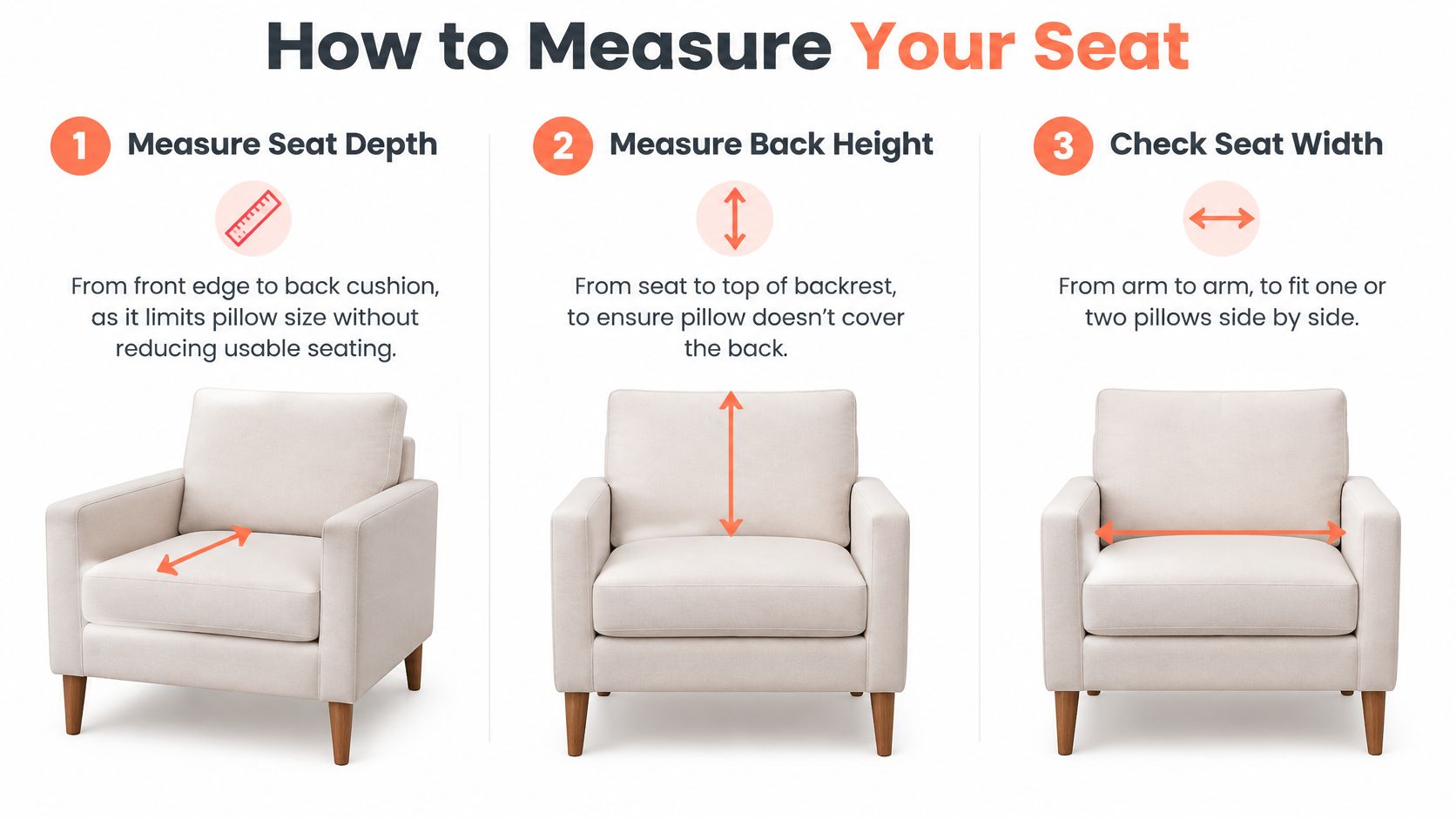
- Measure seat depth. Run the tape from the front edge of the seat to the face of the back cushion. This is your available sitting depth, and a thick pillow will occupy part of it.
- Measure back height. Measure upward from the seat surface to the top of the backrest. A pillow that rises well above the back may look awkward or lose support, particularly on a low chair.
- Check each seating position's width. Measure the space a person occupies, not just the sofa's full arm-to-arm width. Narrow positions often work better with a small square or a lumbar than with broad, overlapping pillows.
- Account for the whole arrangement. Lay out the pillows you intend to keep on the seat and compare their combined footprint with the available width. Allow for overlap, but don't assume overlap eliminates the bulk behind someone's back.
- Choose a display size and a sitting size. Decide which pillow should remain visible and which will be leaned against. Test the arrangement while sitting normally, with your feet supported and your shoulders relaxed.
The Spruce's sofa styling guidance warns that too many pillows can make narrow seating too shallow. Larger pieces often work better at the sides, where they interfere less with the central sitting area.
Comfort check: If you must flatten, fold, or remove the personalized pillow every time you sit down, reduce its size or simplify the arrangement.
A smaller photo pillow can stay upright and visible where a larger one would end up tucked behind an arm. This matters on nursery chairs, recliners, benches, and compact loveseats as much as on sofas.
For an additional visual reference while planning your seating, use the video below.
Finish by recording your own pair: display size, the largest flat template that looks proportional; sitting size, the smallest comfortable option that supports your intended use. Those may be different sizes, and that's a practical result rather than a styling mistake.
Matching Pillow Size and Layering on Your Seating
A chair needs a different arrangement from a sectional. Start with the furniture category below, then reduce the suggested count if the cushions intrude into the space people use.
Pillow size by seating type
| Seating | Square size | Lumbar option | Typical count |
|---|---|---|---|
| Accent chair or children's room | 16 x 16 in | 12 x 20 in | 1 to 2 |
| Apartment sofa or loveseat | 18 x 18 in | 12 x 20 in | 2 |
| Standard three-seat sofa | 20 x 20 in | 12 x 20 in | 3 to 4 |
| Deep sofa or sectional | 20 to 22 in | 14 x 24 in | 4 to 5 |
| Dining chair or armchair | None, lumbar only | 12 x 20 in | 1 per chair |
| Bench or daybed | 18 x 18 in | 14 x 24 in or 14 x 36 in | 2 to 3 |
| Bed | 26 x 26 in Euro and 20 x 20 in | 14 x 36 in | 2 to 4 |
Treat these counts as arrangement starting points, not minimum purchases. For example, the loveseat's lumbar can replace a square when seating is tight rather than becoming another layer.
The following visual shows how the larger-back, smaller-front approach translates across furniture types.
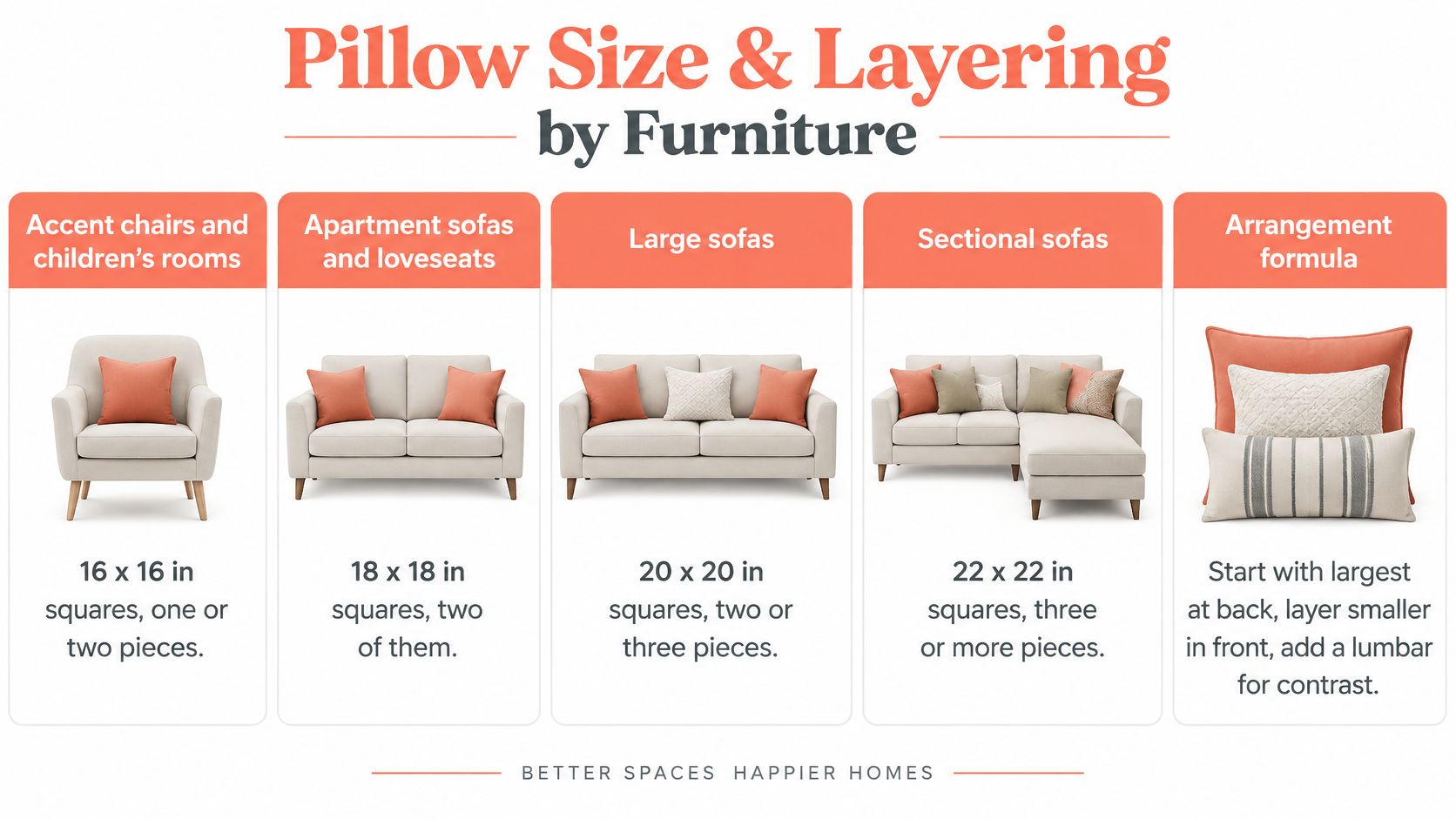
Build from the back without crowding the front
Designer Heather French identifies a 22 x 22-inch pillow as a useful sofa starting point, while another designer favors 20 x 20 inches, in House Beautiful's styling guide. Both approaches require adjusting to seat depth.
On a generous sofa, try 22 x 22 or 24 x 24-inch squares behind 18 or 20-inch squares, then add a lumbar for contrast. Use 2 to 4-inch size steps as an editorial styling guideline so adjacent layers remain distinct. An odd-numbered grouping can feel relaxed, but a balanced pair is perfectly suitable when it preserves sitting room.
For beds, place Euro pillows at the back, standard shams in the middle, and smaller accents in front. On a bench or daybed, a long lumbar can provide a finished appearance without a tall stack.
For shape and style vocabulary beyond dimensions, Groen's Fine Furniture pillow guide offers a useful companion reference. Our guide to matching pillows and throws helps coordinate the surrounding textiles.
Seat depth decides the final arrangement. On shallow furniture, a lumbar alone may serve you better than a complete layered grouping.
Cover Size Versus Insert Size
A pillow with limp corners doesn't necessarily need a larger cover. It may need an insert that fills the cover properly. Start by removing the insert, laying the cover flat without stretching it, and measuring seam to seam, excluding piping or decorative edging.
The Osmoz insert-fitting guide recommends an insert about 2 inches, or 5 centimeters, larger in both dimensions for a full appearance, while allowing less oversizing for firm synthetic fills. The pairings below apply that convention.
Cover sizes and matching insert sizes
| Cover size | Down or feather insert | Firm synthetic insert |
|---|---|---|
| 12 x 20 in lumbar cover | 14 x 22 in | 13 x 21 in |
| 16 x 16 in cover | 18 x 18 in | 17 x 17 in |
| 18 x 18 in cover | 20 x 20 in | 19 x 19 in |
| 20 x 20 in cover | 22 x 22 in | 21 x 21 in |
These are starting pairings, not instructions to force an insert into a tight cover. The synthetic column shows modest oversizing; a particularly firm insert may fit better at the cover's nominal dimensions.
Use the cover's stitched boundary as your measuring reference.
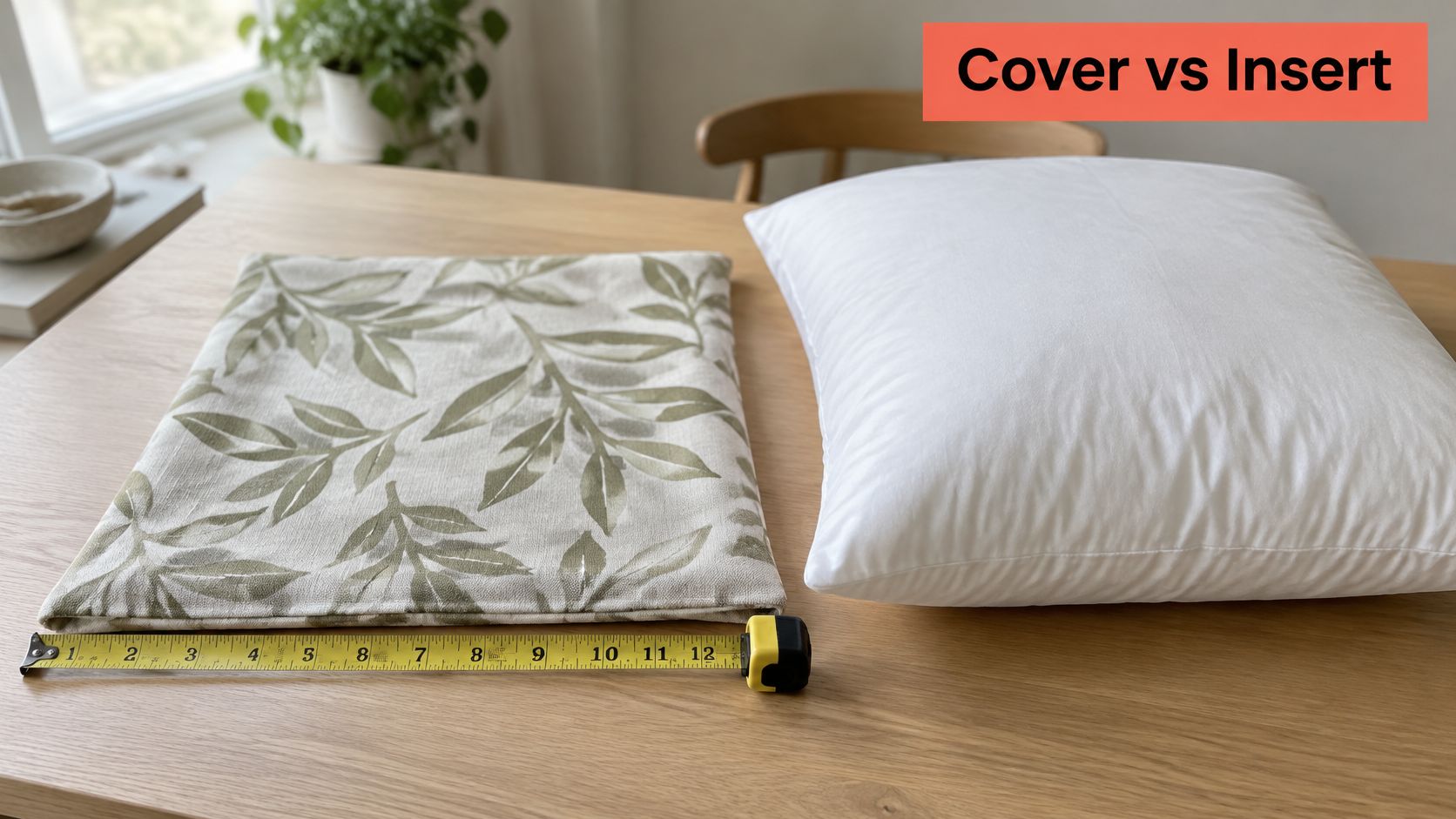
Why fill material changes the fit
Down and feather-down inserts compress and can be worked into the corners. Firm fiber-fill inserts resist compression, so aggressive oversizing can produce a stiff cushion, strained seams, or a zipper that's difficult to close.
Thick seams also reduce internal room. Stretch fabrics, tightly woven covers, piping, and zipper construction change how much fullness the cover can safely accommodate.
The decorative pillow cover sizing guide treats oversizing as a fitting convention rather than a mandatory engineering standard. It also explains why adequate filling matters for photo pillows: a taut surface helps faces, lettering, and borders remain aligned.
A full pillow should look supported, not stretched under pressure.
Fit for the printed surface
Too little fill leaves folds through the artwork. Too much can roll important details around the curved edges, making the visible front look cropped even though the entire image was printed.
Our pillows have removable, machine-washable covers, so a cover can be replaced without changing a suitable insert. Check the replacement cover's actual finished measurements rather than assuming every nominally matching cover has identical internal room.
Before buying either component, confirm whether the listing describes the cover, the insert, or the finished pillow. That distinction prevents a styling decision from becoming a fit problem.
How Pillow Size Changes Your Photo or Name Design
A group photo and a close-up portrait don't need the same layout. In a group image, each face occupies a small part of the frame; in a close-up, the main subject can remain recognizable on a smaller square.
Choose the composition before enlarging the pillow. A larger format won't fix a photograph with tiny subjects, distracting empty space, or a crop that cuts through someone's face.
Match the shape to the subject
- Group photos and collages. Square formats give you space to balance several subjects. Favor a larger usable front panel when individual faces would otherwise become difficult to recognize.
- Single portraits and initials. Smaller squares can suit a clear face, monogram, or uncomplicated motif without unnecessary background.
- Pet portraits. Crop so the face reads clearly, but leave breathing room around ears and whiskers.
- Panoramas and names. Lumbar formats suit horizontal photographs, long names, and text that would feel cramped inside a square.
House Beautiful's pillow styling guidance addresses proportion and layering. For personalized artwork, apply that same attention to what remains visible after the pillow is filled and placed behind other cushions.
Keep important content on the visible front
Our custom pillows use premium fleece made from 100% recycled polyester, with an edge-to-edge, single-sided print. Printing reaches the seams, but that doesn't mean a face or name belongs against the edge. Keep essential details inside the central front panel, away from curved corners and stitched boundaries.
Check image quality separately from layout with our guide to photo resolution for printing. A clean composition and a suitable image file solve different problems.
Custom Photo Blankets benefit from the same layout thinking at blanket scale. Consider where the main subject will sit when the textile is folded or draped, not only when the whole design lies flat.
Our pillows are machine washable and should be tumble dried on low. Before ordering, preview the photograph at the intended size, step back, and confirm that the key face or name stays legible inside the front panel.
Common Sizing Mistakes and How to Fix Them
The mistake to prevent first is confusing cover size with insert size. A shopping comparison becomes misleading when one listing names the textile cover and another names the filling inside it.
The fixes below are practical defaults. They aren't reasons to disregard an insert manufacturer's fit recommendation or keep adding pillows to a seat that already feels crowded.
Common sizing mistakes, results and fixes
| Mistake | Result | Fix |
|---|---|---|
| Measuring the outside edge or piping | Cover looks smaller than the stated size when measurement methods differ | Measure seam to seam |
| Insert the same size as the cover | Flat corners and sagging edges with softer, underfilled inserts | Choose an insert 1 to 2 in larger when the fill compresses safely |
| 20 x 20 in or larger on a loveseat | Little usable seat depth on compact models | Try 18 x 18 in |
| Three large pillows on a narrow sofa | Seat feels crowded | Try two smaller squares and one lumbar, then remove another piece if needed |
| Squares only, no lumbar | Flat, one-dimensional layout | Add or substitute a 12 x 20 in or 14 x 24 in lumbar |
| Mixed unrelated sizes in one row | Uneven, untidy look | Keep sizes in 2 to 4 in steps as a styling guideline |
| Reading cover and insert sizes as the same | Insert looks wrong or cover won't fit | Confirm which size the listing states |
Change the part that causes the problem
If the pillow looks deflated but fits the furniture, investigate the insert before replacing the whole pillow. If the pillow looks beautiful but pushes you toward the seat's front edge, changing the fill won't necessarily solve the furniture mismatch.
Likewise, don't add a lumbar merely to satisfy an arrangement formula. Substitute it for a square when the seat needs less bulk.
Before buying again: Identify whether the problem is footprint, fullness, or artwork placement. Each needs a different correction.
Test your revised arrangement during ordinary use, not just while standing in front of it. The best fix lets the pillow remain attractive without making the seat inconvenient.
Choosing a Personalized Pillow as a Holiday Gift
For November and December gifting, choose the size before finalizing the photograph. Start with the recipient's room, not the arrangement you'd prefer in your own home.
A pillow for a compact apartment should feel easy to live with. A gift for a deep sectional can have more visual presence, but there's no benefit in choosing an oversized design that hides the recipient's favorite photo behind other cushions.
Use what you know about the room
- Apartment sofa or loveseat. An 18 x 18-inch square is a sensible starting point when you know the seating is compact.
- Deep sofa or sectional. Consider 20 x 20 or 22 x 22 inches in the wider market, then check how much room the recipient likes behind their back.
- Unknown furniture. An 18 x 18-inch square is a versatile fallback, not a guarantee of fit. Favor a simple composition that remains clear without a large print area.
If you're keeping the gift a surprise, ask someone in the household about the room or look at a recent photograph of the seating. Note whether the recipient already uses accent pillows or prefers a mostly clear sofa.
For help choosing the subject and presentation, our personalized photo pillow guide offers ideas for turning family and pet photographs into keepsakes.
Make the set feel intentional
A family group image may need a larger square or a tighter crop. A single child's face, pet portrait, or initial can work well in a smaller format with an uncluttered background.
Pair a personalized pillow with a matching throw from Custom Photo Blankets if you want a coordinated holiday gift. Keep the color palette and design style consistent, rather than repeating every decorative detail across both pieces.
Allow time to inspect the artwork before wrapping. Check spelling, facial crops, image orientation, and the selected size before placing the order, then review the holiday shipping cutoffs shown at checkout. Don't assume that a familiar delivery estimate applies throughout the holiday shopping period.
Choose Your Pillow Size and Order With Confidence
A good purchase balances seat space, insert fit, and a readable design. You don't need the largest size or the fullest arrangement. You need a pillow that suits the furniture and keeps the meaningful part of the artwork visible.
Use this final order checklist:
- Record the furniture measurements. Note seat depth, back height, and the width of each sitting position.
- Select the shape. Match the square to the seating, or choose a lumbar when a lower, wider accent would be more useful.
- Confirm the fill pairing. Measure the cover seam to seam and choose an insert according to its compressibility, not size alone.
- Decide how it will be used. A display pillow and a pillow someone leans against may need different levels of firmness.
- Approve the actual listing and artwork. Check the selected dimensions, included components, spelling, crop, and placement before paying.
Set your budget around the finished gift
Our custom pillows come in 16 x 16 inch and 18 x 18 inch sizes. The Custom Pillows collection starts at $26.99 USD, and the highest listed pillow price is $40.49 USD.
For shoppers adding Custom Photo Blankets, our 50 x 60-inch throw is the most popular and most-ordered size. A free pillow is included with $75 in qualifying blanket purchases.
Choose the pillow size that passed your seat check, then build the design around it. For a gift, prioritize a recognizable subject and comfortable scale over extra visual complexity.
That Blanket Co offers personalized pillows and Custom Photo Blankets for meaningful gifts and coordinated home accents. Visit That Blanket Co to choose your pillow size, upload a favorite photograph, and create a design that fits both the recipient's room and the memory you want to share.